Your household budget may soon feel the pinch from a sweeping federal trade offensive. On November 25, 2026, the Office of the U.S. Trade Representative proposed new import tariffs on 14 major trading partners alongside separate penalties targeting Brazil.
These duties are not yet in effect, but they target everyday consumer items like clothing, footwear, furniture, and food sweeteners. The proposals follow earlier executive trade initiatives that faced decisive pushback in federal courts.
Understanding which products face higher duties—and how companies pass those import costs down—helps you anticipate potential retail price increases in 2027.
The New Tariff Blueprint: What Was Announced
Trade officials issued affirmative determinations under Section 301 of the Trade Act of 1974 after investigating foreign industrial excess capacity. The agency concluded that government subsidies abroad artificially distort global trade and undermine domestic manufacturers.
The proposed duties target 14 economies: Bangladesh, Cambodia, China, the European Union, India, Indonesia, Japan, South Korea, Malaysia, Singapore, Switzerland, Taiwan, Thailand, and Vietnam. Reviews covering Mexico and Norway remain pending without final agency findings.
Separately, trade regulators proposed modifying an existing Section 301 action against Brazil under Section 307. That secondary action focuses specifically on imported commercial aircraft and worldwide sugar quotas rather than broad manufacturing categories.
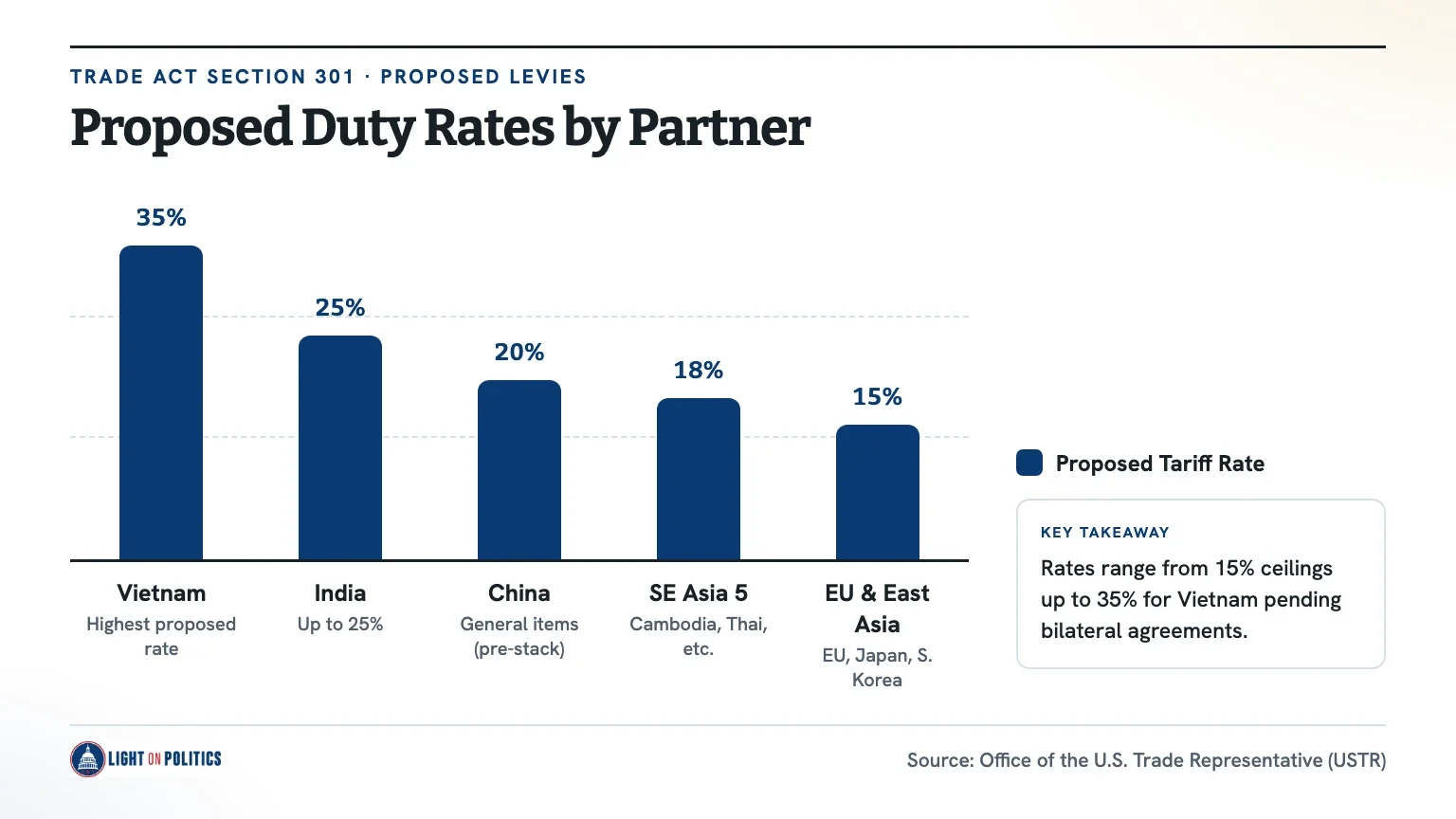
Proposed Duty Rates Across 14 Trading Partners
Vietnam faces the highest proposed duty at 35%, though that levy could drop to 20% if both governments sign a bilateral trade pact. India faces rates up to 25%, while Singapore faces duties up to 20%.
Goods from Bangladesh, Cambodia, Indonesia, Malaysia, and Thailand carry proposed tariffs up to 18%. If commitments fall short, fallback rates could rise to 20% for Bangladesh and 25% for the other four Southeast Asian nations.
The European Union, Japan, South Korea, Switzerland, and Taiwan face proposed tariffs of 15%. For these five partners, the rate acts as an all-in ceiling net of existing duties and July 2026 forced-labor levies.
China faces duties up to 20% on general items, stacking atop 2018 duties for a combined 45% rate. A 40% fallback rate applies if wider negotiations stall before the bilateral trade truce expires on January 10, 2027.
The Brazil Action: Regional Jets and Global Sugar
Rather than penalizing diverse consumer goods from Brazil, trade officials proposed a 10% duty on finished Brazilian aircraft. The action removes an exemption established during earlier bilateral negotiations in July 2026.
Finished aircraft represent Brazil’s fourth-largest export to the United States, generating $2.73 billion in 2025. Brazilian manufacturer Embraer supplies roughly 80% of America’s regional jet market, with carriers like American Airlines holding substantial backorders.
USTR also proposed replacing a 25% Brazilian sugar duty with global tariffs on out-of-quota sugar imports. The proposal adds specific duties of $0.44 per kilogram on raw cane sugar and $0.60 per kilogram on refined sugar.
Because the sugar fee applies nondiscriminatorily across all foreign suppliers, commodity analysts estimate effective out-of-quota sugar tariffs could reach 193%. Domestic raw sugar futures surged 14.65% immediately following the public announcement.

Which Consumer Goods Could Cost More?
You will likely encounter the sharpest cost pressure on apparel, footwear, and travel goods imported from Southeast Asia. Vietnam and Cambodia supply billions of dollars in athletic shoes, outdoor apparel, and clothing to American retailers every year.
Home decor, wooden furniture, consumer electronics, and replacement tires from across the targeted Asian partners also face higher border assessments. Importers will either absorb these incremental costs or pass them along to store shelves.
Packaged food prices could climb as food processors absorb higher expenses for imported sweeteners. Because the United States imports roughly 25% of its sugar supply, higher border levies quickly ripple through commercial bakeries and confectioners.
Medical supplies and generic drugs could also see upward price adjustments. The trade findings specifically cite industrial capacity in India and the European Union, two critical sources for domestic generic medications and hospital devices.
Exemptions: What Avoids the New Duties?
Trade regulators created explicit carveouts to protect specific industrial sectors. Goods already subject to Section 232 national-security tariffs—such as steel, aluminum, copper, and motor vehicles—are exempt from the 14-partner proposal.
Patented pharmaceuticals, advanced semiconductors, and certain civil aircraft parts are also excluded from the new list. Furthermore, personal passenger baggage, informational print media, and humanitarian donations enter without facing any of these proposed duties.
For China, regulators exempted 77 specific product lines under Annex B, covering roughly $30 billion in annual imports. These items reflect prior agreements managed under the bilateral Board of Trade frameworks.

How Import Duties Impact Your Wallet
Historical trade data demonstrates that foreign suppliers rarely pay federal customs levies directly. A comprehensive study by the U.S. International Trade Commission found American importers paid nearly the entire cost of Section 301 tariffs between 2018 and 2021.
Recent research from the Congressional Budget Office indicates that consumers ultimately absorb 95% of tariff burdens through elevated retail prices. Domestic businesses pass these expenses forward to maintain operating margins.
Analysis from the Federal Reserve Bank of New York revealed a 90% pass-through into border import prices, generating a 26% retail price increase within twelve months. These added expenses arrive while headline consumer inflation remains elevated at 3.8%.
Legal Hurdles and Executive Trade Authority
The turn toward Section 301 represents a legal pivot after sweeping executive trade actions faltered in court. On February 20, 2026, the U.S. Supreme Court ruled 6–3 in Learning Resources, Inc. v. Trump that emergency economic statutes do not permit unilateral global tariffs.
That ruling wiped out previous reciprocal trade levies and left the federal government facing up to $175 billion in potential importer refunds. The Court of International Trade likewise halted a backup 10% tariff program in May 2026.
By returning to Section 301, the administration must follow strict statutory procedures. That framework demands formal investigations, detailed notices in the Federal Register, and an open public hearing process before border collection begins.
Essential Questions Answered
When would these new tariffs take effect?
No implementation date is currently set. The trade representative must review public feedback and conclude administrative hearings in January 2027 before publishing any final tariff orders.
Can foreign governments stop these tariffs?
Yes, several partner nations can avoid maximum penalties by signing reciprocal trade pacts or addressing industrial overcapacity. For instance, Vietnam and India can lower their exposure through bilateral deals.
Why is out-of-quota sugar taxed globally?
Regulators applied the sugar fee to all nations above their tariff-rate quotas to prevent trade diversion. Without a uniform duty, foreign suppliers could easily reroute Brazilian sugar through third-party countries.
Can American companies request product exclusions?
Domestic businesses can submit formal comments explaining how higher duties harm local operations or supply chains. Officials often exclude critical goods when domestic alternatives do not exist in sufficient quantities.
Upcoming Deadlines and What to Watch
The public comment process gives you and affected businesses a formal avenue to weigh in. For the Brazil action, written comments are due December 30, 2026, with public hearings scheduled for January 14, 2027.
Deadlines for the 14-nation proposal arrive quickly in the new year. Stakeholders must file written comments by January 5, 2027, ahead of comprehensive public hearings beginning January 25 in Washington.
You can follow the formal rulemaking docket at the Office of the U.S. Trade Representative as regulators determine the final duty schedule. How officials handle these proceedings will determine your retail costs throughout 2027.