
A rare alliance between Democratic Senator Elizabeth Warren and Republican Senator Bernie Moreno could change how working retirees pay Social Security taxes. Their June 2026 proposal targets the federal payroll tax cap—and your earned paycheck.
Under current Internal Revenue Service rules, collecting retirement benefits does not shield your wages from payroll tax withholding. Eliminating the taxable maximum would raise taxes on high-earning retirees who remain in the workforce.
Understanding how this bipartisan plan interacts with existing benefit tax thresholds helps you protect your retirement income. Knowing the rules lets you plan your work schedule and tax strategy before Congress drafts a final bill.
The Flashpoint Behind the Warren–Moreno Proposal
On June 23, 2026, Senators Elizabeth Warren of Massachusetts and Bernie Moreno of Ohio published a joint opinion piece in the New York Times. The two lawmakers called for eliminating the income cap on wages subject to Social Security payroll taxes.
Their announcement arrived just two weeks after the release of the 2026 OASDI Trustees Report on June 9. That annual federal assessment showed Social Security’s retirement trust fund rushing toward depletion faster than government actuaries projected one year earlier.
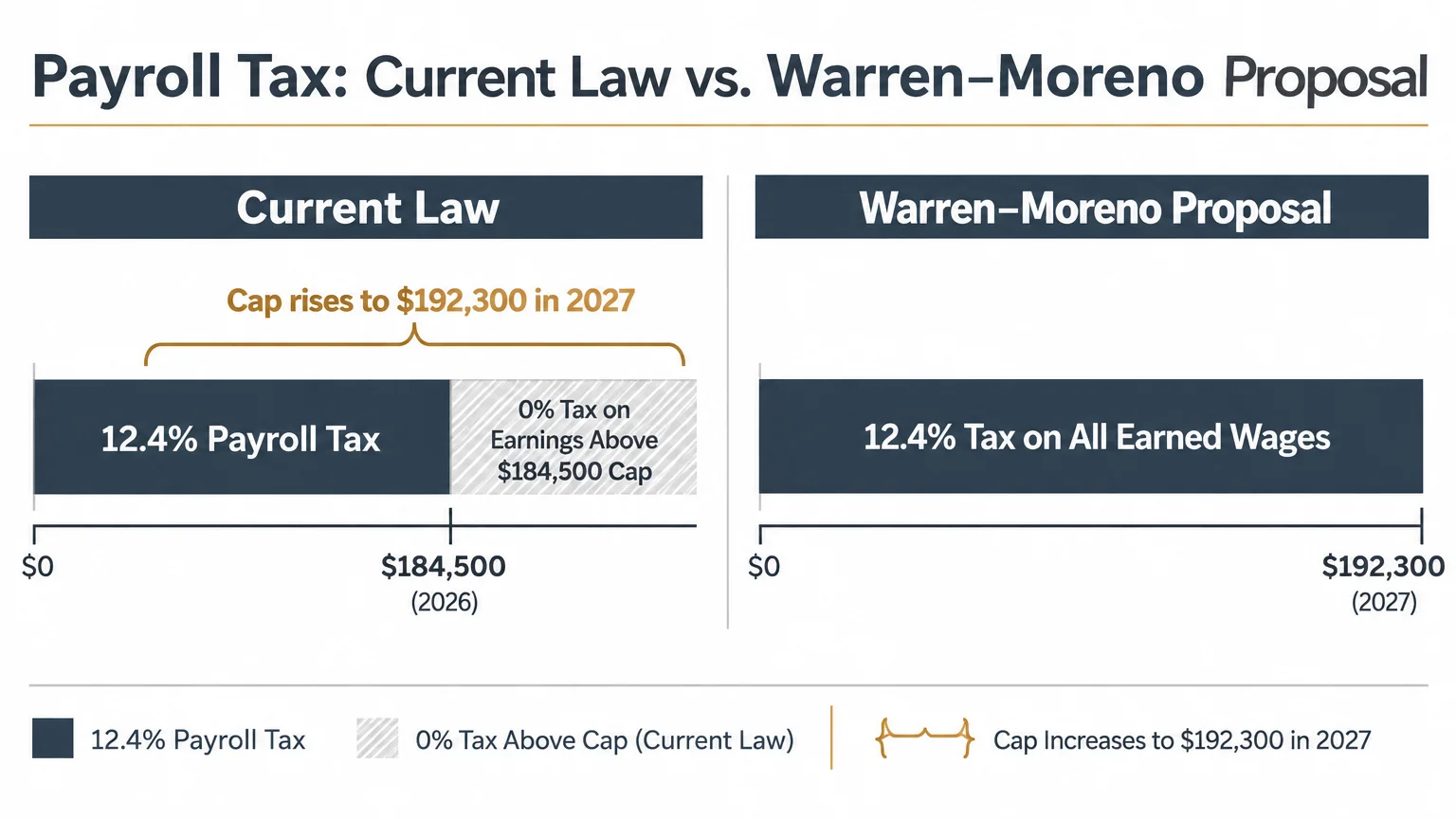
Right now, the combined 12.4% Social Security payroll tax stops applying once your earned wages pass $184,500 in 2026. That cap rises to $192,300 in 2027, capping an employee’s maximum annual Social Security tax at $11,922.60.
Warren and Moreno want that 12.4% levy to apply to every dollar of earned wages above the cap. As of late 2026, both senators report they are drafting legislation, though neither formal bill text nor a bill number exists yet.
Why Retirees Remain Exposed to Payroll Taxes
Many older Americans assume Social Security payroll taxes end once they file for monthly benefits. Internal Revenue Service rules work differently, requiring employers and self-employed workers to withhold payroll taxes on all covered wages regardless of age or benefit status.
If you collect Social Security while consulting, running a business, or holding an executive role, you already pay payroll taxes up to the annual limit. Lifting the cap exposes every dollar you earn above $184,500 in 2026—or $192,300 in 2027—to new withholding.
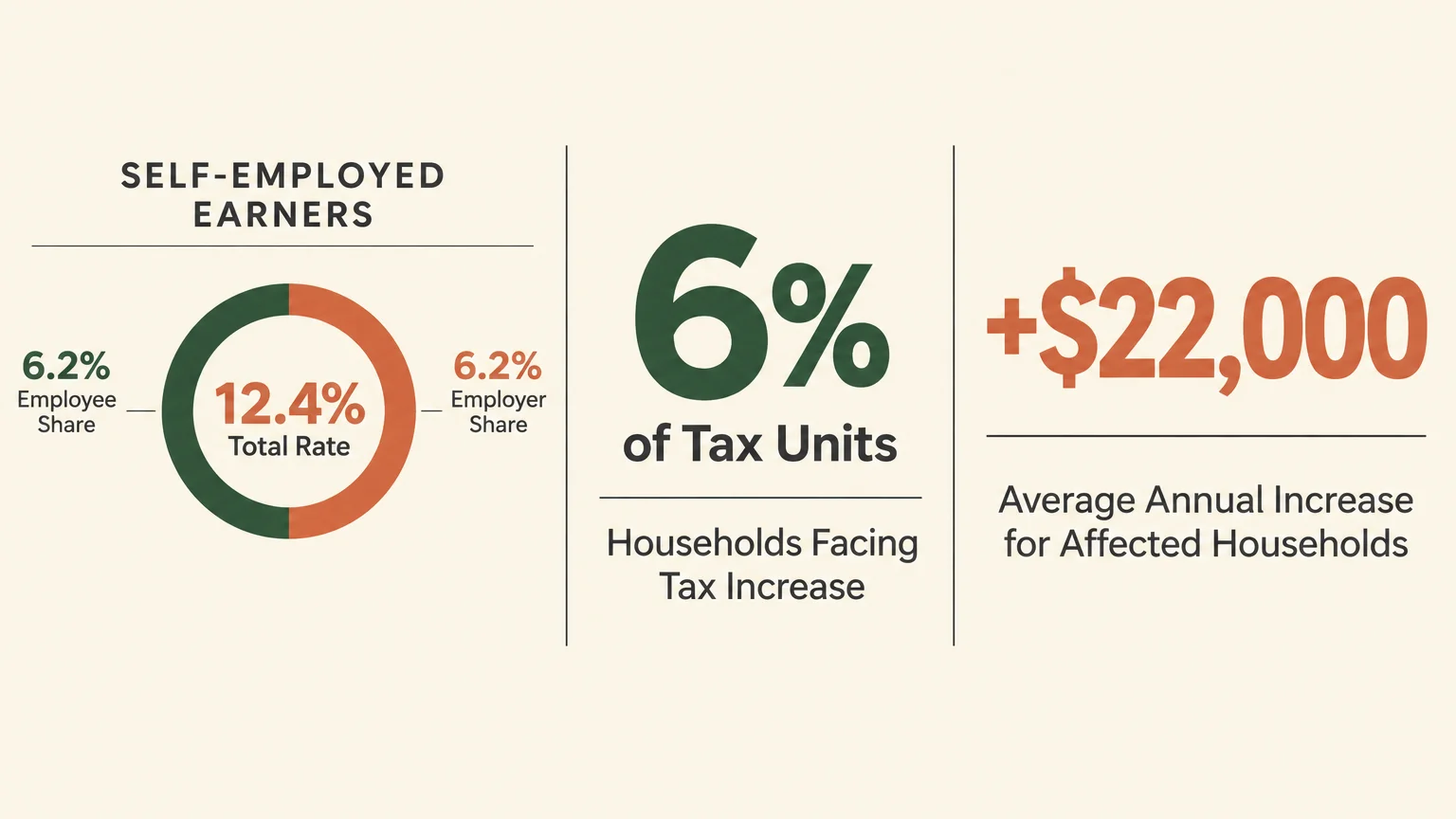
Self-employed retirees face double the exposure on paper because they pay both the 6.2% employee share and the 6.2% employer share. For a retired physician, attorney, or independent contractor earning above the limit, eliminating the cap creates an immediate 12.4% marginal tax jump.
Early Claims Versus Independent Fiscal Math
Warren and Moreno argue in their op-ed that scrapping the wage cap would raise over $3 trillion for Social Security and extend solvency into the next generation. Independent fiscal analysts paint a far tighter picture of what the policy achieves.
A July 2026 analysis from Tax Policy Center revenue estimates projects that eliminating the cap would raise roughly $2.5 trillion in federal revenue from 2026 through 2036. That figure leaves a substantial gap compared with the senators’ public estimate.
The same analysis shows taxes rising in 2026 for roughly 6% of tax units, costing those households an average of about $22,000 more per year. You should factor that potential liability into multi-year retirement budgets if your household relies on late-career earnings.

Power Mapping the Bipartisan Coalitions on Capitol Hill
The Warren–Moreno partnership highlights a broader shift in how Washington factions negotiate entitlement reform. Traditional party lines have splintered into competing populist, institutionalist, and market-oriented coalitions across the Senate.
Warren brings progressive Democrats who want higher earners to fund program solvency without raising the retirement age or trimming monthly checks. Moreno represents an economic populist wing of the Republican Party willing to target upper-income payroll exemptions rather than cut core benefits.
Their alliance contrasts sharply with mainstream congressional tax writers who have spent the past two years defending tax cuts. You can track these competing legislative tracks directly through Congressional legislative records as committees weigh competing solvency frameworks.
The Rival Bipartisan Working Group
While Warren and Moreno focus on lifting the payroll cap, a separate bipartisan Senate group is pushing procedural and investment-based alternatives. Senators Tim Kaine, Dick Durbin, Bill Cassidy, Thom Tillis, and Angus King introduced the PROMISE Act on July 14, 2026.
That legislation would require Congress to gather 50-year solvency recommendations from the Social Security Advisory Board and force a Senate floor vote. Under Senate rules, passing a final reform package through that mechanism would still require 60 votes.
Separately, Senators Cassidy and Kaine have promoted a proposal to borrow roughly $1.5 trillion to seed a parallel investment trust fund. That fund would invest in equities and higher-return assets for 75 years instead of raising payroll taxes or cutting benefits.
Incremental Legislation and the 2025 Tax Baseline
Smaller bipartisan measures have already cleared the White House while major solvency bills remain stalled. On November 23, 2026, Congress enacted the Claiming Age Clarity Act, backed by Senators Kaine, Cassidy, Chris Coons, and Susan Collins.
That law directs the Social Security Administration to replace terms like early eligibility age, full retirement age, and delayed retirement credits with minimum, standard, and maximum monthly benefit age. The change aims to help future retirees avoid costly claiming mistakes.
Meanwhile, the One Big Beautiful Bill Act—enacted in July 2025 as Public Law 119-21—reshaped senior tax policy without touching the Social Security payroll cap. Its temporary senior deduction altered how federal income taxes interact with Social Security checks through 2028.
How the Payroll Tax Cap and Benefit Taxes Actually Work
Evaluating your personal tax risk requires separating two distinct federal levies that many voters confuse. Payroll taxes fund the system while you work, whereas federal income taxes apply to a portion of your monthly benefit checks once your total income crosses statutory lines.
The Warren–Moreno plan alters only the payroll side of that ledger. Yet existing benefit taxation rules—paired with the temporary 2025 senior deduction—determine how much of your total retirement cash flow stays in your pocket.
Inside the 12.4% Payroll Tax and Uncapped Wages
Under current law, employees pay 6.2% of earned wages up to the taxable maximum, and employers match that 6.2% contribution. Self-employed individuals pay the full 12.4% rate up to the same $184,500 threshold in 2026 and $192,300 threshold in 2027.
Medicare taxes operate with no wage cap at all. Employees and employers each pay 1.45% on all earned wages—or 2.9% for self-employed workers—plus an additional 0.9% Medicare surtax above $200,000 for single filers, $250,000 for joint filers, and $125,000 for married separate filers.
Normally, paying Social Security payroll taxes increases your future monthly retirement benefit up to the annual cap. Analysts at both the Tax Foundation and the Tax Policy Center note that the Warren–Moreno proposal appears to offer zero corresponding benefit increases on newly taxed earnings above the cap.
If Congress adopts that structure, upper-income working retirees would pay a straight 12.4% payroll tax surcharge without earning higher monthly Social Security checks in return. You can review how wage withholding operates today through Internal Revenue Service withholding and tax rules.
The 1983 and 1993 Benefit Taxation Thresholds
Even if you stop working entirely, federal law still taxes up to 85% of your Social Security benefits depending on your combined income. Under Section 86 of Title 26 of the United States Code, combined income equals your adjusted gross income plus nontaxable interest plus half of your annual benefits.
Congress never indexed those dollar thresholds to inflation when lawmakers wrote them in 1983 and 1993. For single filers, heads of household, and qualifying surviving spouses, up to 50% of benefits become taxable between $25,000 and $34,000 of combined income, rising to 85% above $34,000.
Married couples filing jointly face the 50% tier between $32,000 and $44,000 of combined income, and up to 85% of benefits become taxable above $44,000. Married couples who live together and file separately can have up to 85% of benefits taxed regardless of income.
Supplemental Security Income payments are never subject to federal income tax. According to the Social Security Administration, revenues from the 1983 tier go directly to the Social Security Trust Funds, while revenues from the 1993 expansion flow to Medicare’s Hospital Insurance Trust Fund.
How the Temporary $6,000 Senior Deduction Shields Middle Earners
Contrary to widespread campaign rhetoric, the 2025 One Big Beautiful Bill Act did not repeal federal taxes on Social Security benefits or alter the 1983 and 1993 thresholds. Instead, lawmakers added a temporary income-tax deduction for taxpayers age 65 and older from 2025 through 2028.
Eligible seniors can claim up to $6,000 per person—or $12,000 for joint filers if both spouses are at least 65—on top of existing standard or itemized deductions. Married individuals filing separately do not qualify for this relief.
The deduction phases out by 6% of modified adjusted gross income above $75,000 for single filers and $150,000 for married couples filing jointly. Once your modified adjusted gross income reaches $175,000 single or $250,000 joint, the deduction vanishes completely.
Because the phaseout hits upper-middle and high earners first, single working retirees earning above the payroll cap receive zero benefit from the temporary senior deduction. They would face both full benefit taxation under Section 86 and uncapped payroll taxes under the Warren–Moreno plan.
What Higher Payroll Taxes and Current Rules Mean for Your Wallet
Policy debates in Washington often treat retirees as a uniform bloc, yet tax changes split older Americans into starkly different financial groups. Your exposure depends on whether you still earn wages, how high your retirement income climbs, and which state you call home.
Checking where your household sits along these thresholds lets you adjust paycheck withholding, retirement account withdrawals, and business income before new rules take effect. Use the current 2026 and 2027 benchmarks to stress-test your cash flow.
High-Earning Working Retirees and Self-Employed Consultants
Roughly 90% of Social Security beneficiaries owe no federal income tax on their benefits during the 2025 through 2028 window, according to the White House Council of Economic Advisers and the Social Security Administration. Only about 12% of seniors—roughly 10% of all beneficiaries—currently pay federal income taxes on those checks.
The Warren–Moreno plan targets a narrow but economically active slice of older households within that upper 6% of tax units identified by the Tax Policy Center. Retired corporate executives serving on boards, part-year medical specialists, and profitable small-business owners would absorb the steepest new bills.
If you file as self-employed and earn $250,000 while collecting benefits in 2027, the current $192,300 cap shields $57,700 of your earnings from the 12.4% Social Security tax. Eliminating that cap would add $7,154.80 in annual Social Security payroll taxes to your bill.
You can prepare for potential payroll changes by reviewing whether your income comes from W-2 wages, self-employment profits, or investment distributions. Investment dividends, capital gains, and traditional retirement account withdrawals are not subject to Social Security payroll taxes, though they still count toward combined income.
The Retirement Earnings Test and Cost-of-Living Reality
Working retirees below full retirement age—age 67 for anyone born in 1960 or later—already navigate strict earnings limits before payroll tax changes enter the picture. If you are under full retirement age for all of 2026, Social Security withholds $1 in benefits for every $2 earned above $24,480.
That annual exempt limit rises to $25,560 in 2027. During the calendar year you reach full retirement age, the exempt limit climbs to $65,160 in 2026 and $67,920 in 2027 for months before your birthday month, withholding $1 per $3 earned above the cap.
Once you hit full retirement age, the earnings test disappears completely—yet payroll tax withholding continues on every dollar of covered wages. Maximum monthly retirement benefits at full retirement age stand at $4,152 in 2026 and $4,188 in 2027, or $5,181 for someone who delayed claiming until age 70 in 2026.
Most retirees live on far smaller checks that barely keep pace with living costs. Morningstar reports the average monthly retirement benefit stood at $2,092 in October 2026, following a 2.8% cost-of-living adjustment in 2026.
On October 14, 2026, federal officials announced a 3.6% cost-of-living adjustment for 2027 covering 76 million Americans—nearly 72 million Social Security beneficiaries starting in January 2027 and roughly 7.3 million Supplemental Security Income recipients starting December 31, 2026. While that increase adds an estimated $75 per month on average to retirement checks, standard Medicare Part B premiums rise to $209.40 per month in 2027.
State-by-State Tax Exposure in 2026
Federal rules represent only one layer of your tax burden during retirement. For tax year 2026, 42 states and Washington, D.C. exempt Social Security benefits entirely from state income taxes, with West Virginia completing its three-year phaseout to a 100% exemption in 2026.
Only eight states still tax Social Security benefits in some form during 2026: Colorado, Connecticut, Minnesota, Montana, New Mexico, Rhode Island, Utah, and Vermont. Most of those eight states apply income-based exemptions or targeted tax credits that shield low- and moderate-income seniors.
If you live in one of those eight states and earn wages above the federal payroll cap, you face potential federal payroll tax increases alongside state benefit taxation. Reviewing your state’s specific adjusted gross income cliffs can help you time Roth conversions or consulting work without triggering avoidable state taxes.

Solvency Math, Oversight Gaps, and Unanswered Questions
Watchdog scrutiny of any Social Security overhaul starts with comparing political promises against official trust fund ledgers. Rhetoric from both parties frequently overstates how far a single tax or investment tweak stretches federal solvency.
Examining the 2026 financial filings from Social Security Administration actuarial data reveals why lifting the payroll tax cap alone cannot balance the program’s long-term books. Every major parameter in the June 2026 Trustees Report points toward tightening timelines.
What the 2026 Trustees Report Actually Shows
In 2025, Social Security collected $1.44 trillion while paying roughly $1.60 trillion to approximately 70 million beneficiaries, pulling combined trust fund reserves down to $2.56 trillion by year-end. About 185 million workers paid Social Security payroll taxes during that year.
Those payroll taxes currently cover about 83% of covered wages nationwide, down from 90% in 1983 because top salaries grew faster than the taxable maximum.
Even so, the June 9, 2026 Trustees Report moved the Old-Age and Survivors Insurance Trust Fund depletion date one quarter earlier, to the fourth quarter of 2032. At that point, continuing incoming revenue will cover only 78% of scheduled retirement and survivor benefits—an automatic 22% benefit cut.
While the Disability Insurance Trust Fund remains projected to pay 100% of scheduled benefits through at least 2100, a theoretical combined fund would still deplete in the third quarter of 2034. Upon combined depletion, incoming revenue would cover 83% of scheduled benefits initially and drop to 65% by 2100.
The program’s 75-year actuarial deficit jumped from 3.82% to 4.42% of taxable payroll in the 2026 report. Analyses from Bipartisan Policy Center fiscal research and the American Enterprise Institute place that long-term shortfall at roughly $30 trillion.
The Trustees and the American Academy of Actuaries attribute the worsened forecast primarily to lower assumed fertility rates—1.75 children per woman compared with 1.90 previously—and lower assumed temporary and unlawfully present immigration. They also cite reduced income-tax revenue flowing to the trust funds following the 2025 tax legislation.
Transparency Gaps in Unfinished Legislation
When Warren and Moreno assert that eliminating the payroll cap extends solvency into the next generation, independent actuarial scoring contradicts that timeline. According to the Tax Policy Center, Social Security Administration actuarial calculations show that removing the cap without benefit changes keeps the system out of annual deficit for only four years and closes roughly half of the long-term shortfall.
Because the senators have not released statutory language as of late 2026, key operational details remain hidden from public oversight. Watchdogs cannot yet verify whether the bill applies to all employer-side contributions without a phase-in or creates a donut-hole exemption between the current cap and higher brackets.
Breaking the traditional link between payroll taxes paid and future monthly benefits also invites intense political pushback. Since Social Security’s inception, lawmakers defended payroll taxes as earned insurance contributions rather than general income taxes—a distinction that disappears for high earners if no extra benefits accrue above $192,300.
Frequently Asked Questions About Social Security Tax Reform
Does the Warren–Moreno plan raise taxes on retirees who no longer work?
No; the proposal applies only to earned wages and self-employment income, leaving monthly Social Security checks, pensions, dividends, and retirement account withdrawals untouched by the 12.4% payroll tax. Only working retirees earning more than $184,500 in 2026 or $192,300 in 2027 would pay higher payroll taxes.
Will the temporary $6,000 senior deduction stay in place after 2028?
Under the 2025 One Big Beautiful Bill Act, the extra deduction of up to $6,000 per taxpayer age 65 and older applies only to tax years 2025 through 2028. Unless Congress votes to extend it, federal tax liability on Social Security benefits will revert to pre-2025 levels in 2029, pushing far more middle-income seniors past the unchanged 1983 and 1993 income cliffs.
Could Congress pass the payroll cap repeal in 2027?
Passing standalone Social Security tax or benefit legislation in the Senate requires 60 votes under standard rules, making rapid passage difficult without broad bipartisan backing. Even if Warren and Moreno introduce formal bill text, their proposal competes directly with the PROMISE Act and the Cassidy–Kaine investment fund framework.
How can I check if my combined income triggers federal benefit taxes today?
Add your adjusted gross income, any nontaxable interest, and exactly half of your annual Social Security benefits to calculate your combined income. Compare that total against the $25,000 and $34,000 thresholds if single, or $32,000 and $44,000 if married filing jointly, while factoring in the temporary senior deduction if your modified adjusted gross income sits below the 2025–2028 phaseouts.

Legislative and Financial Milestones to Watch Next
Several concrete dates will determine whether higher payroll taxes on working retirees move from an opinion page concept to federal law. Watch first for Senators Warren and Moreno to file formal legislative text with a bill number and an official Congressional score.
Monitor whether Senate leaders schedule floor action on the PROMISE Act to force a formal 50-year solvency blueprint from the Social Security Advisory Board. Any floor vote will reveal how many Republicans join Moreno and how many Democrats back the Cassidy–Kaine borrowing alternative.
On your personal calendar, prepare for the January 2027 shift to the $192,300 payroll tax cap, the 3.6% cost-of-living increase, and the $209.40 standard Medicare Part B premium. Track congressional debates ahead of the 2028 expiration of the temporary senior deduction, because lawmakers face a shrinking window before the 2032 retirement trust fund deadline forces automatic benefit cuts.