
A late-career layoff in a cooling job market can derail decades of retirement planning within months. When paychecks stop early, federal tax, healthcare, and Social Security rules punish hasty financial moves.
In late 2026, headline unemployment sits at 4.1%, yet long-term joblessness and layoff anxiety are climbing. Meanwhile, expired healthcare subsidies and tighter Federal Reserve policy raise the financial stakes for older workers.
Knowing how Washington policy interacts with labor-market shocks helps protect your nest egg. Here is how current federal rules shape your risks and the concrete steps you can take right now.
The Late-2026 Flashpoint for Older Workers
Cooling Labor Demand Meets Sticky Inflation
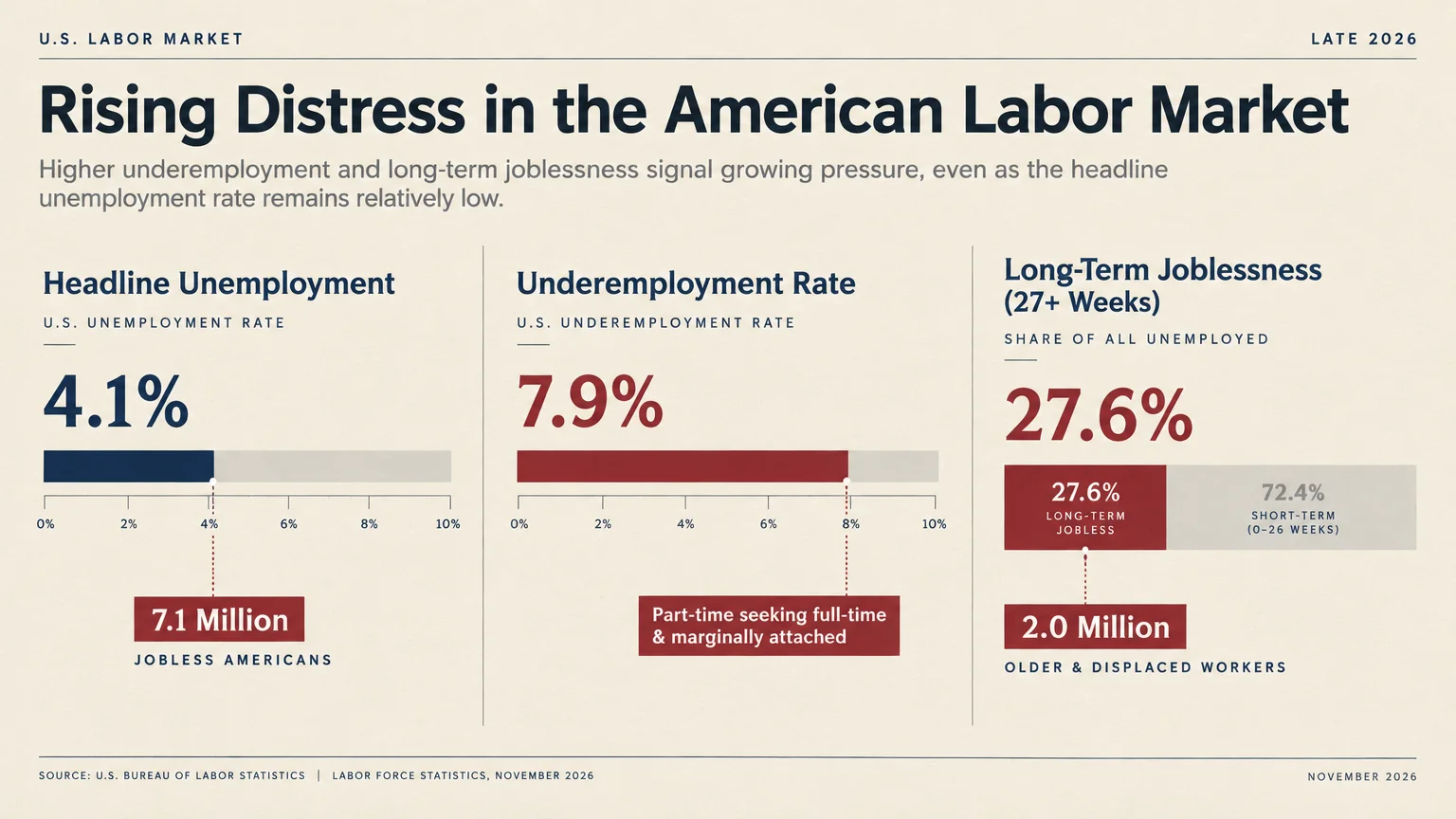
Surface hiring numbers mask growing fragility beneath the American labor market. According to the Bureau of Labor Statistics, the national unemployment rate stood at 4.1% in October 2026, representing 7.1 million jobless Americans.
That headline figure eased slightly from 4.2% in September and has hovered between 4.1% and 4.3% since March 2026. Yet monthly hiring momentum has turned erratic, with payrolls adding 165,000 jobs in October after gaining just 29,000 in September.
Broader measures of labor distress show sharper strain for households trying to stay employed. The underemployment rate—which counts part-time workers seeking full-time hours and marginally attached job seekers—climbed to 7.9% in October from 7.6% in September.
Long-term joblessness poses an even steeper hazard if you lose work near retirement. Roughly 2.0 million Americans, or 27.6% of all unemployed workers, had been out of work for 27 weeks or longer in October 2026.
Workers across the country increasingly sense that corporate hiring is slowing down. In its November 9, 2026 Survey of Consumer Expectations, the Federal Reserve Bank of New York reported that household expectations of higher unemployment reached their highest point since April 2020.
Monetary Tightening and Legislative Gridlock
Inflation complicates every policy tool available to cushion a softer job market. Consumer prices rose 0.4% in October 2026 after jumping 0.6% in September, keeping inflation well above the Federal Reserve’s 2% target.
After raising rates by 25 basis points in September 2026 and holding steady on October 28, Fed Chair Kevin Warsh and Governor Christopher Waller signaled further hikes ahead. Officials pointed to price pressures from tariffs, data-center investment, and energy shocks linked to the U.S.–Israeli conflict with Iran.
Higher borrowing costs directly pressure corporate payrolls just as Congress wraps up a turbulent legislative year. Lawmakers passed the Claiming Age Clarity Act in October 2026 to clarify Social Security labels, yet broader safety-net gaps remain wide open.
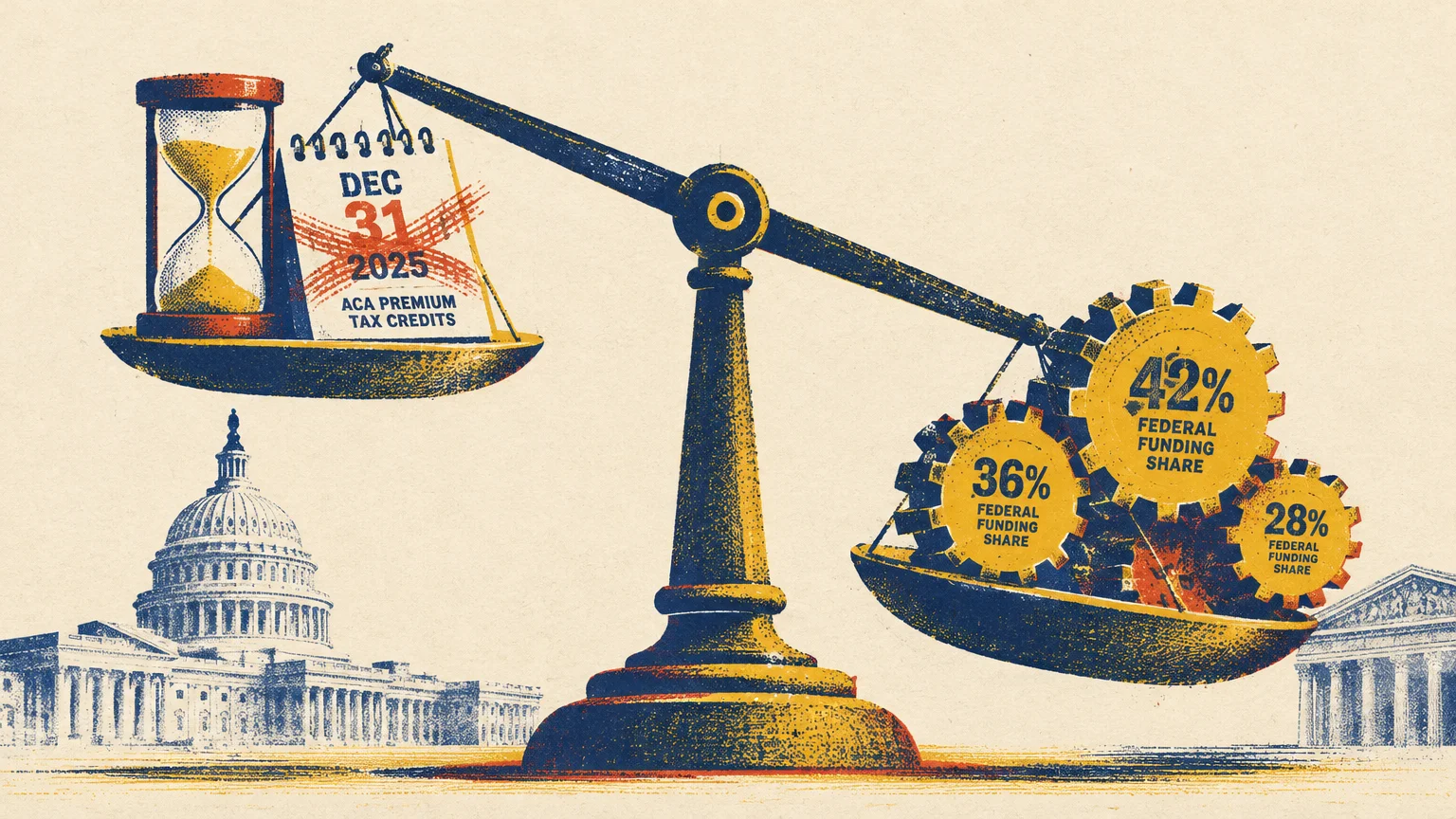
Enhanced Affordable Care Act premium tax credits expired on December 31, 2025, after a House-passed three-year extension stalled in the Senate. For older workers facing corporate restructuring, monetary tightening and congressional inaction now collide directly inside the household budget.
Players and Strategy Behind Retirement Policy
The Federal Reserve Versus Capitol Hill
Two powerful institutions—the Federal Reserve and Congress—pull older workers in opposite financial directions. Central bankers prioritize cooling inflation with higher interest rates, even when tighter credit slows hiring and triggers late-career layoffs.
Those hiring freezes fall heavily on a workforce that has grown noticeably older. A MyPerfectResume analysis of Bureau of Labor Statistics Current Population Survey data from June 2026 shows that workers aged 55 and older make up 23.2% of the U.S. labor force.
On Capitol Hill, fiscal legislation has prioritized near-term tax relief over long-term trust fund stability. The 2025 One Big Beautiful Bill Act reduced income-tax revenues collected on Social Security benefits, narrowing a key funding stream for retirees.
According to the 2026 Social Security Trustees Report, those lower tax revenues—alongside lower fertility and immigration assumptions—accelerated projected trust fund depletion. Political leaders gain immediate voter goodwill from tax cuts while deferring hard solvency choices to future sessions.
The Stalled Healthcare Fight and Older Voters
Healthcare affordability sits at the center of a sharp partisan stalemate in Washington. House lawmakers advanced a three-year extension of enhanced Affordable Care Act subsidies, but Senate gridlock allowed the credits to lapse at the end of 2025.
Roughly 22 million of the nation’s 24 million marketplace enrollees previously relied on those subsidies, according to KFF estimates. That group included 5.5 million older adults aged 55 to 64—workers too young for Medicare yet vulnerable to corporate downsizing.
With subsidies sharply reduced, marketplace enrollment fell by more than 1 million people in 2026.
From a strategic standpoint, you cannot afford to wait on a divided Senate to rescue your transition budget. Building your own bridge between employer coverage and Medicare protects you regardless of which party controls floor votes.
Policy Breakdown: Rules That Punish Early Job Loss
Social Security Claiming Penalties and Earnings Limits
Losing a paycheck at age 62 tempts many workers to claim Social Security immediately. Before filing, check how federal rules reward patience and penalize early applications through the Social Security Administration.
Under the 1983 Social Security amendments, the Full Retirement Age reaches its final endpoint of 67 in 2027 for anyone born in 1960 or later. Claiming benefits at 62 permanently slashes your monthly check by up to 30%.
Waiting past Full Retirement Age delivers guaranteed growth that no bond or savings account matches. Delayed retirement credits boost benefits by 8% per year—two-thirds of 1% each month—up to age 70, yielding 24% more than your full benefit.
To help workers grasp that gap, Congress passed the Claiming Age Clarity Act in October 2026. Starting in 2027, the agency will rename ages 62, Full Retirement Age, and 70 as the minimum, standard, and maximum monthly benefit ages.
Annual inflation adjustments also shift the math when you evaluate when to stop working. Following a 2.8% adjustment in 2026, a 3.6% cost-of-living increase takes effect in January 2027, lifting the average monthly benefit from $2,095 to $2,170.
Higher earners will also see payroll tax caps and maximum payouts climb in 2027. Maximum taxable earnings rise from $184,500 to $192,300, while the top benefit at Full Retirement Age increases from $4,152 to $4,188 per month.
If you claim early after a layoff and later find part-time work, watch the Retirement Earnings Test. In 2026, Social Security withholds $1 in benefits for every $2 earned above $24,480, with that threshold rising to $25,560 in 2027.
During the calendar year you reach Full Retirement Age, a higher earnings threshold applies. Benefits are withheld at $1 for every $3 earned above $65,160 in 2026, increasing to $67,920 in 2027.
Retirement Account Rules and the Rule of 55
Federal tax rules give older savers powerful catch-up tools while you remain employed—and steep penalties if you tap accounts carelessly afterward. Keep track of updated limits published by the Internal Revenue Service in Notice 2026-66.
Employee contribution caps for 401(k), 403(b), 457, and federal Thrift Savings Plans stand at $24,500 in 2026 and rise to $25,500 in 2027. Traditional and Roth IRA limits stay at $7,500 across both years, plus a $1,100 catch-up at age 50.
Workers aged 50 and older can save even more inside workplace plans to offset layoff risks. Standard workplace catch-ups climb from $8,000 in 2026 to $8,500 in 2027, allowing $34,000 in total contributions next year.
Under SECURE 2.0, savers aged 60 through 63 qualify for an enhanced super catch-up limit. That special allowance rises from $11,250 in 2026 to $11,750 in 2027, giving late-career workers a vital final sprint.
High earners face a strict new tax restriction that started in 2026. If your prior-year wages with your plan sponsor exceeded $150,000, every workplace catch-up dollar must go into an after-tax Roth account.
If a layoff strikes before age 59 and a half, withdrawing retirement funds normally triggers a 10% early distribution tax penalty. However, the Rule of 55 offers a crucial legal escape hatch for displaced workers.
You can take penalty-free withdrawals from your current employer’s 401(k) or 403(b) if you lose or leave that job during or after the calendar year you turn 55. That exception does not apply to IRAs or plans from earlier employers.
Avoid rolling your workplace 401(k) into an IRA immediately after a layoff if you need bridge cash. Moving that balance forfeits Rule of 55 access and locks your money behind the 10% penalty until age 59 and a half.
The Pre-Medicare Healthcare Cliff and COBRA Trap
Losing employer health insurance before Medicare begins at age 65 creates one of the sharpest financial cliffs in federal policy. You can extend job-based coverage through COBRA for up to 18 months, though you typically pay the entire premium yourself.
If you turn 65 while on COBRA, you face a costly administrative trap tracked closely on Medicare.gov. COBRA does not count as active-employment coverage for delaying Medicare Part B enrollment.
You have an eight-month Special Enrollment Period after active employment or group coverage ends to sign up for Part B. Missing that deadline while relying on COBRA triggers permanent monthly late-enrollment penalties.
Workers under 65 who turn to Affordable Care Act marketplaces face steep price shock after the 2025 subsidy expiration. KFF estimates that average net premiums jumped roughly 114%—about $1,016 per year—for subsidized enrollees in 2026.
Worse still, the 2026 expiration brought back the strict 400% federal poverty level income cliff. Based on 2025 federal guidelines, earning even $1 above $62,600 for a single person or $84,600 for a couple eliminates every dollar of premium tax credits.
Because severance checks, unused vacation payouts, and pre-tax retirement withdrawals all count as Modified Adjusted Gross Income, a layoff can accidentally push you over that threshold. Drawing from Roth balances or cash savings instead keeps taxable income below the subsidy cliff.
Constituent Impact: Who Bears the Brunt of Layoffs
The Gap Between Expected and Actual Retirement
Older workers often appear sheltered in headline employment reports until downsizing hits their specific industry. Bureau of Labor Statistics data cited by AARP shows unemployment among workers aged 55 and older ticked up to 2.8% in October 2026, leaving 1.1 million older Americans jobless.
Even when older workers stay out of unemployment statistics, many exit the workforce earlier than their financial plans assumed. The 2026 Retirement Confidence Survey from the Employee Benefit Research Institute and Greenwald Research reveals a persistent three-year planning gap.
Active workers expect to retire at a median age of 65, yet current retirees actually stopped working at a median age of 62. A separate April 2026 Gallup poll found a five-year gap, with workers expecting age 66 while retirees averaged age 61.
Nearly half of retirees—46% in 2026—left the workforce earlier than planned. Among those forced out early, 76% cited reasons beyond their control, up sharply from 68% in 2025.
Health problems or disabilities led involuntary exits at 41%, followed closely by company changes such as downsizing, closures, or reorganizations at 35%. Losing three to five years of peak earnings and compounding shrinks retirement security faster than almost any market dip.
Unsurprisingly, confidence in affording a comfortable retirement dropped to near a decade low in 2026. Confidence fell six percentage points among workers to 61% and five points among retirees to 73%, while four in five workers feared federal benefit changes.
Permanent Earnings Scars and Job-Switching Leakage
When a layoff hits in your late 50s or early 60s, bouncing back to a comparable salary proves rare. Bureau of Labor Statistics data cited by Forbes in October 2026 shows roughly one in five displaced workers aged 55 to 64 left the labor force entirely.
Longitudinal Health and Retirement Study research analyzed by the Urban Institute and ProPublica underscores how severely late-career instability damages household wealth. Across the study period, 56% of workers aged 50 and older suffered an involuntary job separation causing six months of unemployment or lasting pay cuts.
Only one in ten displaced older workers ever earned as much again after losing their job. Median household income dropped 42% following separation and remained 14% lower even by age 65.
The odds of facing that financial shock escalate sharply right before Medicare eligibility arrives. Two-year risk of an involuntary job loss jumped from 6% for workers in their early 50s to 22% between ages 62 and 64.
Even workers who successfully land new jobs during an economic slowdown often suffer quiet savings setbacks. Vanguard’s How America Saves 2026 report found that 64% of job switchers earned a raise, with a median pay boost of 10%.
Yet 55% of those job switchers ended up saving less for retirement at their new employer. Lower automatic default enrollment rates at new companies quietly cut their contribution percentages unless they intervened.
If you start a new role after a layoff or job change, log into your new 401(k) portal during your first week. Manually raise your deferral rate to match or exceed your prior savings pace and turn on annual automatic increases.

Oversight, Transparency, and Fiscal Watchdog Findings
Shutdown Data Blind Spots and Trust Fund Math
Evaluating economic risks near retirement requires reliable federal statistics, yet recent Washington dysfunction has blurred key benchmarks. The October 1 through November 12, 2025 federal government shutdown halted price collection, forcing the Bureau of Labor Statistics to omit 12-month October 2026 inflation comparisons.
That data blind spot leaves households and central bankers relying on shorter monthly snapshots while debating further interest-rate hikes. Watchdog clarity matters just as much when assessing Social Security’s long-term ledger.
Analysis from the Bipartisan Policy Center and the 2026 Social Security Trustees Report places Old-Age and Survivors Insurance trust fund depletion in the fourth quarter of 2032. That timeline moved up compared with 2025 projections largely because the 2025 One Big Beautiful Bill Act trimmed benefit tax revenues.
If Congress fails to act before late 2032, incoming payroll taxes would cover only 78% of scheduled payouts. That shortfall would trigger an automatic 22% across-the-board cut—hitting displaced older workers who rely heavily on monthly checks.
Medicare Solvency and Temporary Relief
Healthcare funding faces a parallel solvency crunch right behind Social Security. The 2026 Medicare Trustees Report projects that the Part A hospital insurance trust fund will deplete its reserves in the second quarter of 2033.
Meanwhile, out-of-pocket medical premiums continue outpacing general household inflation. In 2026, the standard Medicare Part B monthly premium jumped 9.7% from $185.00 to $202.90 alongside a $283 annual deductible and a $1,736 Part A hospital deductible.
Trustees projected the 2027 Part B premium at $209.50 per month, with final federal rates pending as of early November 2026. To soften voter frustration ahead of rising medical bills, the Trump administration announced a one-time $90 Part B rebate in October 2026 for 20.8 million original Medicare enrollees.
While a $90 rebate offers brief relief, it leaves structural healthcare inflation and Part A solvency untouched. Stress-testing your personal retirement budget against higher healthcare costs and a potential 22% Social Security trim keeps your plan resilient.
Frequently Asked Questions About Job Loss Near Retirement
Should I claim Social Security at 62 if I lose my job?
Claiming at 62 locks in a permanent reduction of up to 30% compared with waiting until age 67. Unless you lack savings or face severe health limits, bridging expenses with cash or Rule of 55 withdrawals first protects higher lifelong payouts.
Keep in mind that delayed retirement credits add 8% per year up to age 70, shielding your spouse’s survivor benefit as well. Factor in the 3.6% cost-of-living increase starting in January 2027 when weighing how long your emergency cash can stretch.
How can I protect ACA subsidies after a late-career layoff?
Because the 400% federal poverty level cliff returned in 2026, keeping Modified Adjusted Gross Income below $62,600 for singles or $84,600 for couples is essential. Earning $1 over those thresholds erases your entire marketplace premium tax credit.
Ask your departing employer if severance or unused leave payouts can be split across two calendar years to soften your annual income spike. During unemployment, cover living bills from Roth accounts or taxable cash rather than pre-tax 401(k) distributions.
Can COBRA replace Medicare when I turn 65?
No—relying on COBRA after turning 65 creates one of the costliest traps in federal retirement rules. Federal Medicare policy does not recognize COBRA as active-employment group coverage.
Enroll in Medicare Part B within your eight-month Special Enrollment Period once active work ends, even if your 18-month COBRA period still has time left. Acting before that window closes prevents permanent monthly late-enrollment surcharges.
What mistake hurts older workers most when rehired?
Accepting a new employer’s default 401(k) contribution rate quietly erodes your retirement readiness even when you earn a raise. Over half of job switchers end up saving less for retirement simply by leaving automatic enrollment settings unchanged.
Check your new plan immediately to capture any employer match and apply catch-up limits of $8,000 in 2026 or $8,500 in 2027. If you are aged 60 to 63, use the super catch-up allowance—and route catch-ups to Roth if prior-year sponsor wages topped $150,000.
Outlook: Milestones to Watch Through 2027
Several immediate dates will determine how sharply job-market pressures test older Americans over the coming year. First, watch the Federal Reserve’s December 8 and 9, 2026 policy meeting for signals on whether Chair Kevin Warsh proceeds with another interest-rate hike.
Next, monitor final federal announcements on the 2027 Medicare Part B monthly premium and presidential signature on the Claiming Age Clarity Act. Senate negotiations over whether to revisit stalled Affordable Care Act subsidy extensions also merit close attention.
On January 1, 2027, multiple statutory shifts take effect simultaneously across household budgets. The 3.6% Social Security adjustment begins, Full Retirement Age completes its transition to 67 for those born in 1960 or later, and workplace savings limits rise to $25,500.
Longer term, congressional action ahead of the 2032 Social Security and 2033 Medicare trust fund deadlines will shape every retiree’s financial security. Building a 12-to-24-month cash and healthcare bridge today ensures a weak job market never forces you into retirement on someone else’s schedule.