

The November 3, 2026 midterm elections handed Democrats control of both congressional chambers, effectively ending President Donald Trump’s conditional $5,000 check pledge. Trump explicitly tied those payouts to Republicans holding the House and Senate.
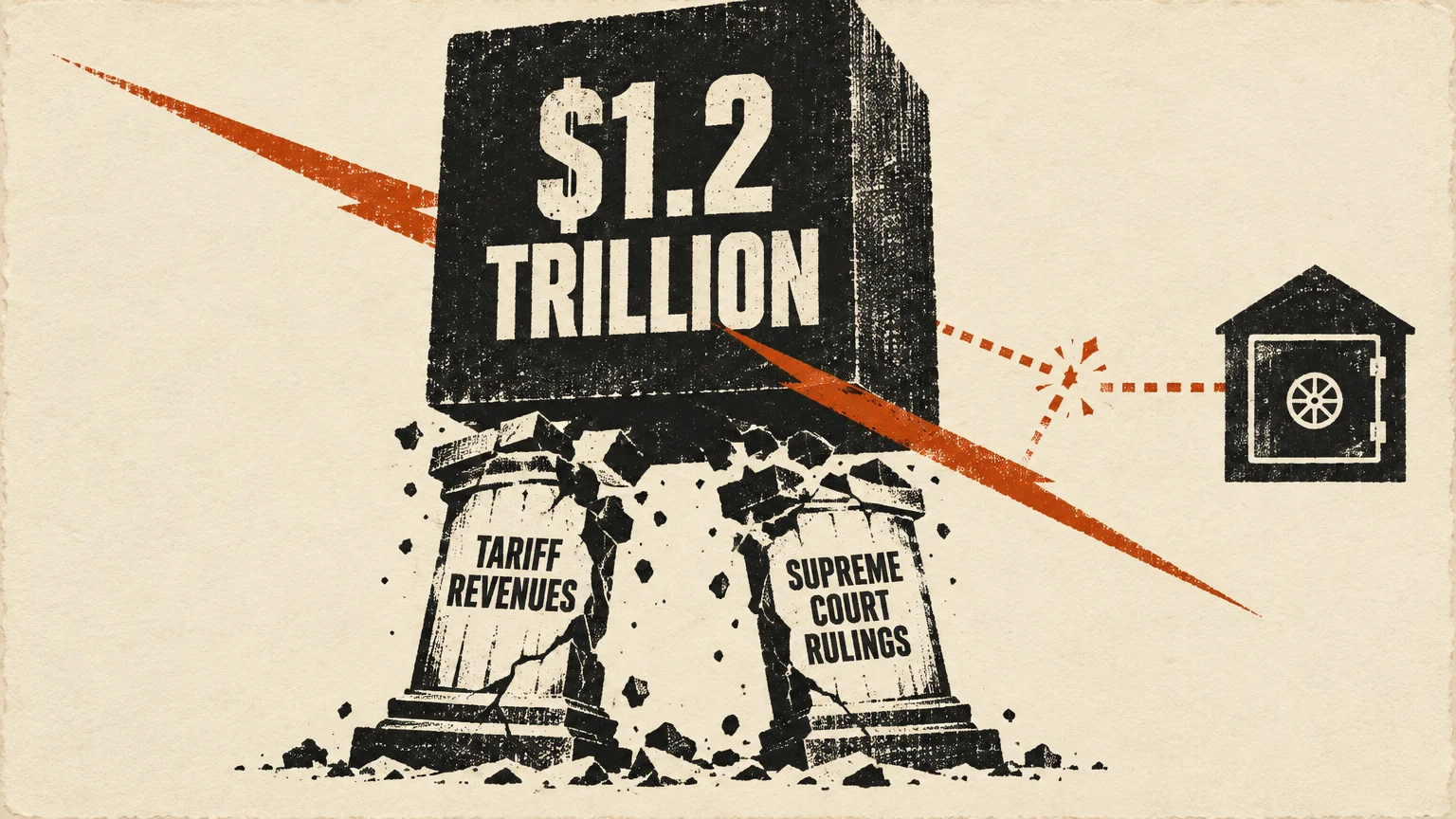
Even before voters delivered a divided government, fiscal shortfalls, Supreme Court tariff rulings, and Republican pushback left no realistic path for a $1.2 trillion program. No legislative text has ever been introduced in either chamber.
You can use this power-mapping breakdown to separate campaign rhetoric from binding law as Washington pivots toward the 2027 agenda. Knowing which relief bills actually have floor votes helps you plan your household finances.
The Flashpoint: Voters Deliver a Divided Washington
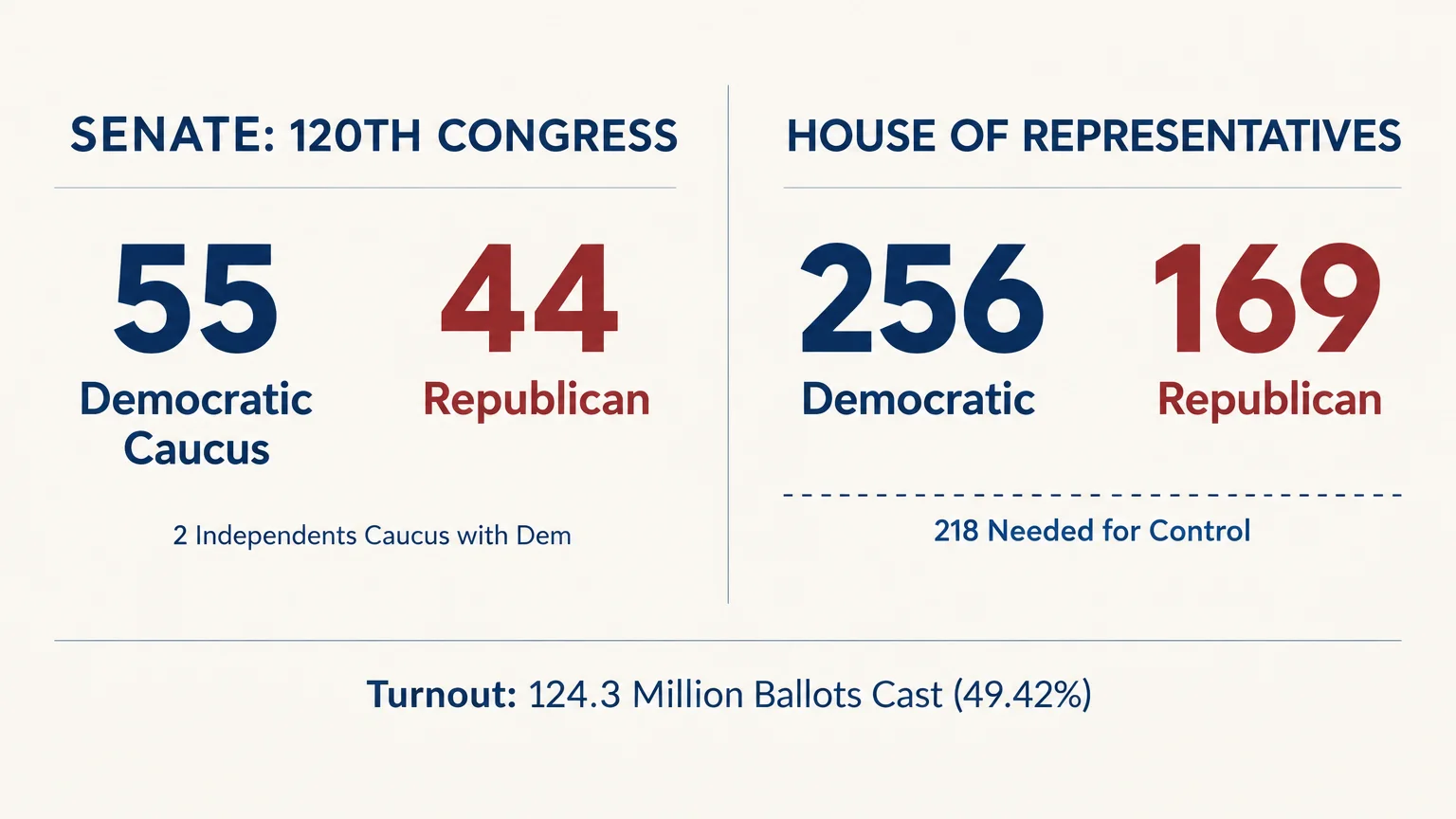
Voters turned out in historic numbers on November 3, 2026, reshaping federal power for the final two years of Trump’s presidency. Post-election tallies show 124.3 million Americans cast ballots, representing 49.42% of eligible voters and the second-highest midterm turnout since 1914.
Associated Press race calls as of November 16, 2026 show Democrats capturing 55 Senate seats to Republicans’ 44, including two independents who caucus with Democrats, with one race still uncalled. Democrats flipped at least eight GOP-held Senate seats, including Maine, North Carolina, Ohio, Iowa, Kansas, South Carolina, and Texas.
In the House of Representatives, Associated Press counts give Democrats 256 seats to Republicans’ 169, with 10 races uncalled and 218 needed for control. Those results guarantee Trump will face a bicameral Democratic Congress for the first time in either of his presidential terms.
That electoral shift directly triggers the condition Trump set on September 9, 2026, at the Republican National Committee’s midterm convention in Dallas. Speaking to supporters, Trump promised a $5,000 “Trump dividend” check for every adult U.S. citizen only if Republicans kept both congressional chambers.
Trump stated, “If the Republicans win, you win with us and you get $5,000,” while adding that recipients would have to spend the money inside the United States. He repeated that pitch on September 13, in an October 3 video, and in his final pre-election speech.
Despite that high-profile campaign push, congressional Republicans never turned the pledge into legislation. On September 10, 2026, Sen. Bernie Moreno of Ohio announced on X that he would prepare a “Trump Dividend” bill for immediate post-election passage.
Moreno explained on CNN five days later that Republicans needed unified control of Congress to advance the checks through budget reconciliation without Democratic support. Yet on November 4, 2026, Moreno’s spokeswoman Reagan McCarthy told The Center Square that no bill text had been made public.
McCarthy noted that the Senate floor remained closed to new bill introductions until the following week. Meanwhile, the White House declined to answer press inquiries about whether Trump intends to pursue the $5,000 payments after losing Congress.
Outgoing congressional Republicans retain narrow majorities during the November and December lame-duck session, holding 53–47 in the Senate and 218–214 in the House alongside one GOP-caucusing independent and two vacancies. Their primary deadline is December 11, 2026, when a federal continuing resolution expires.
Once the 120th Congress convenes on January 3, 2027, House Minority Leader Hakeem Jeffries of New York is positioned to become Speaker, while Sen. Chuck Schumer of New York is favored to become Senate Majority Leader. That calendar leaves zero institutional runway for Trump’s dividend pledge.
Players and Strategy: Coalitions Behind the Check Debate
Understanding why the $5,000 plan stalled requires mapping the sharp divisions inside Trump’s own party alongside Democratic leadership’s rival priorities. Even within the executive branch, senior officials offered conflicting accounts of who would qualify and how the Treasury would pay.
After Trump pitched a universal check for every adult citizen in Dallas, Vice President JD Vance narrowed the scope during an appearance on Fox News. Vance said high-income Americans would not receive the payouts and argued tariff revenue would cover the cost.
On Capitol Hill, Republican leaders publicly distanced themselves from any blank-check guarantee. House Speaker Mike Johnson of Louisiana told CNN that congressional action would be mandatory and warned that “the devil’s in the details.”
Fiscal conservatives in the House Freedom Caucus raised louder objections over the price tag. Rep. Chip Roy of Texas openly questioned how lawmakers could finance a “well over $1 trillion” federal outlay while deficits continue rising.
Incoming Democratic leaders dismissed the proposal outright as campaign theater rather than a legislative blueprint. Appearing on ABC’s This Week, Jeffries rejected the promise as not a “serious proposal” aimed at addressing household costs.
Once Democrats assume gavel control in January 2027, their strategic coalition plans to target trade policy and safety-net restoration instead of universal Trump-branded checks. Party leaders have announced plans to hold votes to repeal Trump’s tariffs, restore expired Affordable Care Act subsidies, and reverse Republican healthcare and food-assistance cuts.
Still, targeted cash relief remains alive on the Democratic side through a separate proposal focused on energy and grocery inflation. Rep. Ro Khanna of California has proposed a plan for $1,700 refund checks to help U.S. families absorb higher food, gas, and power prices linked to the war in Iran.
Khanna’s narrower $1,700 family rebate illustrates how incoming House Democrats may frame affordability relief without adopting Trump’s universal dividend model. However, even targeted checks face steep Senate hurdles if fiscal moderates balk at deficit spending.
Voters themselves expressed deep skepticism long before election night arrived. A pre-election Economist/YouGov poll found 57% of registered voters doubted Trump would deliver the $5,000 checks even if Republicans swept Congress.
That public doubt reflected Trump’s recent track record on unfulfilled payout promises. In 2025, Trump floated $5,000 “DOGE dividend” checks tied to Department of Government Efficiency budget cuts, followed in November 2025 by a promise of “at least $2,000” tariff-rebate checks.
Neither of those 2025 concepts advanced through congressional committees, and the Treasury never issued a single check. For you as a voter tracking legislative credibility, watching whether lawmakers file actual bill text on Congress.gov provides the clearest test of political intent.
Policy Breakdown: Why the Fiscal and Legal Math Fails
Beyond midterm politics, the basic arithmetic behind a $5,000 dividend collapses under current federal budget constraints. U.S. Census Bureau figures place the adult citizen population between 240 million and 245 million people.
Sending $5,000 to every adult citizen would cost $1.2 trillion to $1.23 trillion in a single year. Marc Goldwein of the Committee for a Responsible Federal Budget noted that one round of those checks would exceed all three rounds of COVID-19 stimulus payments combined.
Borrowing to cover that payout would push total costs even higher as interest compounds. Cato Institute policy analyst Alfredo Carrillo Obregon estimated the true price tag could reach $1.3 trillion once debt-service costs are included.
Washington enters 2027 with virtually no fiscal cushion to absorb a $1.3 trillion expenditure. In its October 8, 2026 Monthly Budget Review, the Congressional Budget Office reported a fiscal year 2026 federal deficit of $2.0 trillion, or $1,993 billion.
That annual shortfall jumped $218 billion, or 12%, above fiscal year 2025’s $1.775 trillion deficit. Federal receipts totaled $5.403 trillion while federal outlays climbed to $7.396 trillion.
Meanwhile, gross federal public debt crossed $40 trillion for the first time on August 18, 2026, reaching $40.04 trillion. By October 5, 2026, the Treasury Department fiscal data portal recorded $40.25 trillion in total debt, rising to $40.5 trillion by early November.
Budget analysts warn federal borrowing is on pace to collide with the $41.1 trillion statutory debt limit set in the 2025 reconciliation act during early 2027. Any lame-duck push to add $1.2 trillion in new checks would accelerate that default crisis.
Equally damaging to the administration’s plan, the tariff revenue Vance cited to fund the dividend has shrunk dramatically after a major defeat at the Supreme Court of the United States. On February 20, 2026, justices ruled 6–3 in Learning Resources, Inc. v. Trump, alongside Trump v. V.O.S. Selections, striking down Trump’s primary tariffs.
The Court held that the International Emergency Economic Powers Act “does not authorize the President to impose tariffs,” invalidating Trump’s 2025 “fentanyl” and “reciprocal” import duties. Trump pivoted to a temporary 150-day 10% import surcharge under Section 122 of the Trade Act of 1974, which expired on July 24, 2026.
On that same July 24 deadline, the administration imposed Section 301 tariffs ranging from 10% to 12.5% across 60 economies. Yet those replacements could not offset massive court-ordered refunds from the invalidated emergency duties.
Following a March 4, 2026 U.S. Court of International Trade order, U.S. Customs and Border Protection began refunding roughly $166 billion in invalidated tariffs in May 2026. By October, importers had already seen $129 billion in refund claims accepted.
Because of those payouts, the Congressional Budget Office slashed its fiscal year 2026 customs revenue forecast by $250 billion and added $0.9 trillion to projected deficits through 2036. Treasury monthly statements show net customs duties dropped to $173.2 billion in fiscal year 2026, down from $194.9 billion in fiscal year 2025.
Tax Foundation senior economist Erica York pointed out that a single $1.2 trillion dividend would exhaust roughly all new tariff revenue projected over an entire decade. Even if Vance’s income cap trimmed total eligibility, customs collections remain nowhere near large enough to cover multi-hundred-billion-dollar checks.
Constitutional appropriation rules erect one final barrier against unilateral action by the White House. Although Trump told CBS News he believed congressional approval was unnecessary, constitutional scholars, Johnson, and Moreno all acknowledge that issuing Treasury dividend checks requires a statutory appropriation passed by Congress.
Constituent Impact: What Voters Gain and Lose in 2027
If you built a 2027 household budget expecting a $5,000 windfall, you need to remove that assumption from your financial planning immediately. No statutory mechanism exists to put a $5,000 Trump dividend into your checking account this winter or next spring.
Even if Trump had sought an administrative workaround, the Dallas requirement that recipients spend the money inside the United States posed severe logistical hurdles. Creating a restricted domestic-spending voucher system for more than 240 million adults would require massive federal infrastructure that no agency currently operates.
Instead of a $5,000 check, your household finances in 2027 will feel the direct tug-of-war over tariffs, healthcare premiums, and debt-limit negotiations. Section 301 tariffs of 10% to 12.5% on 60 economies continue raising wholesale costs on imported electronics, clothing, and household goods.
When Democrats convene the 120th Congress on January 3, 2027, their pledged votes to repeal Trump’s tariffs could eventually lower retail price pressures if bipartisan trade coalitions form in the Senate. However, Trump holds veto power over any standalone repeal bill passed by Congress.
You should also watch how Congress addresses everyday energy and grocery spikes driven by the war in Iran. Khanna’s $1,700 family refund check directly targets working households squeezed by utility bills, pump prices, and supermarket inflation.
Comparing those two tracks shows a clear policy split for families across industrial Midwest states and rural communities alike. Trump’s pitch offered a one-time $5,000 cash injection conditioned on partisan control, whereas Democratic leaders prioritize recurring healthcare subsidies and food-assistance restoration.
If lawmakers restore expired Affordable Care Act subsidies early next year, millions of marketplace enrollees could see lower monthly health insurance premiums rather than a one-off check. Similarly, reversing Republican cuts to food assistance would directly stabilize monthly grocery budgets for low-income households.
At the same time, the approaching $41.1 trillion debt ceiling in early 2027 creates real financial risks for savers, borrowers, and federal beneficiaries. Prolonged brinkmanship between Trump and a Democratic Congress could rattle Treasury bond yields, pushing mortgage and auto loan rates higher.
To protect your own wallet during this transition, review your 2027 marketplace health plan options carefully in case Congress retroactively adjusts subsidy rules. You should also monitor official Treasury and agency notices rather than relying on viral social media posts claiming stimulus checks are ready for signup.
Oversight and Ethics: Vote-Buying Statutes and Transparency
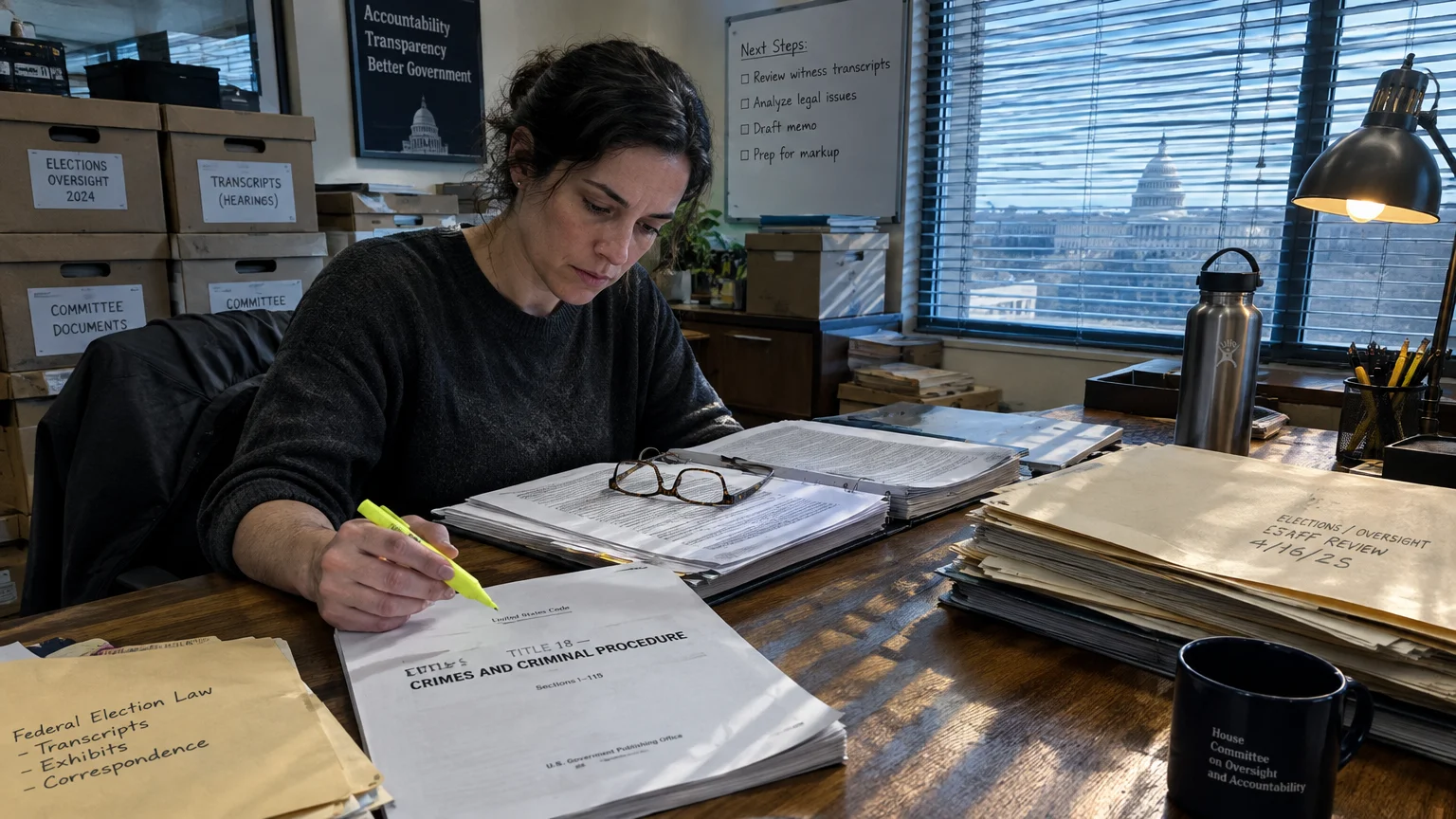
Beyond fiscal policy, Trump’s conditional $5,000 offer sparked intense legal scrutiny regarding federal election integrity rules. Throughout the autumn campaign, critics and legal commentators questioned whether promising cash payments for a specific electoral outcome crosses statutory lines.
Observers specifically cited 18 U.S.C. § 597, a federal statute prohibiting expenditures to influence voting. Violations of that law carry financial penalties and up to one year in prison, or two years for willful offenses. Critics also cited 52 U.S.C. § 10307(c).
However, election-law specialists emphasize that Supreme Court precedent gives candidates wide latitude when making broad policy promises. In Brown v. Hartlage, decided in 1982, the Court drew a clear distinction between illegal private vote buying and political pledges carried out through normal legislative processes.
Because a $5,000 federal dividend would require public statutory enactment by Congress rather than private campaign cash handed directly to individual voters, legal experts generally view Trump’s Dallas speech as protected campaign rhetoric rather than prosecutable vote buying. Still, watchdog groups argue that conditioning public Treasury funds on partisan election outcomes blurs democratic norms.
Transparency concerns extend beyond campaign speeches to how bills are drafted and communicated to the public. When Moreno’s office promised a “Trump Dividend” bill on September 10 and still had no public legislative text by November 4, constituents lacked any way to inspect income caps, spending restrictions, or offset claims.
Without published statutory language, voters could not verify whether the administration intended to exclude high earners as Vance suggested or pay everyone equally as Trump stated. Nor could independent budget scorekeepers verify how the proposal would interact with existing tax credits or benefit programs.
Another major oversight issue centers on the $166 billion in invalidated emergency tariffs now flowing back out of federal coffers. With $129 billion in refund claims accepted by Customs and Border Protection through October 2026, a key question is whether importers pass any recovered duties back to consumers or retain them as corporate windfalls.
You can apply three basic verification checks whenever a politician promises a new check or tax rebate. First, confirm whether an actual bill number exists on official congressional trackers; second, check whether the Congressional Budget Office has scored its deficit impact; and third, verify which congressional committee holds jurisdiction over the appropriation.
Frequently Asked Questions About Stimulus Checks in 2027
Can President Trump issue $5,000 checks by executive order without Congress?
No, the president cannot unilaterally issue $5,000 federal dividend checks without an appropriation passed by Congress. Although Trump told CBS News he believed congressional approval was unnecessary, constitutional rules grant Congress exclusive power over federal spending.
Both House Speaker Mike Johnson and Sen. Bernie Moreno publicly confirmed that delivering the checks would require congressional legislation. Without a statute signed into law, the Treasury Department has zero legal authority to disburse $1.2 trillion to citizens.
Could Republicans pass the Trump dividend during the 2026 lame-duck session?
Passing a $5,000 dividend during the November and December 2026 lame-duck window is virtually impossible. Republicans hold a narrow 218–214 House majority and 53–47 Senate majority until January 3, 2027, leaving almost no margin for fiscal-hawk defections.
Moreno’s office confirmed on November 4 that no bill text had even been released, while Rep. Chip Roy and Speaker Johnson raised serious concerns about funding and legislative details. Lawmakers also face an immediate December 11, 2026 deadline just to keep existing federal agencies funded.
What happened to the tariff money meant to fund the $5,000 checks?
The tariff revenue projected to support new payouts shrank sharply after the Supreme Court invalidated Trump’s emergency tariffs in February 2026. Customs and Border Protection is currently refunding roughly $166 billion in duties collected under that struck-down authority.
As a result, net customs duties dropped to $173.2 billion in fiscal year 2026, while the Congressional Budget Office cut its customs revenue forecast by $250 billion. A $1.2 trillion payout would consume roughly an entire decade of projected new tariff collections.
Will Congress pass any stimulus or rebate check in 2027?
Universal $5,000 checks are off the table in the 120th Congress, though smaller targeted relief proposals remain part of the 2027 debate. Rep. Ro Khanna has proposed a $1,700 family refund check to counter food, gas, and power inflation tied to the war in Iran.
Even so, incoming Democratic leaders Jeffries and Schumer are focusing first on restoring expired Affordable Care Act subsidies, reversing food-assistance cuts, and holding votes to repeal Trump’s tariffs. Any direct check bill would still need bipartisan Senate support and Trump’s signature to become law.
Outlook: Key Dates and Legislative Milestones to Watch
As Washington transitions from midterm campaigns to divided governance, four specific milestones will determine what happens to your taxes, benefits, and household costs. Watching these calendar checkpoints lets you follow real legislative power rather than political spin.
First, monitor the December 11, 2026 federal funding deadline during the remaining lame-duck weeks. Congress must pass a new spending package or continuing resolution before midnight on that date to prevent a partial government shutdown.
Second, mark January 3, 2027, when the 120th Congress officially convenes and power shifts to Democratic majorities in both chambers. Jeffries and Schumer will immediately set committee rosters and floor schedules for tariff repeals and healthcare subsidy votes.
Third, watch early 2027 negotiations over the $41.1 trillion statutory debt limit as gross federal debt climbs past $40.5 trillion. Any bipartisan deal to raise the borrowing cap will likely set tight guardrails against costly new spending programs, including stimulus checks.
Fourth, track whether Khanna’s $1,700 inflation refund gains committee hearings or formal budget scores in the new House Democratic caucus. Only bills that clear committee markups and floor votes stand a chance of reaching your mailbox.
By anchoring your expectations to verified legislative filings, Treasury data, and Supreme Court limits, you can tune out recycled check rumors. Focus instead on concrete policy shifts in trade, healthcare premiums, and debt-limit stability that will shape your finances throughout 2027.





whqh4n
xcrbnu