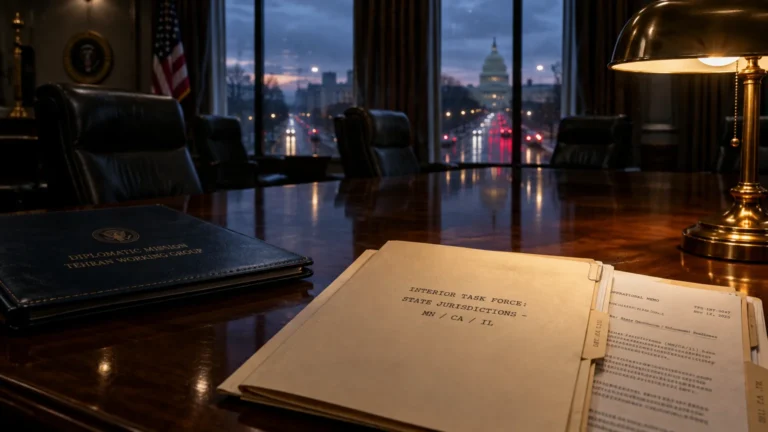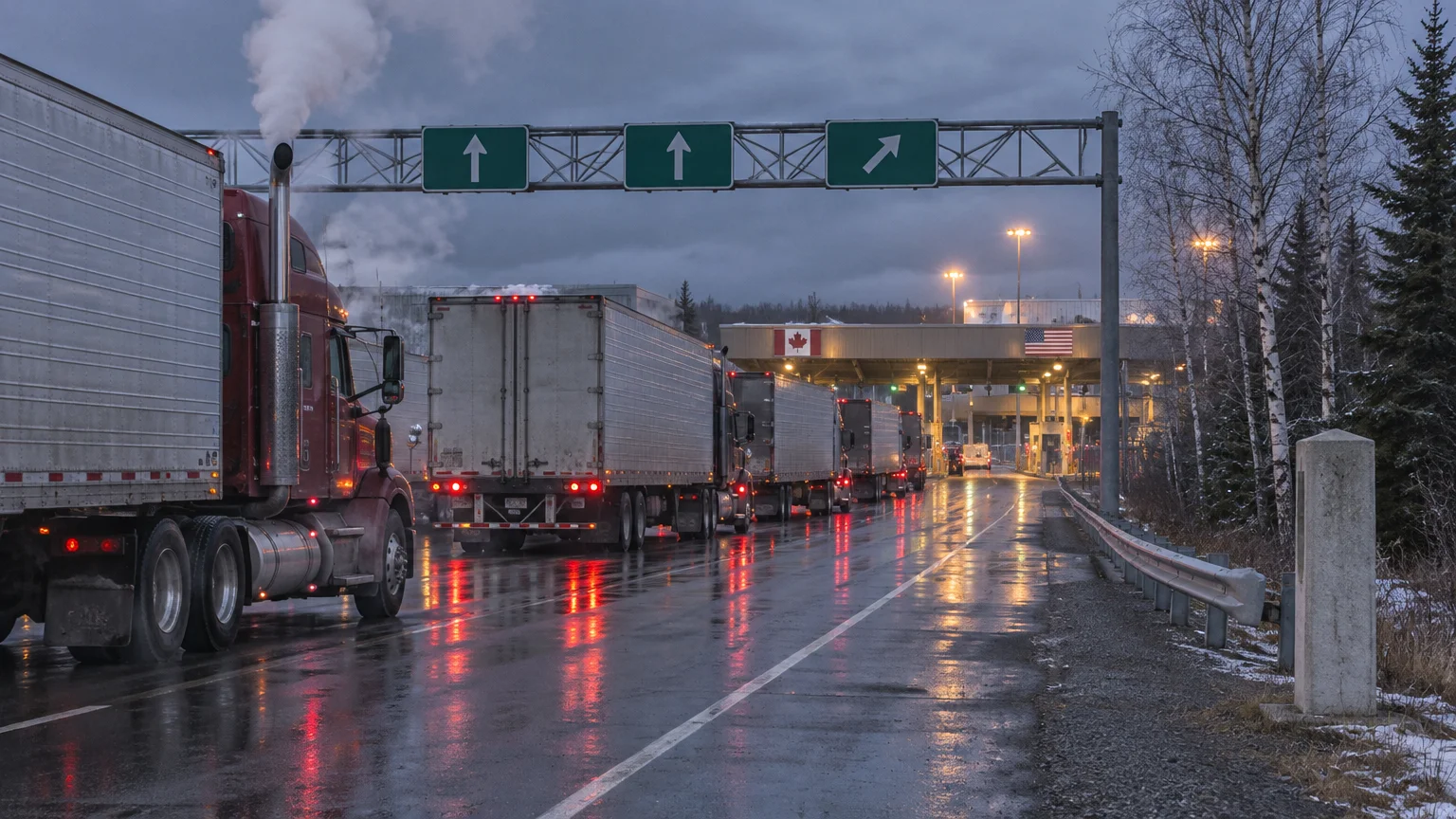
Nearly four in ten Canadians now view the United States as an enemy country, according to November 2026 Leger Marketing polling. For American households and exporters, that diplomatic rupture already drives higher border costs and shrinking sales.
Two years of escalating tariffs, stalled trade extensions, and annexation talk have fractured North America’s closest alliance. Voters on both sides of the border now face an unpredictable economic landscape.
Mapping the executive proclamations, court rulings, and congressional power shifts behind this breakdown gives you concrete benchmarks. You can use those signals to track upcoming tariff repeal fights and North American trade talks.
The Polling Flashpoint Behind the Border Rift
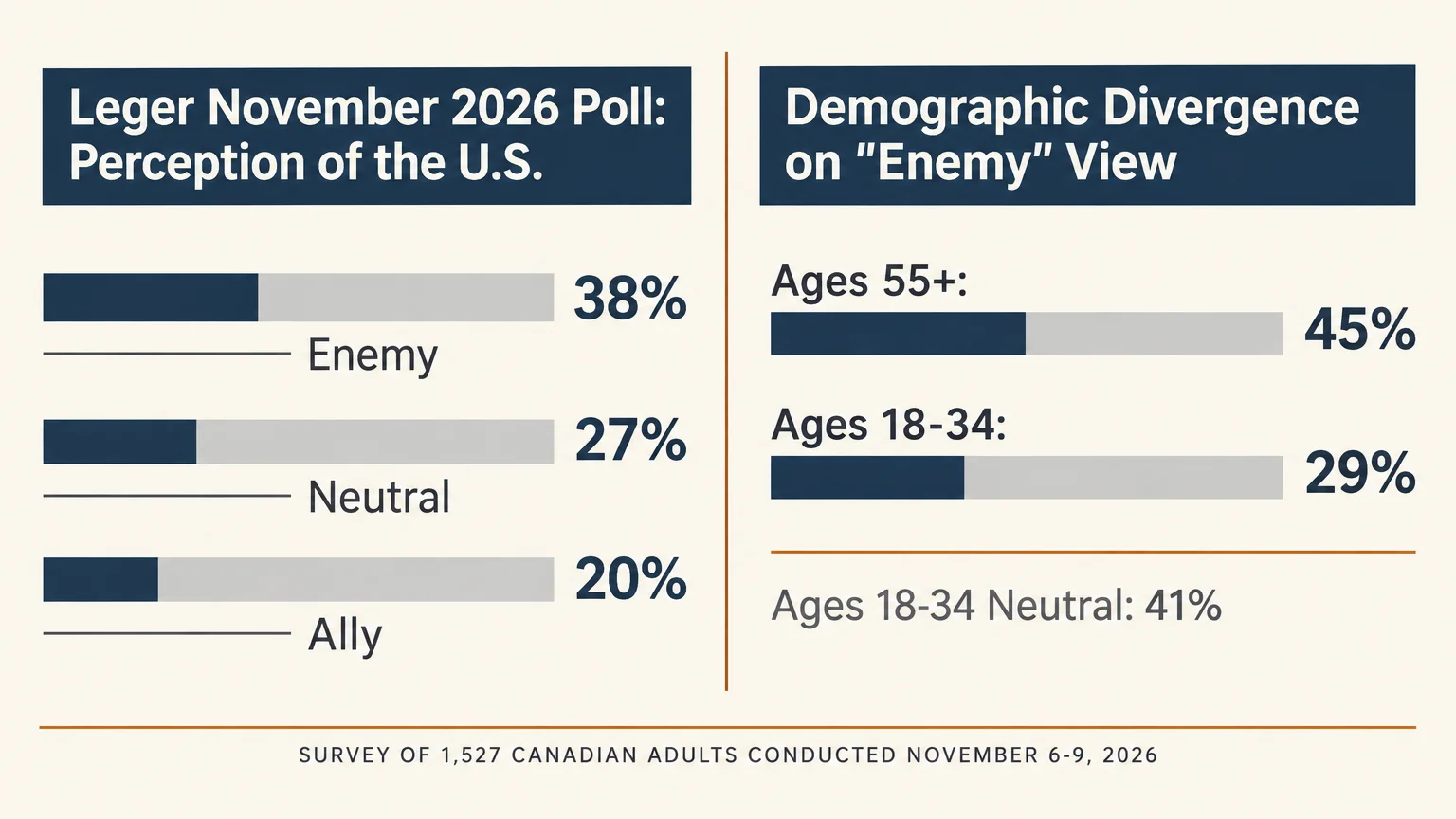
In a Leger Marketing survey of 1,527 Canadian adults conducted November 6 to 9, 2026, 38% called the United States an “enemy country.” Only 20% described their southern neighbor as an ally, while 27% viewed the country as neutral.
That November snapshot followed an even sharper peak earlier in the fall. In Leger’s late-August survey of 1,552 Canadians, 41% labeled the United States an enemy, marking a 15-percentage-point jump since June 2025.
Age and geography deepen the divide inside Canada. Among Canadians aged 55 and older, 45% saw the United States as an enemy in November, compared with 29% of adults aged 18 to 34.
Younger Canadians leaned toward detachment rather than outright hostility, with 41% calling the United States neutral in November. In August, nearly half of Quebecers—49%—and 51% of older Canadians used the enemy label.
To grasp how rapidly public sentiment eroded, look back to February 2025, when emergency border tariffs first hit. Back then, 27% of Canadians called the United States an enemy and 30% still viewed it as an ally.
By spring 2025, Pew Research Center polling captured the emerging contradiction across 1,024 Canadian respondents. The United States ranked simultaneously as the top answer for Canada’s most important ally and its greatest threat.
What changed between spring 2025 and autumn 2026 was the White House’s decision to abandon normal trade rules. On August 22, 2026, President Donald Trump imposed 50% tariffs on roughly $20 billion in American-dollar value of Canadian goods.
Yet Canadian voters did not treat those policies as permanent American consensus. In Leger’s November 2026 poll, 72% of Canadians viewed the 2026 U.S. midterm election results as good news for their country.
Two-thirds of Canadian respondents said they felt pleased with the U.S. midterm outcome, while just 7% expressed disappointment. Nearly half—48%—predicted the incoming Congress would make favorable trade negotiations easier to reach.
If you track North American politics for business or policy decisions, that midterm signal matters. Canadian hostility tracks closely with specific executive actions rather than irreversible hatred of American communities.
Mapping the Players, Coalitions, and Asymmetry
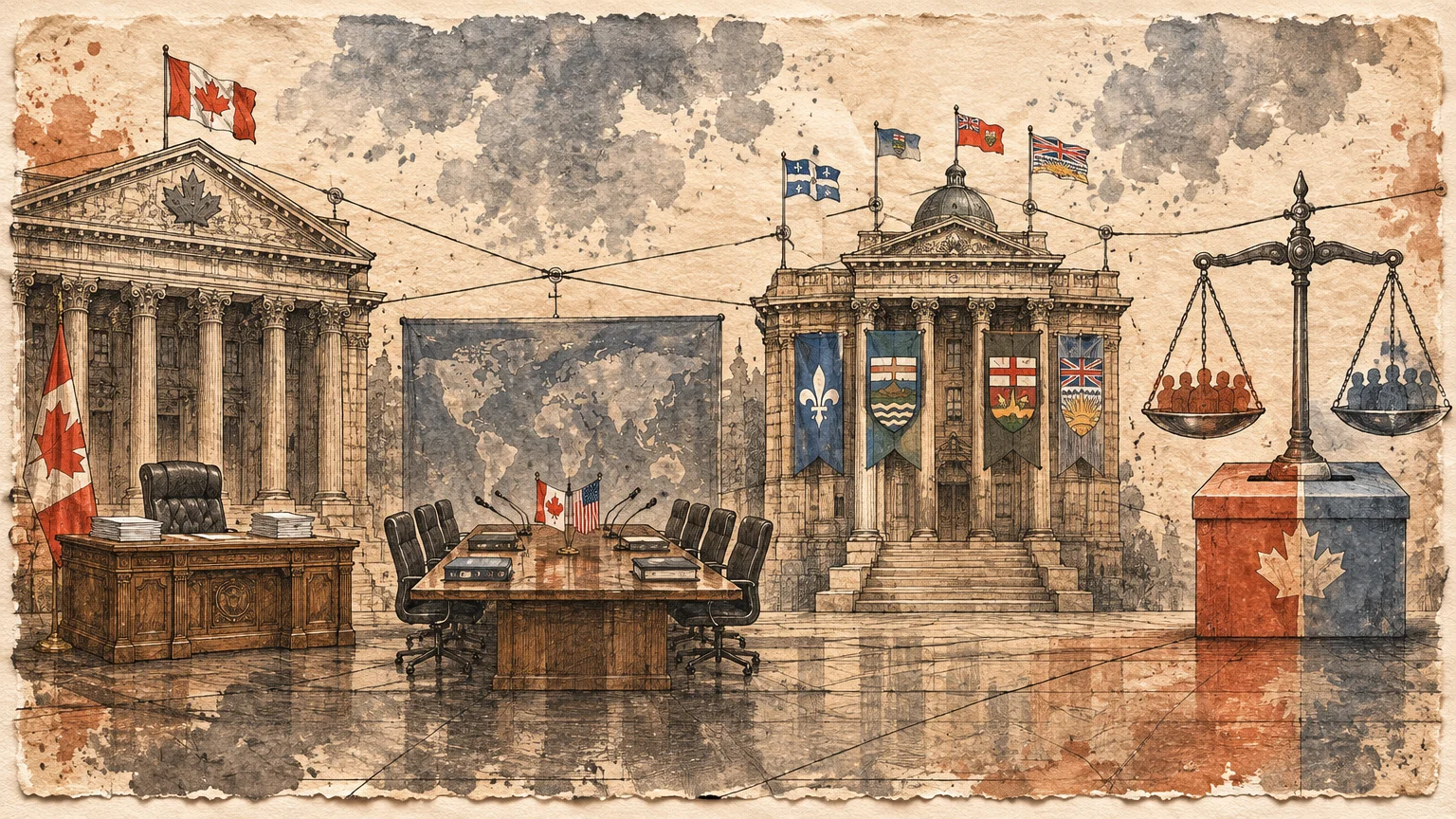
Power in this dispute flows through four distinct arenas: the White House, Ottawa’s trade negotiators, provincial legislatures, and a divided U.S. electorate. Watching how each player moves helps you separate political theater from binding policy.
At the federal level in Washington, the administration relies on unilateral trade proclamations rather than congressional votes. After failing to secure quick bilateral concessions in mid-2026, White House officials targeted Canadian dairy, alcohol, and automotive policies directly.
On the Canadian side, Trade Minister Dominic LeBlanc and Chief Negotiator Janice Charette lead an increasingly rigid negotiating team. As of November 19, 2026, their talks with Washington had failed to deliver an interim tariff relief agreement.
Auto tariffs remain the central roadblock keeping both capitals from a settlement. Because North American vehicle supply chains cross the border repeatedly before final assembly, neither government can easily carve out narrow exemptions without angering domestic manufacturers.
Behind Ottawa’s negotiators sits a remarkably unified Canadian public coalition—though partisan cracks still appear underneath. In Leger’s June 2025 data, 44% of Conservative supporters still called the United States an ally, compared with 17% of Liberals and 12% of New Democrats.
As tariffs broadened across consumer sectors in 2026, overall Canadian tolerance collapsed across party lines. Angus Reid Institute surveys from July and August 2026 found 79% of Canadians held an unfavorable view of President Trump, including 69% who felt “very” unfavorable.
More troubling for long-term diplomacy, skepticism bled into views of ordinary Americans. Angus Reid reported that 48% of Canadians held an unfavorable view of the American people, outnumbering the 45% who held a favorable opinion.
In February 2023, 48% of Canadians told Angus Reid that Ottawa should treat Washington as a valued partner and ally. By August 2026, 65% said Canada must approach the United States cautiously or as a potential threat.
Yet American public opinion tells a radically different story, creating a dangerous attention gap. In Angus Reid’s U.S. survey of 1,000 adults, 79% held a favorable view of Canadians and 78% favored treating Canada as a valued partner or friendly neighbor.
Nearly six in ten Americans—59%—opposed the 50% tariffs threatened in August 2026. The real issue is salience: 91% of Canadians followed the trade conflict closely, compared with 69% of Americans.
Partisan erosion inside the United States still poses a long-term hurdle for repair. Gallup’s March 2026 survey recorded a sharp drop in American favorable ratings of Canada to new lows, driven primarily by Republicans and independents.
Meanwhile, provincial premiers in Canada bypassed diplomatic niceties by pulling American spirits and wine off government-run liquor store shelves. Those subnational shelf bans turned provincial retail boards into powerful economic weapons.
In Washington, the November 2026 midterm elections shifted the congressional balance of power just enough to reopen legislative oversight. Atlantic Council analysts noted in mid-November that bipartisan lawmakers in the incoming Congress could hold enough votes to repeal the 1930 tariff statute behind the August duties.
If you want to gauge whether bilateral ties will stabilize in 2027, watch that emerging coalition on Capitol Hill. Farm-state Republicans and border-state Democrats share direct constituency pressure from agricultural, manufacturing, and tourism losses.
Policy Breakdown: How Washington Bypassed Trade Law
To understand why Canadian voters reacted so fiercely in 2026, you have to trace the legal maze the White House built after losing in court. Every tariff wave relied on a different statutory lever.
The conflict began on February 1 and March 4, 2025, when President Trump invoked the International Emergency Economic Powers Act, known as IEEPA. Those orders slapped 25% emergency tariffs on most Canadian goods and 10% duties on Canadian energy.
Ottawa hit back immediately with 25% retaliatory tariffs on $30 billion of American products. Two days later, Washington paused duties on goods complying with the United States-Mexico-Canada Agreement, known as USMCA in Washington and CUSMA in Ottawa.
Rather than de-escalating, the administration pivoted to Section 232 national security tariffs, which bypass USMCA exemptions entirely. Steel and aluminum duties started at 25% on March 12, 2025, doubled to 50% on June 4, and expanded to 50% on copper on August 1.
That same August, Washington raised tariffs on non-compliant Canadian imports to 35% and ended the $800 de minimis duty-free exemption for small parcels on August 29. Suddenly, routine e-commerce shipments faced customs paperwork and new border taxes.
Then came a major constitutional check from the U.S. Supreme Court. On February 20, 2026, in Learning Resources, Inc. v. Trump, the justices ruled 6–3 that IEEPA does not grant presidents authority to impose tariffs.
Chief Justice John Roberts wrote the majority opinion, forcing U.S. Customs and Border Protection to begin refunding collected IEEPA duties through its CAPE portal. For a brief moment, importers expected broad relief.
Instead, the administration immediately substituted new legal authorities within days of the ruling. It imposed a temporary 10% global surcharge under Section 122 from February 24 through July 24, 2026, while keeping Section 232 metal tariffs intact.
When that temporary Section 122 authority expired on July 24, the White House rolled out 10% and 12.5% Section 301 tariffs across 60 economies. Even then, roughly 85% of Canadian exports entered duty-free under USMCA, facing an average effective rate of 5.2% in May 2026.
Everything snapped on August 22, 2026, following Proclamation 11048 and collapsed bilateral negotiations. President Trump invoked Section 338 of the Tariff Act of 1930—a Great Depression statute never previously used—to impose 50% tariffs on roughly $20 billion of Canadian goods.
Critically, Section 338 duties apply regardless of whether a shipment satisfies USMCA origin rules. They also stack directly on top of existing Section 232 tariffs on steel, aluminum, and copper, pushing effective border costs dramatically higher.
According to the Penn Wharton Budget Model, the overall average effective U.S. tariff rate climbed from 2.3% in January 2025 to 7.1% by August 2026. Canada’s Finance Ministry pegged the targeted trade value at $27.6 billion in Canadian dollars.
On September 8, 2026, Ottawa deployed dollar-for-dollar counter-tariffs ranging from 15% to 50% on $27.6 billion CAD of American goods. That same day, the White House issued five more Section 338 proclamations, expanding product coverage on September 15 and banning select imports on September 29.
The escalation continued right up to the U.S. midterms. Under Proclamation 11076, effective October 30, 2026, Washington removed 22 tariff lines while adding 100 new product categories to the 50% penalty list.
Compounding the tariff shock was the collapse of long-term treaty certainty. During the mandatory six-year USMCA Joint Review on July 1, 2026, the Office of the U.S. Trade Representative declined to approve a 16-year extension through 2042.
Under Article 34.7 of the agreement, failing to extend the pact triggers mandatory annual reviews every year until the current July 1, 2036 sunset date. Unless all three governments reverse course, North American manufacturers now face yearly cliffhangers over market access.

Constituent Impact: Who Pays on Both Sides
Bilateral trade between the United States and Canada is not an abstract diplomatic ledger. In 2025, total goods trade reached $716 billion, alongside $157 billion in cross-border services where the United States enjoyed a $27.7 billion surplus.
While Washington pointed to an overall $48 billion bilateral deficit in 2025—including a $10.5 billion agricultural deficit—both economies depend heavily on each other’s inputs. Canada supplies nearly 60% of U.S. crude oil imports and leads global potash production for American farms.
By September 2026, the monthly U.S. goods and services trade deficit with Canada narrowed to $4.4 billion. Yet that statistical shift came alongside severe localized pain for households, retailers, and border communities.
On the Canadian side, vulnerability is acute because 73% of Canadian exports flow south, while 46% of Canadian imports arrive from the United States. In Leger’s August 2026 survey, 63% of Canadians expected new tariffs to inflict a major or moderate hit on personal finances.
An overwhelming 87% expected at least some financial impact on their households. Even though 35% named inflation and cost of living as Canada’s top problem, 74% backed Ottawa’s counter-tariffs—and 66% still supported retaliation even if retail prices rose.
For American consumers and small businesses, Proclamation 11076 pushed 50% border taxes directly into everyday supply chains. The October 30 additions targeted cocoa powders, paints, soaps, carpets, air conditioners, freezers, power tools, and industrial valves.
Meanwhile, Canada’s September 8 counter-tariffs hit core U.S. manufacturing states with 15% to 50% duties. American exports of steel, aluminum, dairy, household appliances, farm equipment, paper, plastics, and electronics lost price competitiveness overnight.
Distillers, vintners, and brewers suffered one of the sharpest consumer boycotts in modern trade history. According to a July 2026 White House fact sheet, Canadian imports of U.S. alcoholic beverages plunged 81%—a $582 million drop—between March 2025 and February 2026.
Border tourism towns across New York, Michigan, Maine, Washington, and Florida absorbed an equally punishing blow. Before the trade war, Canadians accounted for roughly one-quarter of all foreign visitors to the United States, spending $20.5 billion in 2024.
The U.S. Travel Association estimated the 2025 Canadian travel boycott cost the American economy $4.5 billion in a single year. By September 2026, Canadian visits remained 29% below September 2024 levels, even after modest rebounds from 2025’s depressed base.
Statistics Canada recorded September 2026 return trips rising 5.6% by car and 11.6% by air compared with September 2025. Still, leaving nearly three in ten pre-dispute travelers at home starves U.S. hotels, restaurants, and small retailers of steady revenue.
Small online sellers also lost friction-free cross-border fulfillment when the $800 de minimis exemption vanished in August 2025. If you run an independent retail brand shipping to Ontario or British Columbia, higher brokerage fees and retaliatory duties now erase thin profit margins.

Oversight, Sovereignty Rhetoric, and Accountability
Beyond pocketbook math, watchdog analysts see serious governance risks in how the executive branch engineered this confrontation. Cycling rapidly through emergency statutes bypassed both congressional oversight and treaty dispute panels.
When the Supreme Court struck down IEEPA tariffs in February 2026, it affirmed that Congress holds constitutional taxing power. Yet the White House pivoted immediately to Section 122, Section 301, and dormant Section 338 provisions without seeking a single floor vote.
Resurrecting Section 338 of the 1930 Smoot-Hawley-era Tariff Act illustrates that statutory loophole. Congress never repealed the 96-year-old discrimination clause, allowing a president to stack 50% tariffs on top of Section 232 duties and override USMCA rules.
Administrative transparency around tariff refunds has also strained public accountability. Importers trying to recover unlawful IEEPA charges through Customs and Border Protection’s CAPE system face complex documentation hurdles while simultaneously absorbing new Section 338 bills.
At the same time, inflammatory sovereignty rhetoric transformed a commercial dispute into a perceived national security threat north of the border. Repeated references to absorbing Canada as the 51st U.S. state galvanized fierce opposition across Canadian provinces.
In Leger’s August 2026 survey, 85% of Canadians rejected becoming the 51st state, with only 9% in favor. Worse, following U.S. military action in Venezuela, January 2026 polling showed 31% of Canadians believed direct U.S. action to take control of Canada was likely.
Remarkably, 20% of 1,011 American respondents in that same January 2026 survey also rated direct U.S. intervention in Canada as likely. Those numbers show how quickly executive rhetoric normalizes scenarios once considered unthinkable between NATO allies.
You do not have to accept official spin on either side of the border when evaluating these shifts. Checking primary government filings lets you see which domestic industries actually benefit and which ones bear the costs.
Use the Department of Finance Canada portal to inspect exact Harmonized System tariff codes hit by Ottawa’s September 8 counter-tariffs. On the U.S. side, review Federal Register notices from the Trade Representative to track Section 338 exclusions.
You can also monitor new repeal legislation on the official congressional legislative tracker once the new Congress convenes. Pairing those bill trackers with Federal Election Commission lobbying and campaign finance filings reveals which trade associations are pushing hardest for relief.
Frequently Asked Questions
What legal precedent allows a president to bypass USMCA with Section 338 tariffs?
Section 338 is an unused clause inside the Tariff Act of 1930 permitting up to 50% duties against countries judged to discriminate against U.S. commerce. Because it predates modern trade agreements, the White House argues it applies regardless of USMCA compliance.
Unlike IEEPA, which the Supreme Court struck down 6–3 in February 2026, Section 338 has not yet faced a final appellate ruling. Legal challenges from affected importers remain an active risk for the administration’s tariff architecture.
How long can these tariffs stay in place without congressional approval?
Unlike Section 122 surcharges, which expired automatically after five months in July 2026, Section 338 and Section 232 tariffs carry no automatic sunset clock. They stay active indefinitely unless the president revokes them, courts block them, or Congress passes a repeal bill.
Because overriding a presidential veto requires two-thirds majorities, bipartisan lawmakers need broad coalition support to strip Section 338 from federal law. Watch early 2027 committee hearings to see whether farm-state and border-state members force a floor vote.
Why do Canadian voters back retaliation even when it raises their own prices?
Polling shows Canadians view the 2026 tariffs as an attack on national sovereignty rather than an ordinary commercial disagreement. In August 2026, 78% expected Ottawa’s counter-tariffs to raise consumer prices, yet 66% still backed retaliation despite higher household costs.
Provincial shelf bans on American alcohol and reduced leisure travel south give voters tangible ways to register protest without waiting for diplomatic summits. That civic solidarity makes backing down politically costly for Canadian Prime Minister and trade negotiators alike.
Could the incoming Congress or annual USMCA reviews reverse this breakdown in 2027?
Yes, though timing depends on legislative strategy and White House flexibility. Leger’s August 2026 polling shows 64% of Canadians say their view of the United States would change under different leadership, and in November 72% welcomed the U.S. midterm results.
Even without immediate statutory repeal, congressional pressure could push the administration toward an interim deal with LeBlanc and Charette on auto and metal tariffs. Conversely, another deadlock during the July 2027 USMCA annual review would prolong market uncertainty.
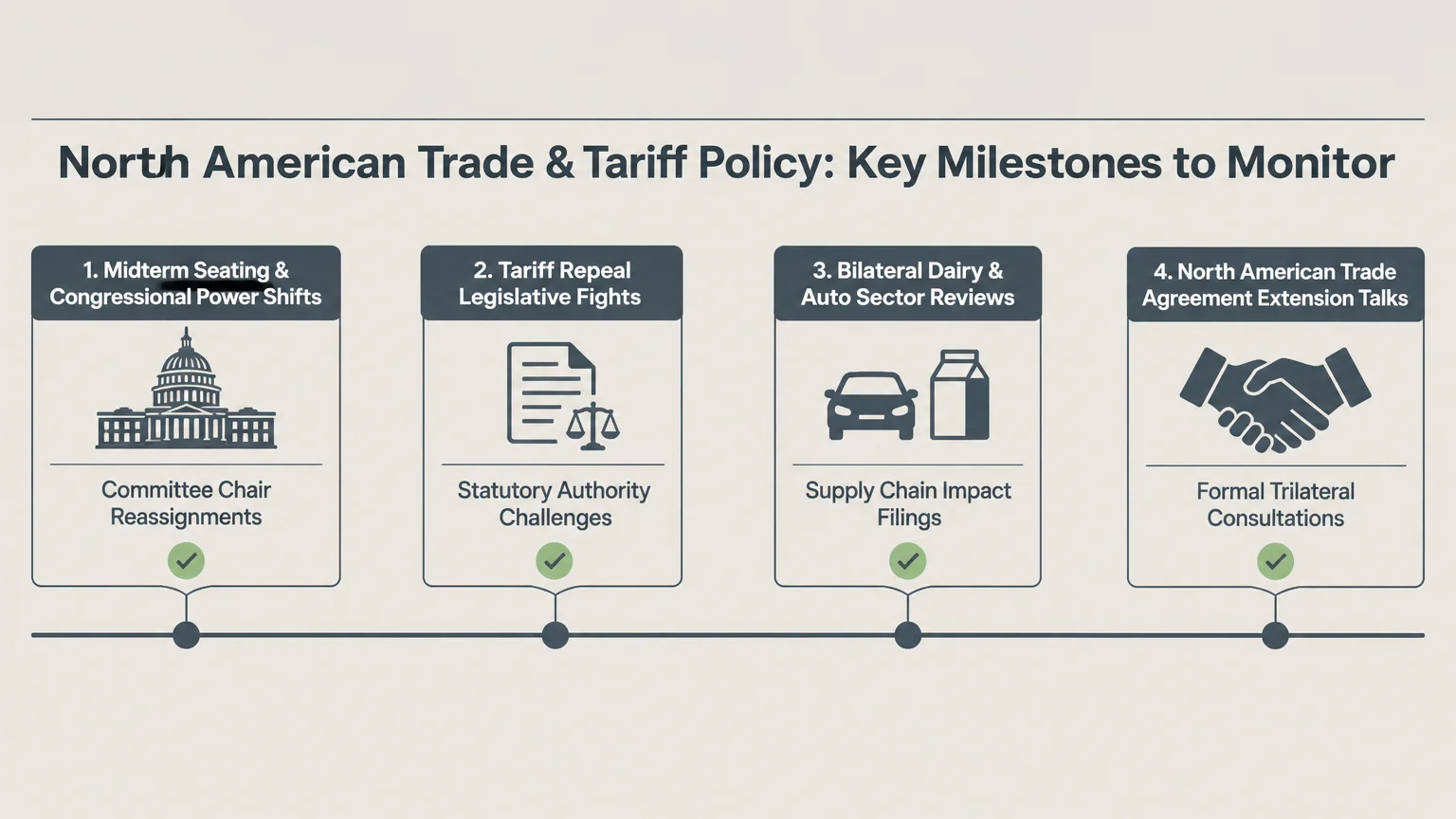
Outlook: Key Milestones to Monitor Next
Three concrete dates and legislative benchmarks will determine whether the U.S.–Canada relationship stabilizes or fractures further over the coming year. Put these checkpoints on your calendar if your business, portfolio, or community relies on cross-border trade.
First, watch whether bipartisan members in the newly seated U.S. Congress introduce standalone legislation to repeal Section 338 of the Tariff Act of 1930. Committee markups and co-sponsorship counts will quickly reveal whether lawmakers have veto-proof momentum or only symbolic leverage.
Second, track ongoing negotiations between Canadian Trade Minister Dominic LeBlanc, Chief Negotiator Janice Charette, and their U.S. counterparts over automotive and Section 232 tariffs. Any interim framework lifting 50% duties would trigger immediate reciprocal cuts from Ottawa’s $27.6 billion CAD retaliation list.
Third, monitor the mandatory annual USMCA Joint Review scheduled around July 1, 2027, one year after Washington declined the 16-year extension. Until all three North American partners restore multi-year treaty certainty, border retailers, manufacturers, and voters will keep bracing for sudden shocks.