
President Donald Trump signed the bipartisan Claiming Age Clarity Act on November 20, 2026, overhauling how the government labels your retirement claiming options. This unanimous Senate-backed law takes effect as Congress prepares larger battles over your future payroll taxes and benefits.
Meanwhile, lawmakers across party lines are floating trillion-dollar trust fund investments and higher wage caps ahead of the 2027 legislative session. These competing plans respond to official projections showing retirement reserves depleting by late 2032.
Sorting enacted rules from early proposals lets you protect your retirement budget today while tracking real legislative risks ahead.
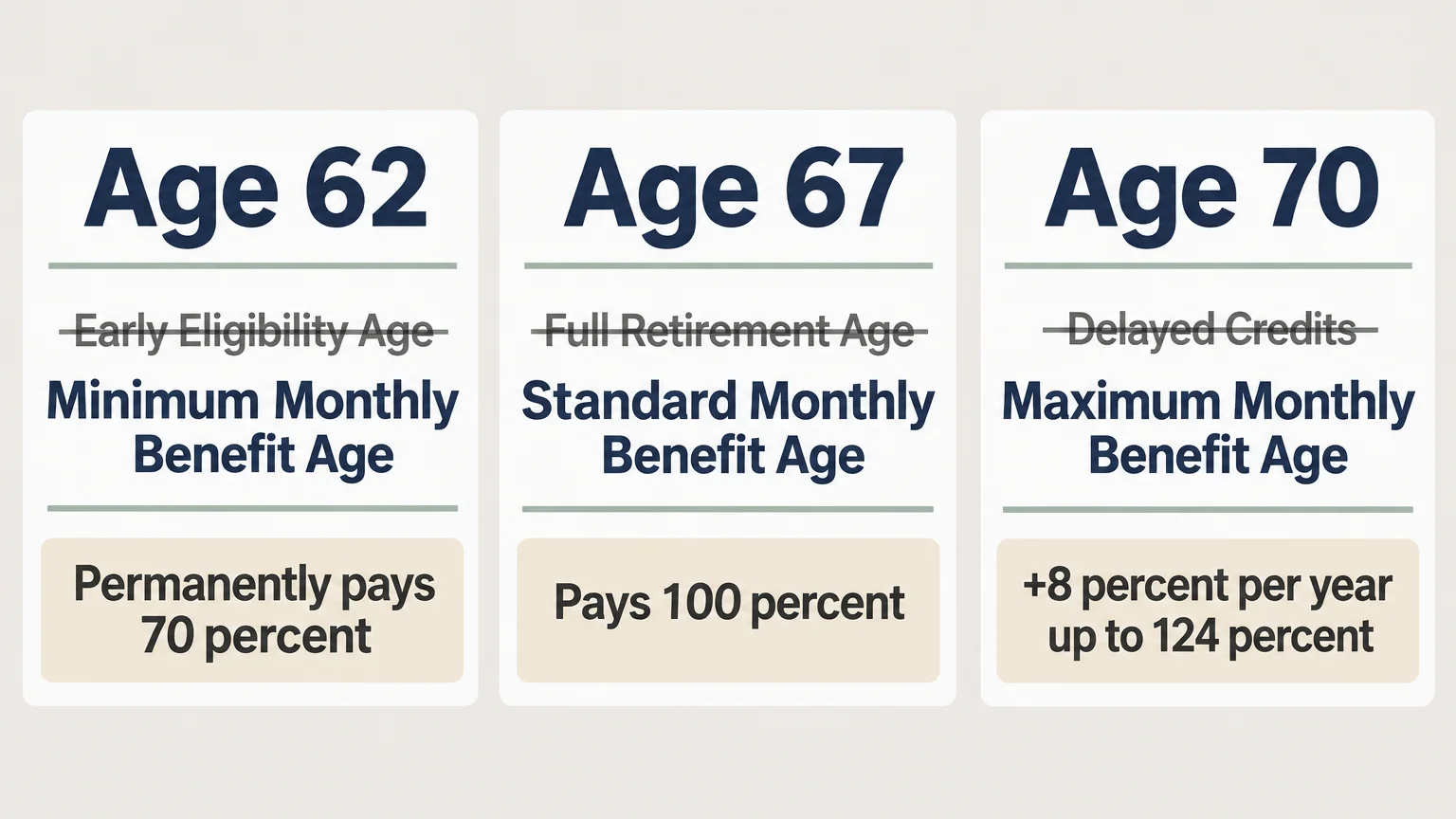
What Just Passed: Inside the Claiming Age Clarity Act
On November 20, 2026, President Trump signed H.R. 5284, the Claiming Age Clarity Act, according to a White House announcement issued the following day. The legislation cleared the House in December 2025 and passed the Senate by unanimous consent in September 2026.
Representative Lloyd Smucker, a Pennsylvania Republican, and Representative Don Beyer, a Virginia Democrat, authored the bipartisan bill in the House. Senators Bill Cassidy, Tim Kaine, Susan Collins, and Chris Coons steered the companion measure through the federal legislative process.
This new statute neither raises your retirement eligibility age nor trims a single dollar from your monthly check. Instead, it directs the Social Security Administration to replace misleading retirement labels across official forms, online calculators, and mailed benefit statements.
Federal administrators must swap the phrase early eligibility age—currently age 62—for minimum monthly benefit age. They must also replace full retirement age or normal retirement age with standard monthly benefit age.
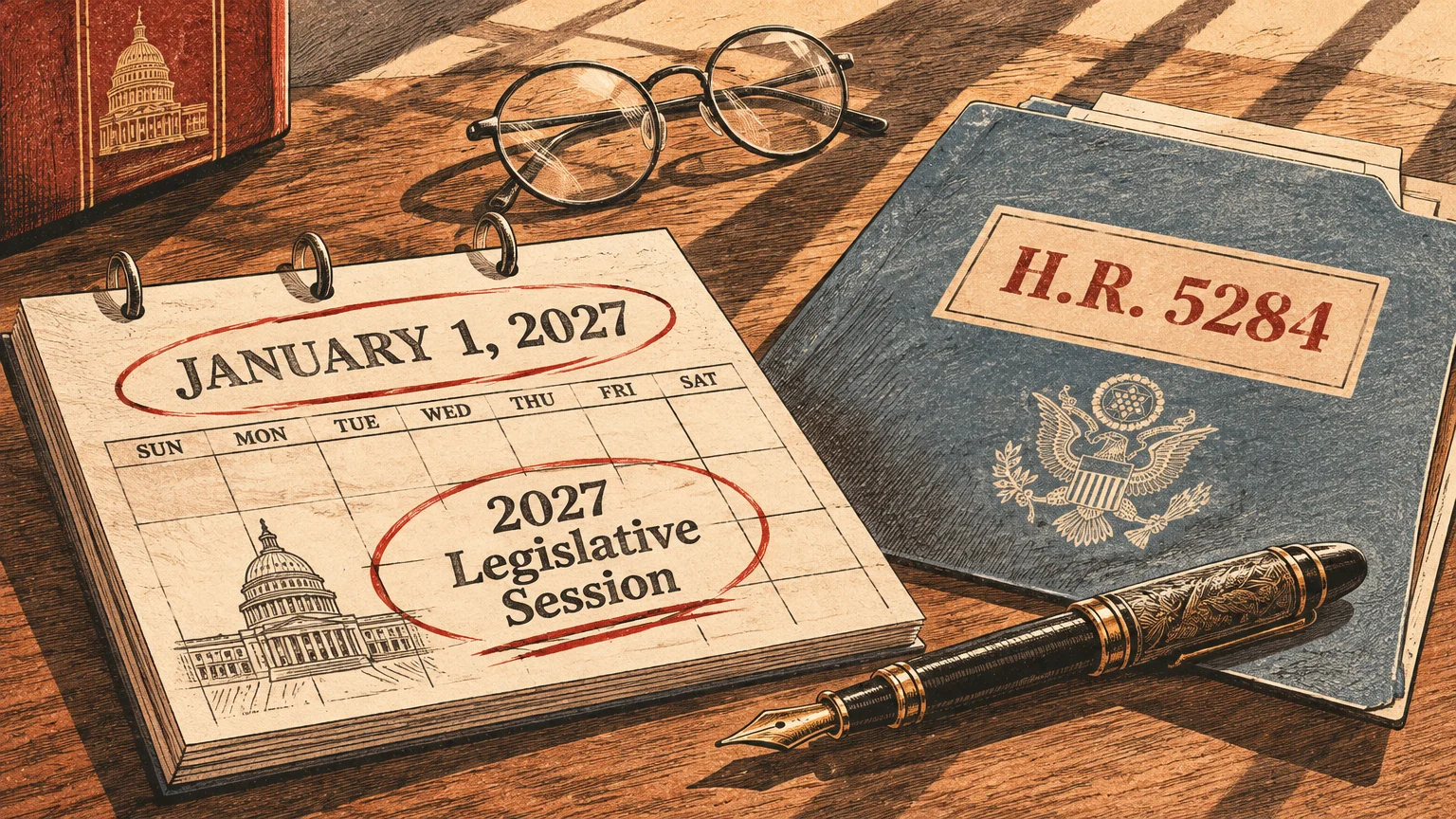
Delayed retirement credits earned up to age 70 will become your maximum monthly benefit age. Under the statute, the agency must finish updating these terms within 12 months of enactment or by January 1, 2027, whichever date arrives later.
Why did lawmakers in both parties invest political consensus in three vocabulary updates? According to the Congressional Research Service, 26 percent of new retired workers in 2024 started collecting Social Security right at age 62.
Many workers read the term full retirement age or early eligibility age and assume waiting brings little extra reward. In reality, for anyone born in 1960 or later, claiming at age 62 permanently reduces monthly checks by 30 percent, paying just 70 percent.
Under current Social Security Administration rules, waiting until age 67 delivers 100 percent of your standard monthly benefit. Holding off until age 70 adds 8 percent for every delayed year, lifting your lifelong monthly payout to 124 percent.
You can apply this clarity immediately when mapping out your own retirement timeline. Before choosing a start date, compare your projected monthly checks at ages 62, 67, and 70 rather than treating the earliest claiming window as a standard target.

Players and Power Mapping Ahead of the 2027 Congress
Bipartisan Dealmakers and Senate Arithmetic
Passing terminology updates by unanimous consent proved far easier than closing Social Security’s multi-trillion-dollar financing gap. Following the November 2026 midterm elections, Democrats will take control of both the House and the Senate in January 2027.
That divided government guarantees intense negotiations with President Trump, who holds veto power over any final legislation. Furthermore, Senate budget rules prohibit lawmakers from using fast-track reconciliation bills to alter Social Security benefits or trust fund revenues.
Any substantive overhaul of payroll taxes, trust fund investing, or benefit formulas therefore needs at least 60 Senate votes to survive a filibuster. Bipartisan dealmaking is not merely political rhetoric; it is a strict procedural necessity.
Inside that 60-vote constraint, three distinct legislative coalitions are competing to define the 2027 agenda. Republican Senator Bill Cassidy of Louisiana and Democratic Senator Tim Kaine of Virginia are advancing a debt-backed investment fund aimed at centrist lawmakers.
On the populist flank, Ohio Republican Bernie Moreno and Massachusetts Democrat Elizabeth Warren joined forces in June 2026 to target high-earner payroll tax caps. Meanwhile, Vermont Independent Senator Bernie Sanders is organizing a progressive benefit expansion push.
Once Democrats assume the Senate majority in January 2027, Sanders stands in line to chair the Senate Finance Subcommittee on Social Security. That gavel will give him direct control over committee hearings, legislative markups, and rival solvency proposals.
Polling Pressure and Outside Think Tanks
Lawmakers are weighing these legislative alliances against bipartisan voter preferences captured in August 2026 polling. A national survey by Voice of the People and the University of Maryland School of Public Policy—reported by the Committee for a Responsible Federal Budget—revealed broad appetite for shared sacrifice.
More than two-thirds of polled voters across party lines favored applying Social Security payroll taxes to earnings above $400,000. Comparable bipartisan majorities supported trimming benefits for the highest-earning fifth of retirees and gradually raising the payroll tax rate to 13 percent.
Survey respondents also backed gradually increasing the normal retirement age to 68 as part of a balanced package. Those findings signal that voters accept painful trade-offs more readily than congressional campaigns often assume.
Outside Capitol Hill, policy researchers and advocacy organizations are actively scoring every plan to influence undecided members. The Committee for a Responsible Federal Budget and the Bipartisan Policy Center are among the groups weighing in, with the Committee warning against debt-financed proposals that dodge tax or benefit adjustments.
At the same time, free-market analysts at the Cato Institute and the Tax Foundation are mobilizing against steep payroll tax increases on upper-income earners.
Decoding the Competing 2027 Social Security Proposals
The Cassidy-Kaine $1.5 Trillion Market Fund
Senator Cassidy stated in mid-November 2026 that President Trump and several Senate Democrats support exploring his investment-fund concept. Often called The Big Idea, the plan would borrow $1.5 trillion from general federal revenue to launch a separate market portfolio.
Under current law, Social Security trust funds hold only special-issue U.S. Treasury securities backed by the federal government. Cassidy’s proposed fund would instead invest in equities and broader financial assets for 60 to 75 years before transferring returns back to pay benefits.
Cassidy projects that long-term market compounding could close 60 to 70 percent of Social Security’s funding shortfall. Bipartisan Policy Center data confirms that since 1983, S&P 500 returns have beaten effective trust fund Treasury interest rates by an average of 4.4 percentage points annually.
For working households, this strategy seeks to shore up future checks without raising your payroll tax rate or cutting benefits. However, critics warn that borrowing $1.5 trillion leaves taxpayers carrying steep interest obligations if market returns lag expectations.
The Moreno-Warren Payroll Tax Cap Elimination
Senators Moreno and Warren detailed an entirely different solution in a June 23, 2026, New York Times opinion piece. They are drafting bipartisan legislation to eliminate the Social Security payroll tax cap without awarding extra retirement credit on newly taxed earnings.
Today, workers and employers split a 12.4 percent OASDI payroll tax—6.2 percent apiece—only up to an annual taxable maximum. Self-employed Americans pay the entire 12.4 percent rate themselves up to that same yearly cap.
Official scoring by the Social Security Administration’s Office of the Chief Actuary illustrates how eliminating that cap starting in 2027 affects solvency. Measured against 2026 Trustees Report baselines, applying the full 12.4 percent tax with zero benefit credit eliminates 58 percent of the 75-year shortfall.
That option, cataloged as Provision E2.1, also eliminates 40 percent of the funding deficit in the 75th projection year. By contrast, eliminating the cap while granting extra benefit credit above today’s threshold—Provision E2.2—closes only 45 percent of the 75-year shortfall.
Watch what this distinction means for your paycheck if Congress revives the bill in 2027. Neither version raises payroll taxes on workers earning below the current wage cap, but high-earning professionals and dual-income households above it would face major take-home pay reductions.
The Sanders Expansion Blueprint
Rather than borrowing in financial markets or trimming upper-tier checks, Senator Sanders continues championing the Social Security Expansion Act. His legislation would raise annual benefits by at least $2,400 per recipient while altering the cost-of-living adjustment formula.
To pay for broader payouts, Sanders proposes lifting payroll taxes on high earners and applying Social Security taxes to investment income. Although progressive advocates rally behind the bill, it lacks the 60 Senate votes needed to overcome a Republican filibuster or a presidential veto.
Even so, Sanders’ anticipated subcommittee chairmanship gives him leverage over any bipartisan compromise negotiated in 2027. Final legislation pairing revenue hikes with solvency protections will likely face demands from his caucus to shield lower-income retirees from benefit cuts.

How These Shifts Affect Your Checks and Paycheck Taxes
2027 Cost-of-Living Gains Versus Medicare Costs
While lawmakers debate 2027 reforms, automatic federal adjustments announced on October 14, 2026, are already reshaping next year’s checks. Roughly 72 million Social Security beneficiaries—and 76 million total Social Security and Supplemental Security Income recipients—receive a 3.6 percent cost-of-living adjustment in 2027.
That 2027 raise climbs noticeably above the 2.8 percent adjustment paid throughout 2026. Higher Social Security deposits begin in January 2027, while Supplemental Security Income recipients receive their adjusted payments on December 31, 2026.
According to the Social Security Administration, the average retired worker check grows by roughly $75 per month, rising from $2,095 in 2026 to $2,170 in January 2027. Bipartisan Policy Center research notes that roughly 40 percent of retirees depend on Social Security for at least half their income.
Healthcare deductions will absorb part of that nominal raise before the money hits your bank account. The 2026 Medicare Trustees Report projects standard Medicare Part B monthly premiums increasing from $202.90 in 2026 to $209.50 in 2027.
Top-earning new retirees also see updated monthly benefit ceilings under the Social Security Administration’s 2027 COLA Fact Sheet. Throughout 2026, maximum monthly checks reach $2,969 at age 62, $4,152 at age 67, and $5,181 at age 70.
Starting in 2027, the maximum monthly payout for a new worker claiming at standard retirement age increases to $4,188. Checking your personalized benefit statement and updated Medicare withholding now helps you set an accurate post-tax household budget for January.
Higher Wage Caps and Earnings Test Thresholds
High-income workers will notice higher Social Security payroll deductions starting in January 2027 under routine wage-indexing rules. Even without congressional action, the taxable wage maximum climbs from $184,500 in 2026 to $192,300 in 2027.
At the 6.2 percent employee tax rate, workers hitting that threshold pay up to $11,922.60 next year, compared with $11,439 in 2026. Including the matching employer share, maximum combined OASDI taxes reach $23,845.20 per capped employee in 2027.
Keep in mind that separate Medicare hospital insurance taxes of 1.45 percent each for workers and employers already apply to every dollar earned. High earners also pay an additional 0.9 percent Medicare surtax above $200,000 for single filers or $250,000 for joint filers.
If you collect Social Security before reaching standard retirement age while holding a job, the 2027 retirement earnings test raises your penalty-free ceiling. For claimants under standard retirement age all year, the annual earnings limit climbs from $24,480 in 2026 to $25,560—or $2,130 monthly—in 2027.
Above that cap, the Social Security Administration withholds $1 in benefits for every $2 you earn over the threshold. During the calendar year you reach standard retirement age, the exempt limit expands from $65,160 in 2026 to $67,920—or $5,660 monthly—in 2027.
In that transition year, the agency withholds $1 for every $3 earned above the threshold prior to your birthday month, after which earnings limits vanish completely. Meanwhile, earning one work credit in 2027 requires $1,970 in covered wages, up from $1,890 in 2026.
The 2032 Cliff for Current and Future Retirees
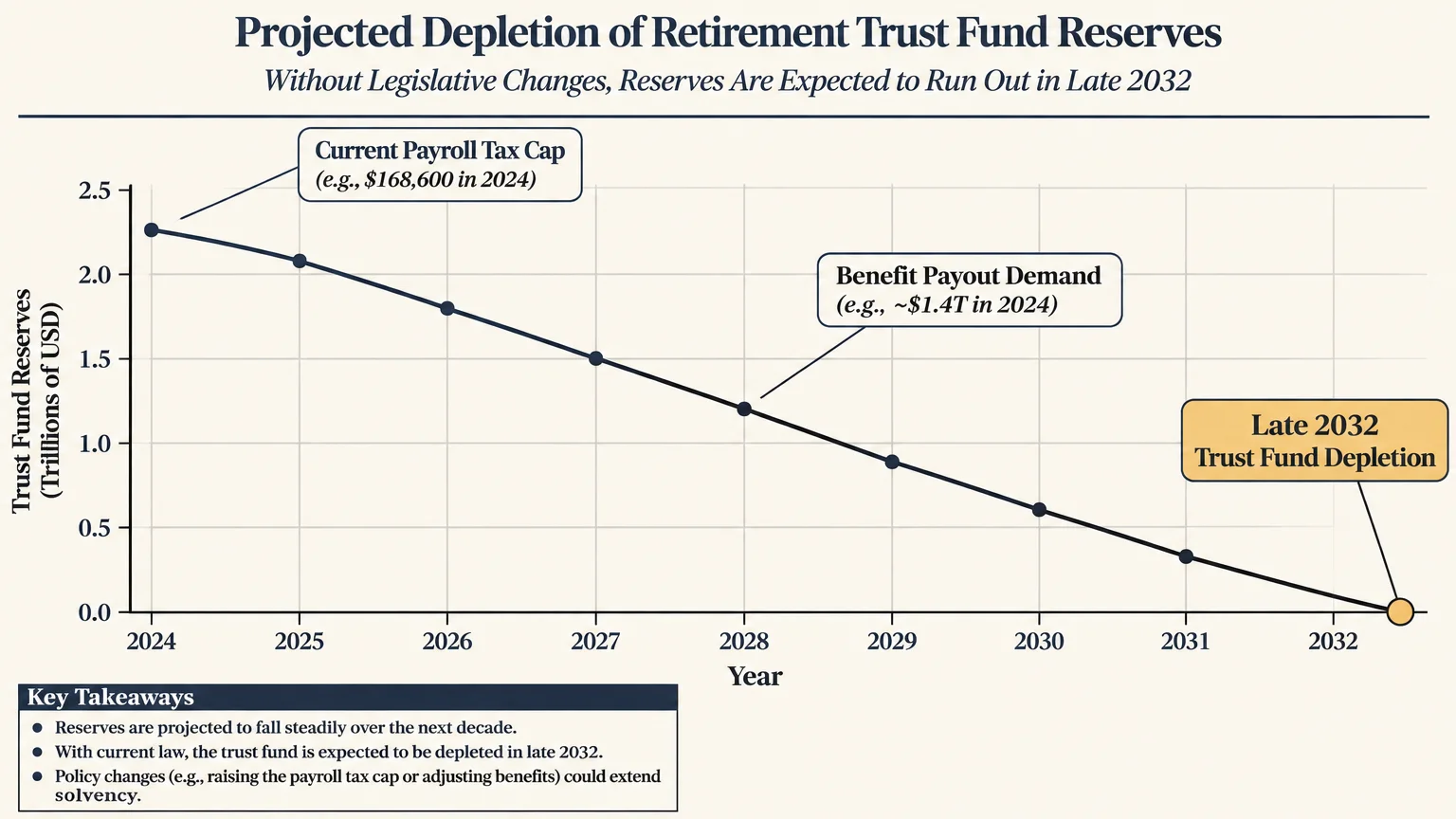
Every legislative proposal heading into 2027 revolves around a hard solvency deadline published in the June 9, 2026, Trustees Report. The Old-Age and Survivors Insurance trust fund—which finances retirement and survivor benefits—is now projected to deplete its reserves in the fourth quarter of 2032.
That depletion timeline moved forward by one full quarter compared with the 2025 Trustees projection. Once trust fund reserves reach zero, ongoing payroll tax collections can legally cover just 78 percent of scheduled benefits, forcing an automatic 22 percent across-the-board reduction.
Without congressional action, payable benefits would erode steadily over subsequent decades, dropping to 62 percent of scheduled levels by 2100. By contrast, the legally separate Disability Insurance trust fund remains solvent with positive reserves across the entire 75-year forecast through 2100.
Federal administrators cannot divert disability reserves to postpone the 2032 retirement cut unless Congress passes new legislation merging the accounts. Even if lawmakers theoretically combined both trust funds, pooled reserves would still run dry in the third quarter of 2034, triggering a 17 percent benefit cut and falling to 65 percent payable by 2100.
For any household entering retirement over the next several years, an automatic 22 percent reduction in 2032 represents a major income shock. Stress-testing your personal retirement savings and fixed monthly expenses against a 78-percent payout scenario gives you practical protection against legislative gridlock.
Oversight, Solvency Drivers, and Economic Warnings
Why the 2026 Trustees Report Worsened
Fiscal watchdogs sounded urgent alarms after the 2026 Trustees Report revealed a 16 percent single-year jump in Social Security’s 75-year actuarial deficit. That deficit climbed 0.60 percentage points from 3.82 percent of taxable payroll in 2025 to 4.42 percent—or 1.5 percent of GDP—in 2026.
The Committee for a Responsible Federal Budget identified that jump as the largest single-year deterioration in nearly half a century. Official Trustees figures put the 75-year present-value shortfall at $29.3 trillion, up from $25.1 trillion in 2025, while Committee for a Responsible Federal Budget and Bipartisan Policy Center analyses cite $31 trillion and roughly $30 trillion respectively.
Cash-flow strain has been building inside the system for years. Program outlays have exceeded non-interest revenue since 2010 and surpassed total income—including Treasury interest—since 2021.
Trust fund reserves shrank by $160 billion during 2025, ending that year at $2.56 trillion against roughly $1.7 trillion in annual benefit payments in 2026. Over the upcoming decade, the Committee for a Responsible Federal Budget projects cumulative cash deficits reaching $3.8 trillion.
Three specific demographic and policy revisions drove the sudden worsening documented in June 2026. First, actuaries lowered their long-term total fertility assumption from 1.90 to 1.75 children per woman, driving over half the deterioration according to Committee for a Responsible Federal Budget estimates.
Second, reduced net immigration projections accounted for roughly one-third of the wider shortfall by shrinking the future base of payroll taxpayers. Third, the 2025 One Big Beautiful Bill Act lowered federal income tax liabilities for many Social Security beneficiaries.
Because revenue from taxing Social Security benefits flows directly back into the trust funds, those tax cuts accelerated depletion into 2032. Both the Bipartisan Policy Center and the Committee for a Responsible Federal Budget attribute roughly one-quarter of the 2026 deterioration to that tax law.
Deep structural shifts compound those recent setbacks, according to Bipartisan Policy Center data. The ratio of covered workers supporting each beneficiary dropped from over 5-to-1 in 1960 to 2.9-to-1 today and is projected to hit 2.2-to-1 in the 2070s.
Rising wage concentration at the top has simultaneously shrunk the share of earnings subject to payroll taxes since 1983. Today only 83 percent of total covered wages fall below the taxable cap, compared with 90 percent after the 1983 overhaul.
Debt Risks and Marginal Tax Rate Warnings
Independent research centers have surfaced serious oversight concerns regarding both leading bipartisan 2027 frameworks. In March 2026 and May 2026 studies, the Committee for a Responsible Federal Budget and the Center for Retirement Research at Boston College evaluated Cassidy’s borrowed market-investment model.
Both research groups warned that borrowing $1.5 trillion to buy equities exposes federal taxpayers to stock market volatility and elevated Treasury interest costs. Across most modeled scenarios, leveraged trust fund investing leaves taxpayers holding larger public debt unless Congress pairs it with genuine tax or benefit changes.
Conversely, free-market researchers caution that uncapping payroll taxes without offsetting reforms could slow broader economic output. A July 2026 Cato Institute analysis notes that stacking a 12.4 percent uncapped payroll tax atop the 37 percent top federal income tax bracket squeezes high earners.
Once state income taxes enter the calculation, combined top marginal tax rates on labor surpass 60 percent in many states, hitting 58 percent in Ohio and 62 percent in Massachusetts. Tax Foundation modeling underscores sharp revenue trade-offs when payroll taxes rise without benefit offsets.
Analyzing a combined 90-percent wage cap expansion and payroll tax above $400,000, the Tax Foundation estimates $2.8 trillion in conventional 10-year revenue. Dynamically accounting for reduced labor supply and slower growth cuts that 10-year yield to $1.3 trillion while reducing GDP by 1.4 percent.
That same Tax Foundation model projects 1.7 million fewer full-time jobs under that tax structure. Lawmakers returning in January 2027 must balance those growth warnings against the consequences of automatic 22 percent cuts in late 2032.
Frequently Asked Questions About Social Security Changes
Did Congress raise the retirement age in November 2026?
No, the Claiming Age Clarity Act signed on November 20, 2026, makes zero changes to your eligibility ages or monthly benefit formulas. Age 62 remains the earliest claiming option, age 67 stays standard for those born in 1960 or later, and age 70 stays the maximum.
Only the descriptive labels printed on federal forms and digital statements will change under the law. Raising the standard retirement age—such as moving it toward 68—would require new legislation passed by Congress and signed by the president in 2027 or later.
Will your payroll taxes automatically jump in 2027?
If your annual wages stay at or below $184,500, your 6.2 percent Social Security payroll tax deduction will not change in 2027. Only workers earning above $184,500 pay additional Social Security tax next year as the indexed cap climbs to $192,300.
Eliminating the taxable cap completely under the Moreno-Warren concept remains an unpassed legislative proposal rather than active federal law. Even if lawmakers approve a cap overhaul during 2027, Congress would determine its effective start date.
Can Congress pass major Social Security cuts or tax hikes with 51 Senate votes?
No, Senate reconciliation rules strictly prohibit lawmakers from altering Social Security benefits or trust fund financing with a simple majority vote. Any major reform package requires 60 Senate votes to clear a filibuster, forcing cross-party negotiation.
With Democrats taking control of both chambers in January 2027 while Republican President Trump holds veto authority, neither party can pass a unilateral bill. Durable legislation requires alignment among House Democrats, bipartisan Senate moderates, and the White House.
When would automatic benefit cuts start if lawmakers fail to act?
According to the June 2026 Trustees Report, the retirement and survivors trust fund exhausts its reserves in the fourth quarter of 2032. At that point, ongoing payroll tax revenue covers just 78 percent of scheduled checks, forcing an automatic 22 percent cut.
Disability Insurance beneficiaries face no immediate shortfall because their separate trust fund retains positive reserves through 2100. However, administrators cannot shift disability funds to cover retirement checks unless Congress passes explicit legislation.
What to Watch Through 2027
Four concrete milestones over the coming year will reveal whether Congress reaches a durable Social Security deal or drifts closer to the 2032 cliff. First, verify your January 2027 benefit deposit and paycheck withholdings as the 3.6 percent COLA and $192,300 wage cap take effect.
Second, track the opening weeks of the new Democratic-led House and Senate in January 2027. Early subcommittee hearings led by Senator Sanders alongside bipartisan negotiations involving Senators Cassidy, Kaine, Moreno, and Warren will show which tax or investment concepts hold viable 60-vote support.
Third, watch the 2027 Trustees Report for updated depletion projections reflecting demographic trends and the 2025 tax law. Fourth, expect the Social Security Administration to roll out its revised claiming-age terminology across public tools no later than November 2027.
While Washington bargains, you can take two immediate steps to safeguard your retirement security. Log into your online federal Social Security account today to audit your annual earnings history, because unrecorded wage years permanently lower your standard monthly payout.
Finally, build a contingency budget that works even if benefits drop to 78 percent payable in late 2032. Keeping household debt low and maintaining flexible savings ensures your retirement plan stays resilient no matter which bipartisan deal lawmakers strike in 2027.