
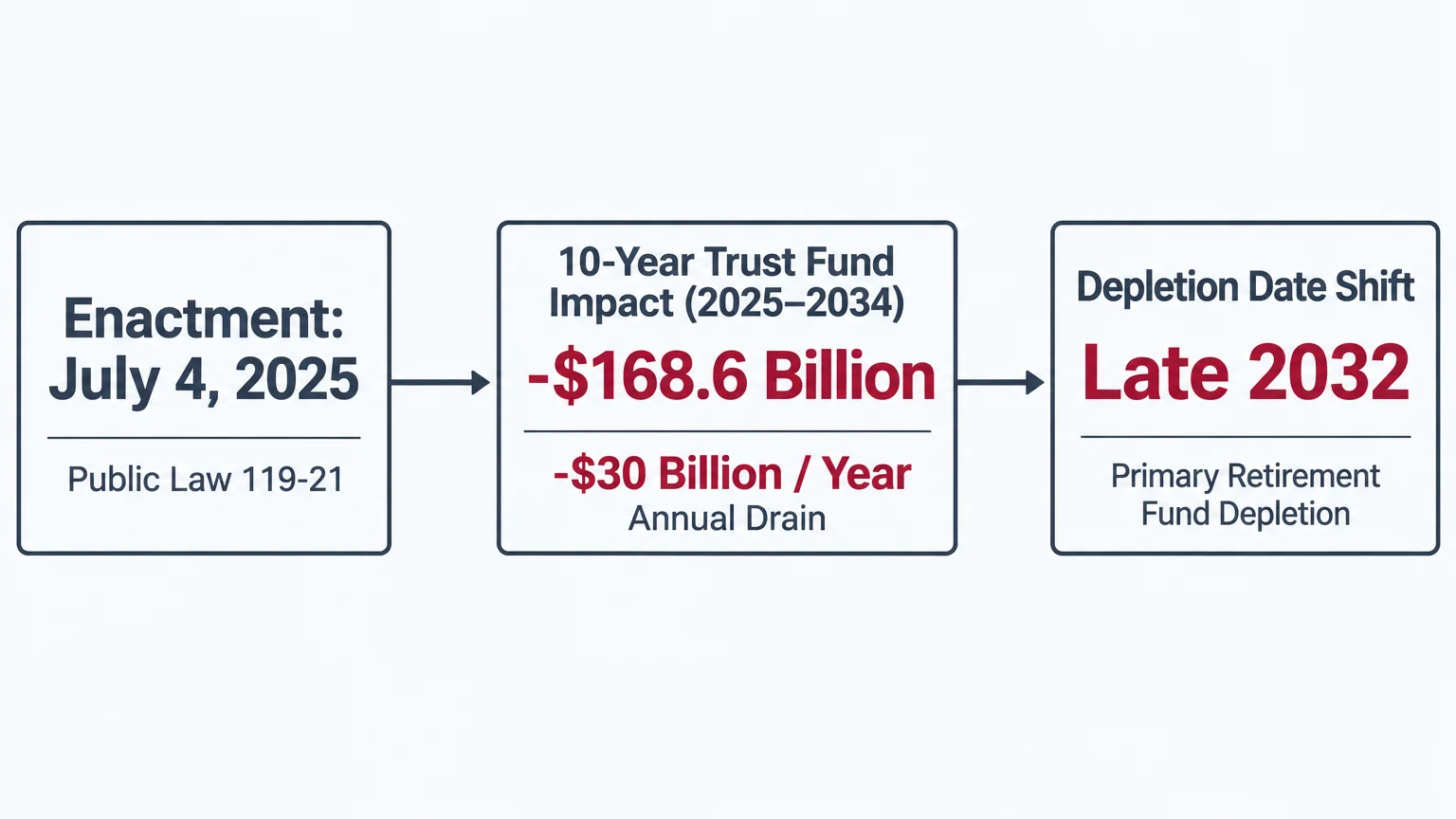
Signed on July 4, 2025, the One Big Beautiful Bill Act did not cut your Social Security check or raise payroll taxes. Yet federal actuaries soon revealed the law adds $168.6 billion to Social Security’s shortfall through 2034.
That quiet revenue drain speeds up the countdown to automatic benefit cuts for more than 71 million Americans. According to the 2026 Social Security Trustees Report, the primary retirement fund now runs dry in late 2032.
Seeing how income tax brackets siphon money from trust funds helps you protect your retirement budget. Here is how Washington’s fiscal math reshapes your future payouts and tax bill.
Flashpoint: How a Tax Bill Rewrote Social Security’s Clock
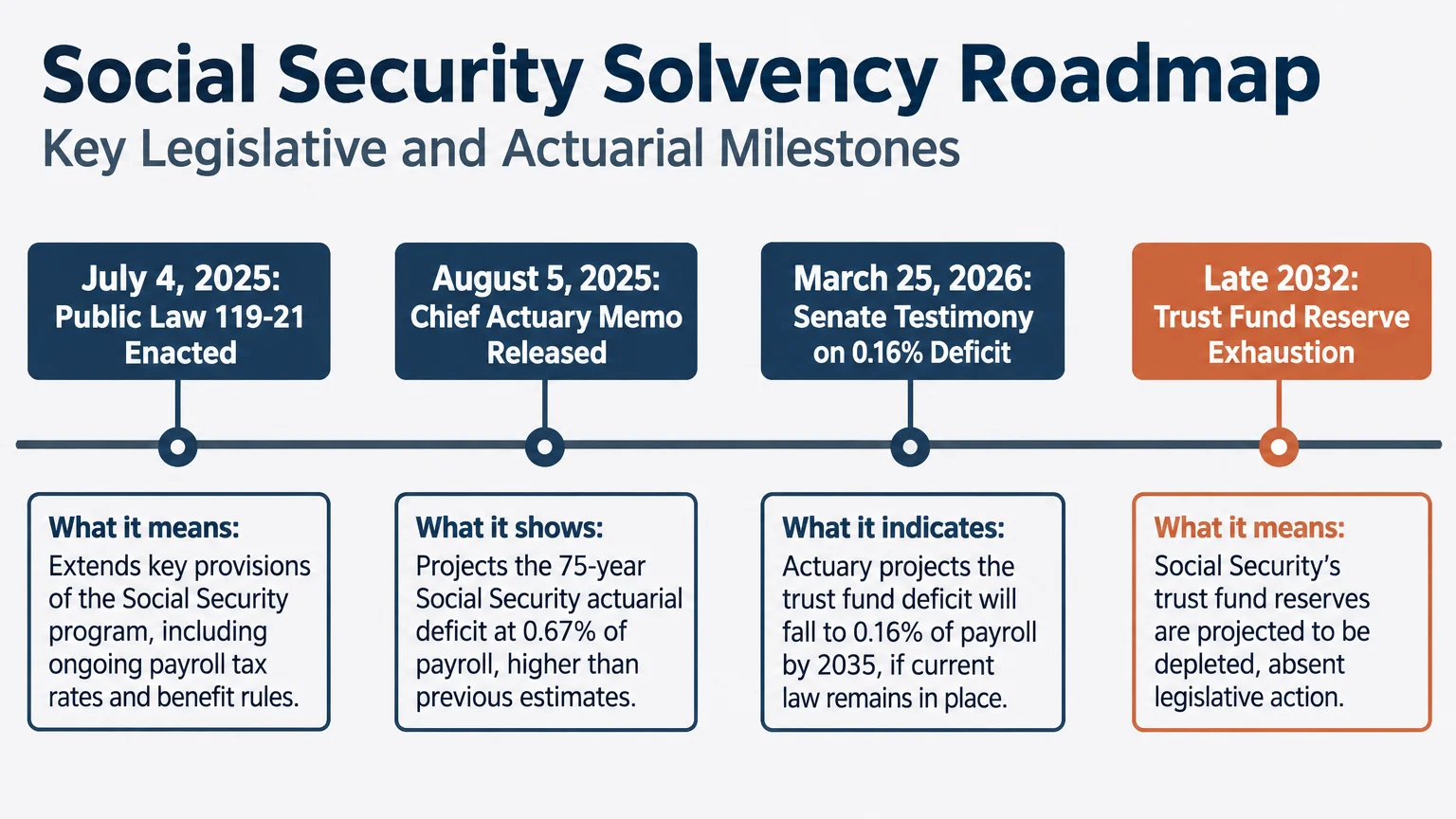
On July 4, 2025, Congress enacted the One Big Beautiful Bill Act, officially designated as Public Law 119-21. You can verify the statute’s enactment details through legislative records on Congress.gov.
Because lawmakers passed the sweeping package using Senate budget reconciliation rules, the Byrd rule barred any direct changes to Social Security payroll taxes or benefit formulas. The law also left intact the federal statute that subjects certain Social Security benefits to income taxes.
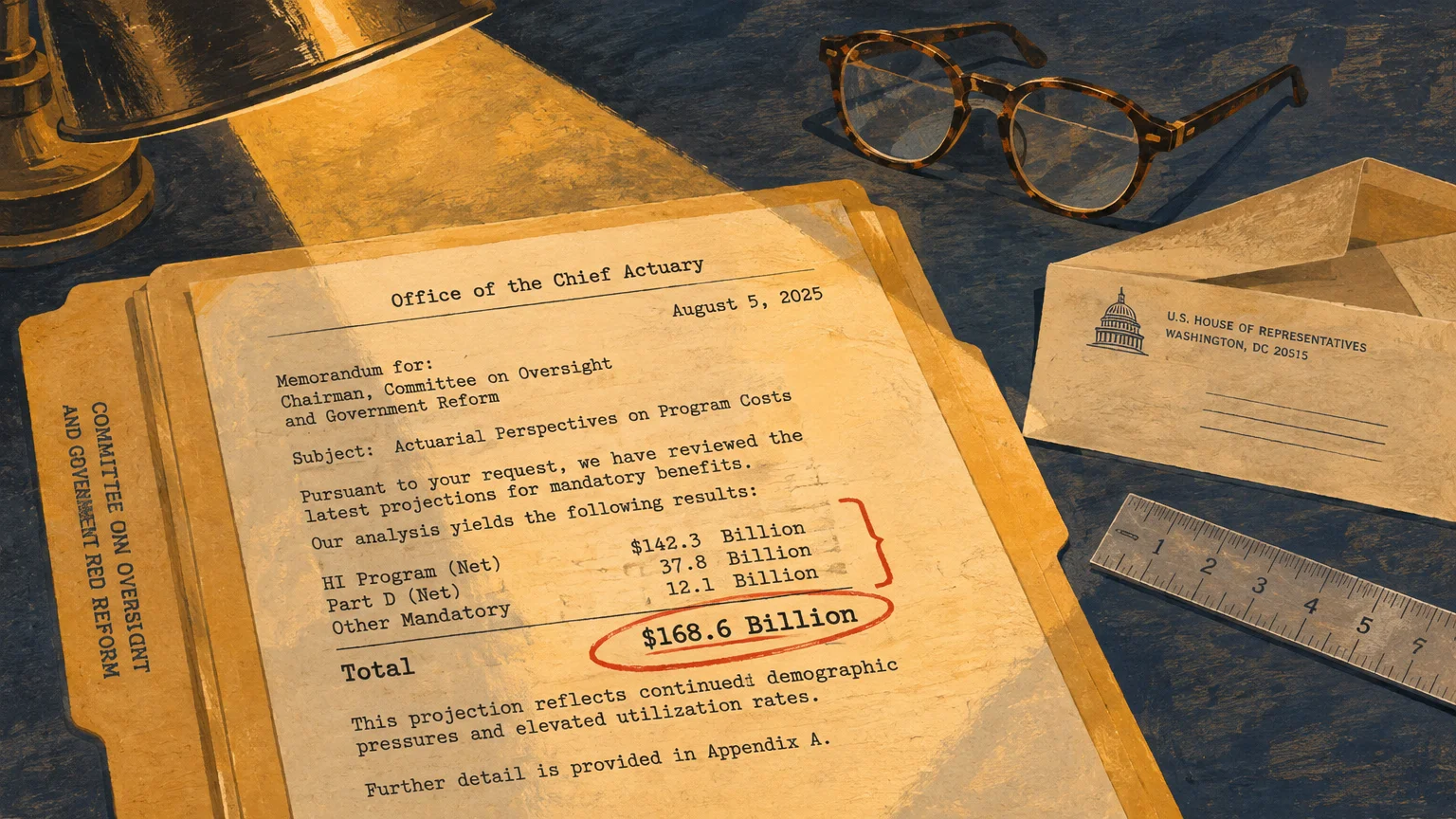
Despite those procedural guardrails, the legislation still hit Social Security’s ledger within weeks of enactment. On August 5, 2025, Social Security Administration Chief Actuary Karen P. Glenn sent a formal cost estimate to Sen. Ron Wyden and Rep. Steven Horsford.
According to the Social Security Administration Office of the Chief Actuary, the law adds $168.6 billion in net costs to the Social Security trust funds from 2025 through 2034. That figure represents the present value of lost revenue calculated as of January 1, 2025.
Independent fiscal analysts quickly translated that ten-year deficit into an annual cash flow problem. The Committee for a Responsible Federal Budget estimates that the law strips roughly $30 billion per year from Social Security trust fund revenue.
The long-range financial hit reaches far beyond the current ten-year budget window. In March 25, 2026 testimony before the Senate Budget Committee, Glenn reported that the law worsens Social Security’s 75-year actuarial balance by 0.16 percent of taxable payroll.
That seemingly small percentage translates into roughly $1.1 trillion in additional unfunded obligations over 75 years, or just under 0.1 percent of gross domestic product. For workers and retirees watching Congress, the lesson is straightforward.
Lawmakers do not need to pass a headline-grabbing Social Security reform bill to alter your retirement solvency. Any major income tax overhaul automatically changes how much money flows into the program’s reserves.
To be sure, economic growth projections remain a point of contention among federal scorekeepers. On September 2, 2025, Glenn sent a follow-up letter to Wyden and Horsford addressing estimates from the Congressional Budget Office and the Joint Committee on Taxation.
She noted that modest near-term economic growth projected by those two agencies could partially offset the trust fund loss if that growth materializes. However, Glenn emphasized that actuarial standards of practice barred her office from booking unconfirmed growth offsets in its official score.
When evaluating major tax legislation, you should always look past floor speeches and read the chief actuary’s letters. Those technical memos expose indirect fiscal shifts long before they show up in your annual benefit statement.

Players, Strategy, and the Messaging Battle
Reconciliation Rules and Congressional Maneuvering
Budget reconciliation gives the Senate majority a powerful procedural shortcut to pass tax and spending bills with a simple majority vote. Yet that tool comes with strict limits under the Byrd rule, which protects Social Security from direct legislative tampering during partisan budget votes.
By working through income tax deductions and permanent rate extensions instead of FICA formulas, congressional authors stayed inside reconciliation boundaries. That strategy allowed supporters to deliver tax relief without triggering a 60-vote point of order in the Senate.
Democratic lawmakers on the Senate Finance and House Ways and Means panels quickly targeted that indirect revenue link. By requesting formal actuarial reviews, Wyden and Horsford forced federal scorekeepers to put a precise dollar figure on the hidden trust fund cost.
Subsequent Senate Budget Committee hearings in March 2026 kept the focus on those long-term obligations. For voters tracking power shifts on Capitol Hill, those committee letters and hearings provide the clearest paper trail of legislative tradeoffs.
White House Claims vs. Independent Watchdogs
While actuaries tallied the trust fund deficit, administration economists framed the law as a historic tax victory for older Americans. The White House Council of Economic Advisers estimated that 88 percent of seniors receiving Social Security will pay no federal income tax on their benefits.
According to those White House figures, roughly 51.4 million beneficiaries now owe zero tax on benefits, up from 64 percent under prior law. Administration analysts also projected that 33.9 million seniors will receive an average tax cut of $670 in 2026.
Independent tax researchers pushed back sharply against how that data was presented to the public. Analysts at the Urban-Brookings Tax Policy Center and the Committee for a Responsible Federal Budget noted that the law never altered the statutory taxation of benefits.
Instead, the legislation expanded deductions across all forms of income, which shrinks total tax liability for eligible filers. Because the lowest-income seniors already owed zero federal income tax, they gain no extra cash from a larger deduction.
At the top of the income ladder, high-earning retirees lose the new senior deduction entirely due to phase-out thresholds. As a result, the Tax Policy Center estimated that fewer than half of older adults actually receive a tax cut from the provision.
The gap between those two narratives shows why you must scrutinize tax statistics carefully. One metric counts everyone who owes zero tax after the bill passes, while the other counts only the households whose tax bills actually drop.
Before adjusting your retirement withholdings, check your own prior-year tax return rather than relying on broad national percentages. If you already owed no federal income tax on your benefits, your net cash flow remains unchanged.
Policy Breakdown: The Hidden Pipeline Draining the Trust Funds
The 1983 and 1993 Tax Transfer Formula
Understanding why a general tax cut hurts Social Security requires looking back at bipartisan solvency deals enacted in 1983 and 1993. Those amendments created a direct funding pipeline connecting your federal Form 1040 to the nation’s retirement and health trust funds.
Under existing law documented by the Committee for a Responsible Federal Budget, up to 50 percent of your Social Security benefits become taxable once your combined income crosses $25,000 as a single filer. For married couples filing jointly, that first threshold begins at $32,000.
Every dollar of federal income tax collected from that initial 50 percent tier transfers straight into the Social Security trust funds. When Congress lowers income tax rates or raises deductions, those dedicated transfers shrink automatically.
A second tier kicks in at higher income levels under the 1993 budget law. Up to 85 percent of benefits face taxation once combined income exceeds $34,000 for single filers or $44,000 for joint filers.
Revenue generated by that additional 35 percent taxable tier flows directly into Medicare’s Hospital Insurance trust fund. Consequently, shrinking a senior’s overall income tax bill reduces incoming cash for both Social Security and Medicare at the same time.
Permanent Brackets and the New Senior Deduction
Two distinct pieces of Public Law 119-21 drive the $168.6 billion revenue drop identified by the chief actuary. First, the statute permanently extends the lower individual income tax rates and brackets originally enacted in the 2017 Tax Cuts and Jobs Act.
Second, for tax years 2025 through 2028, the law introduces a temporary enhanced deduction for seniors. According to Internal Revenue Service guidance in Publication 505, eligible taxpayers age 65 and older can deduct up to $6,000 per person.
Married couples filing jointly can claim up to $12,000 if both spouses are at least 65 years old. You claim this break on Schedule 1-A regardless of whether you take the standard deduction or itemize expenses.
Strict eligibility guardrails govern who qualifies for the temporary break. Claimants must hold a valid Social Security number and cannot file returns using the married filing separately status.
The deduction also phases out once modified adjusted gross income exceeds $75,000 for single filers or $150,000 for joint filers. The benefit drops completely to zero when modified adjusted gross income hits $175,000 for individuals or $250,000 for married couples.
Crucially, this temporary provision stacks directly on top of the existing additional standard deduction for taxpayers age 65 and older. According to Fidelity tax breakdowns, that baseline age-based add-on equals $2,050 for single filers and $3,300 for married couples.
If you fall near the phase-out zone, managing retirement account withdrawals can preserve more of this deduction through 2028. Spacing out Roth conversions or capital gains across tax years may prevent your income from crossing the $75,000 or $150,000 thresholds.
Why Tips and Overtime Rules Do Not Drain FICA
Alongside the senior break, the 2025 law enacted high-profile temporary deductions commonly marketed as no tax on tips and no tax on overtime. Those provisions sparked widespread confusion among workers wondering if tipped wages still build Social Security credits.
Payroll compliance rules and IRS guidance clarify that those deductions apply strictly to federal income taxes. Your tips and overtime earnings remain fully subject to federal FICA payroll taxes.
Workers and employers still pay 6.2 percent each—or 12.4 percent combined—for Social Security on covered earnings, alongside the 2.9 percent combined Medicare payroll tax. For 2026, that Social Security payroll tax applies to annual earnings up to $184,500.
According to tax schedule updates reported by TheStreet, that taxable wage cap rises to $192,300 in 2027. Because FICA taxes remain untouched on tips and overtime, your future Social Security benefit calculation continues counting those wages normally.
Check your pay stubs this year to ensure your employer withholds FICA accurately while reflecting income tax deductions properly. Verifying those lines early prevents surprise tax balances when you file next spring.

Constituent Impact: What the 2026 Trustees Report Means for Your Wallet
Winners and Sidelines Under the Senior Deduction
Across the country, the financial impact of the temporary senior deduction varies sharply by household income tier. Research from the Urban-Brookings Tax Policy Center shows that middle- to upper-middle-income retirees capture the largest share of the tax relief.
Seniors earning roughly $80,000 to $130,000 per year see the biggest payoff, averaging a tax cut of about $1,100. That relief boosts their after-tax income by roughly 1 percent through 2028.
By contrast, modest-income retirees who rely heavily on Social Security alone already owed zero federal income tax under prior law. For those households, the temporary deduction delivers no extra spending power while quietly accelerating trust fund depletion.
Meanwhile, affluent retirees with modified adjusted gross income above $175,000 single or $250,000 joint receive zero benefit from Schedule 1-A. Still, they retain lower marginal tax rates from the permanent extension of the 2017 rate brackets.
The 2032 Depletion Cliff and Potential Benefit Cuts
While temporary tax savings end in 2028, the trust fund solvency clock keeps ticking toward a hard statutory wall. On June 9, 2026, federal officials released the 2026 Social Security Trustees Report detailing the program’s updated timeline.
The Old-Age and Survivors Insurance trust fund, which pays retirement and survivor benefits, is now projected to deplete its reserves in the fourth quarter of 2032. That marks a shift of one calendar quarter earlier than the first-quarter 2033 date projected in 2025.
Some political commentators describe that change as moving the cliff forward by a full year from 2033 to 2032. While the calendar year changed, the actual shift measured just three months on the actuarial ledger.
When reserves hit zero in late 2032, federal law prevents Social Security from borrowing money or running a deficit. Incoming payroll and benefit-tax revenue would cover only 78 percent of scheduled benefits, triggering an automatic 22 percent across-the-board cut.
For the more than 71 million beneficiaries counted by AARP in June 2026, that shortfall carries severe household consequences. Late-2026 figures cited by FinanceBuzz place the average monthly benefit at roughly $2,170.
A 22 percent reduction on a $2,170 monthly check equals roughly $477 less per month, or about $5,730 lost every year. Estimates from the Committee for a Responsible Federal Budget place the average cut even higher, at roughly $500 per month.
If you are within ten years of retirement, stress-test your financial plan against a potential 22 percent benefit haircut starting in late 2032. Building a modest cash buffer or delaying retirement slightly can shield your essential living expenses if Congress stalls.
Comparing OASI, DI, Combined OASDI, and Medicare HI
Washington often discusses Social Security as a single giant pot of money, yet federal law separates retirement funds from disability funds. The Disability Insurance trust fund remains financially healthy and is projected to pay 100 percent of scheduled benefits through 2100.
If Congress passed legislation merging the retirement and disability funds, the combined OASDI reserves would last slightly longer. In her August 2025 letter, Glenn estimated that Public Law 119-21 alone would pull combined depletion from late 2034 into early 2034.
However, the June 2026 Trustees Report kept combined OASDI depletion at the third quarter of 2034, when 83 percent of scheduled benefits would remain payable. Stronger near-term productivity and wage growth helped offset the tax law’s drag and lower immigration over the short term.
Medicare faces its own parallel squeeze from the exact same benefit-tax pipeline. The 2026 Trustees Report projects that Medicare’s Hospital Insurance trust fund will deplete its reserves in the second quarter of 2033, one quarter earlier than estimated in 2025.
According to the Committee for a Responsible Federal Budget, the 2025 tax law increases Medicare’s 75-year shortfall by 0.09 percent of taxable payroll. When tracking congressional negotiations, watch whether lawmakers treat Social Security and Medicare insolvency together or separately.
Oversight, Ethics, and the July 2025 SSA Email Controversy
Beyond fiscal policy, the 2025 tax law triggered a sharp watchdog dispute over how federal agencies communicate with the public. On July 3, 2025—one day before the bill was signed—the Social Security Administration sent a mass email to beneficiaries.
According to reporting from WUSF and NPR, the agency email claimed the legislation eliminates federal income taxes on Social Security benefits for nearly 90 percent of beneficiaries. Watchdogs at the Tax Policy Center and the Committee for a Responsible Federal Budget immediately labeled that message misleading.
Because the underlying tax thresholds from 1983 and 1993 remained untouched, benefits are still calculated as taxable income on federal returns. Furthermore, the senior deduction expires after 2028, making any relief temporary rather than a permanent repeal.
Using an official benefits agency listserv to promote disputed legislative claims raises serious transparency questions for nonpartisan oversight. Citizens rely on agency alerts for accurate benefit rules, not simplified political talking points.
Examining the broader ledger from the 2026 Trustees Report underscores why plainspoken financial honesty matters. Between 2025 and 2026, Social Security’s 75-year actuarial deficit expanded from 3.82 percent of taxable payroll to 4.42 percent.
Over that same period, the program’s 75-year open-group unfunded obligation climbed from $25.1 trillion to $29.3 trillion. Measured against the broader economy, that long-term gap grew from 1.3 percent of GDP to 1.5 percent of GDP.
Annual cash deficits are already draining existing reserves every single month. In 2025, combined trust fund income totaled $1.45 trillion against $1.61 trillion in expenses, shrinking reserves by $160.2 billion to $2.56 trillion by year-end.
For 2026, trustees project total program costs of $1,697 billion against total income of $1,493 billion. Every year Congress postpones structural fixes, that annual gap forces larger tax hikes or steeper benefit adjustments later.
Actuarial breakdowns presented by Karen Glenn on October 27, 2026 also keep the 2025 tax law in proper perspective alongside demographic trends. Lowered ultimate fertility assumptions—reduced from 1.90 to 1.75 children per woman—worsened the 75-year shortfall by 0.35 percent of payroll.
Updated immigration assumptions ranked second among negative drivers, subtracting another 0.21 percent of taxable payroll. The One Big Beautiful Bill Act ranked third at minus 0.16 percent, partially offset by near-term economic gains of plus 0.10 percent and mortality updates of plus 0.09 percent.
Recognizing all three negative forces prevents partisan oversimplification of the solvency crisis. Demographics drive most of the long-term gap, yet the 2025 tax law measurably made a tough fiscal problem worse.
Frequently Asked Questions About OBBBA and Social Security
Did the One Big Beautiful Bill Act eliminate taxes on Social Security benefits?
No, Public Law 119-21 left the 1983 and 1993 benefit-taxation formulas completely intact under Senate reconciliation rules. Instead, it extended lower 2017 income tax brackets and created a temporary senior deduction that lowers overall tax bills for certain retirees.
Lower-income seniors already owed zero tax on benefits, while high-income filers phase out of the deduction completely. As a result, the Tax Policy Center found that fewer than half of older adults actually receive a tax cut from the senior provision.
Why did the combined OASDI depletion date stay in 2034 while OASI moved to 2032?
Federal law keeps the retirement fund and the disability fund legally separate, meaning retirement reserves cannot automatically draw on disability surpluses without an act of Congress. On its own, the retirement fund now faces reserve depletion in the fourth quarter of 2032.
On a combined hypothetical basis, stronger near-term productivity and wage growth in the 2026 Trustees Report offset short-term revenue losses from the tax law. That economic cushion kept the combined theoretical depletion date in the third quarter of 2034.
When does the temporary senior deduction expire, and how could that affect future Congresses?
Under current law, the enhanced senior deduction of up to $6,000 per person applies only to tax years 2025 through 2028. Unless Congress passes new legislation, the break vanishes right as the 2028 presidential and congressional elections conclude.
Extending the deduction past 2028 would deepen the revenue loss flowing into Social Security and Medicare even further. Letting it expire, however, would raise tax bills for middle-income seniors just four years before the 2032 depletion cliff.
Are tips and overtime exempt from Social Security payroll taxes?
No, the temporary deductions for tips and overtime apply solely to federal income taxes, not payroll taxes. Workers and employers still pay the combined 12.4 percent Social Security tax and 2.9 percent Medicare tax on tipped and overtime earnings.
Because those wages remain fully covered by FICA up to the annual taxable maximum, they still count toward your future Social Security benefit formula. You should review your W-2 and pay stubs each year to confirm accurate payroll reporting.
Outlook: The Legislative Milestones Ahead
Over the next six years, three scheduled fiscal milestones will force Congress to confront the consequences of its 2025 tax architecture. First, watch annual OASDI Trustees Reports each spring for signs of whether economic growth continues masking the revenue drain.
Second, track the 2028 expiration cliff for the temporary senior deduction on Schedule 1-A. Whoever controls Congress and the White House after the 2028 election will face immediate pressure to either extend that tax break or replace lost trust fund revenue.
Third, monitor whether lawmakers propose merging the OASI and DI trust funds before the fourth quarter of 2032. Reallocating payroll tax shares buys roughly two extra years of solvency—pushing the cliff toward 2034—without solving the underlying 75-year deficit.
In the meantime, keep your personal retirement strategy grounded in verifiable numbers rather than agency headlines or campaign flyers. Check your annual earnings record, maximize tax-advantaged savings where eligible, and plan for a realistic margin of safety before 2032 arrives.