
In January 2027, Social Security benefits rise by 3.6%—yet your actual net gain depends heavily on your pension. If you draw both a Social Security check and a government or private annuity, colliding federal rules will reshape your household budget.
Recent laws eliminated harsh public-pension penalties and added a temporary senior tax deduction, while state COLA caps and rising Medicare costs pull in the opposite direction. Tracking how each formula interacts protects your monthly cash flow before automatic deductions hit your account.
A Triple Policy Shift Hits Dual-Income Retirees
On October 14, 2026, the Social Security Administration (SSA) announced a 3.6% cost-of-living adjustment (COLA) for 2027. That bump exceeds the 2.8% increase in 2026 and the 2.5% adjustment in 2025.
For retirees collecting both Social Security and a pension, however, that headline rate tells less than half the story. Two major pieces of federal legislation enacted in 2025 have permanently altered the baseline of your combined retirement income.
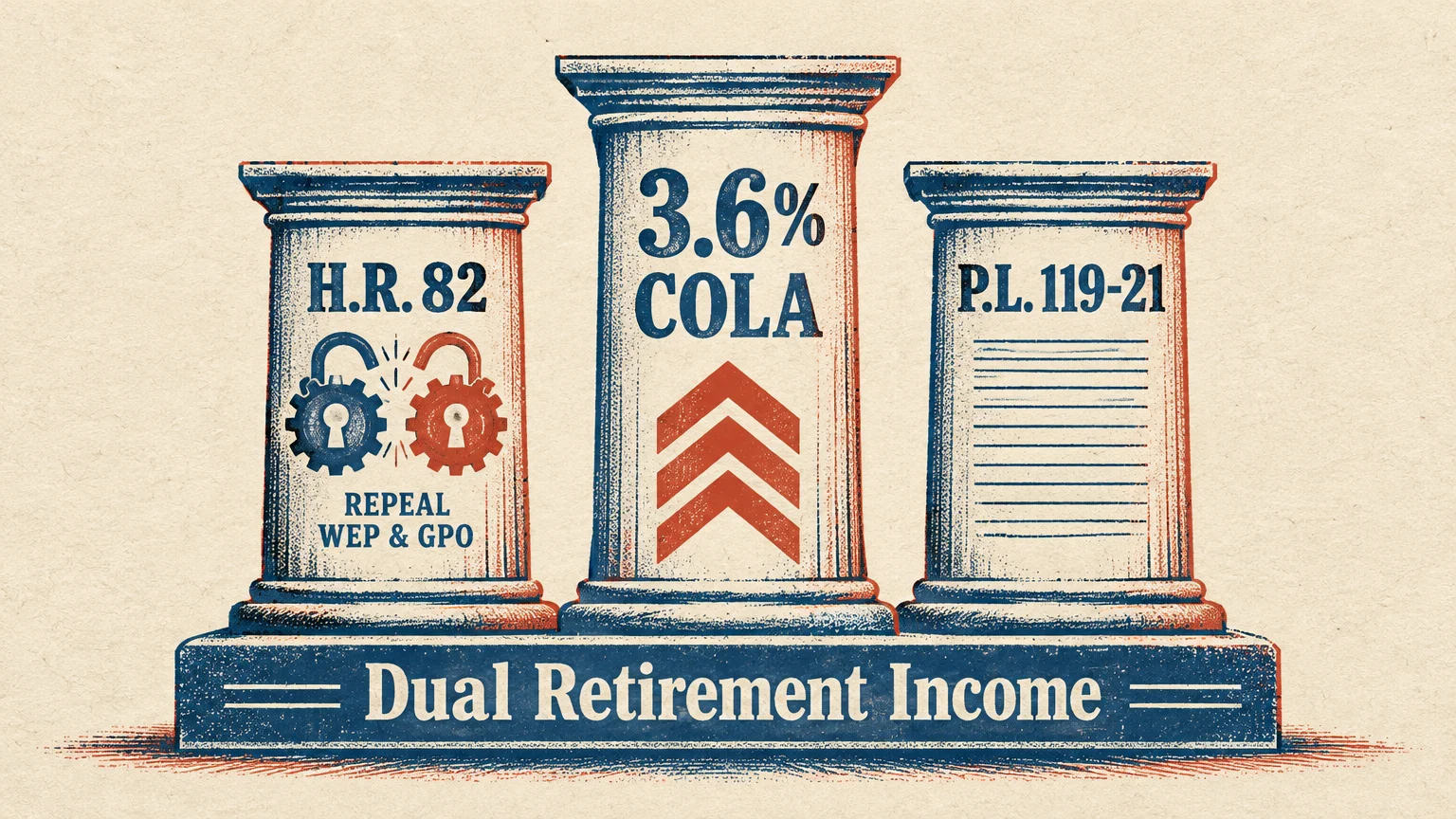
First, the Social Security Fairness Act (H.R. 82), signed into law on January 5, 2025, eliminated the Windfall Elimination Provision (WEP) and the Government Pension Offset (GPO). Millions of teachers, firefighters, police officers, and federal civil servants now collect the 2027 COLA on full, unreduced Social Security bases.
Second, the One Big Beautiful Bill Act (P.L. 119-21), signed on July 4, 2025, reshaped senior tax liability through 2028 without altering how Social Security benefits are counted as taxable income. You face a higher gross check, shifting Medicare deductions, and an unindexed federal tax threshold.
Power Dynamics Behind the 2027 Retirement Ledger
The convergence of these policies reflects years of legislative pressure from public-sector labor unions, retiree coalitions, and congressional tax writers. For decades, lawmakers debated whether repealing WEP and GPO rewarded double-dipping or corrected an unfair penalty against modest public workers.
Passing H.R. 82 broke a decades-long deadlock, but it carried a substantial fiscal price tag. The Congressional Budget Office (CBO) projected that repealing both offsets increases direct federal spending by $198 billion from fiscal year 2024 through 2034.
Budget watchdogs and fiscal policy analysts quickly flagged the downstream effects on program solvency. According to the 2026 Social Security Trustees Report, the Old-Age and Survivors Insurance (OASI) Trust Fund reserves will now deplete in the fourth quarter of 2032.
That timeline arrived one quarter earlier than the Trustees projected in 2025. Analysts at the Bipartisan Policy Center and the Trustees point to lower fertility and immigration assumptions alongside two legislative drivers: the WEP and GPO repeal and lower tax revenue from the 2025 tax law.
Meanwhile, state treasurers and federal budget managers continue enforcing strict limits on pension-side COLAs. Whenever inflation tops 3%, federal law automatically trims the inflation adjustment for newer civil service retirees, shifting more purchasing-power weight onto Social Security.
Breaking Down the 2027 Rules Across Every Income Stream
How the 3.6% Social Security Increase Works
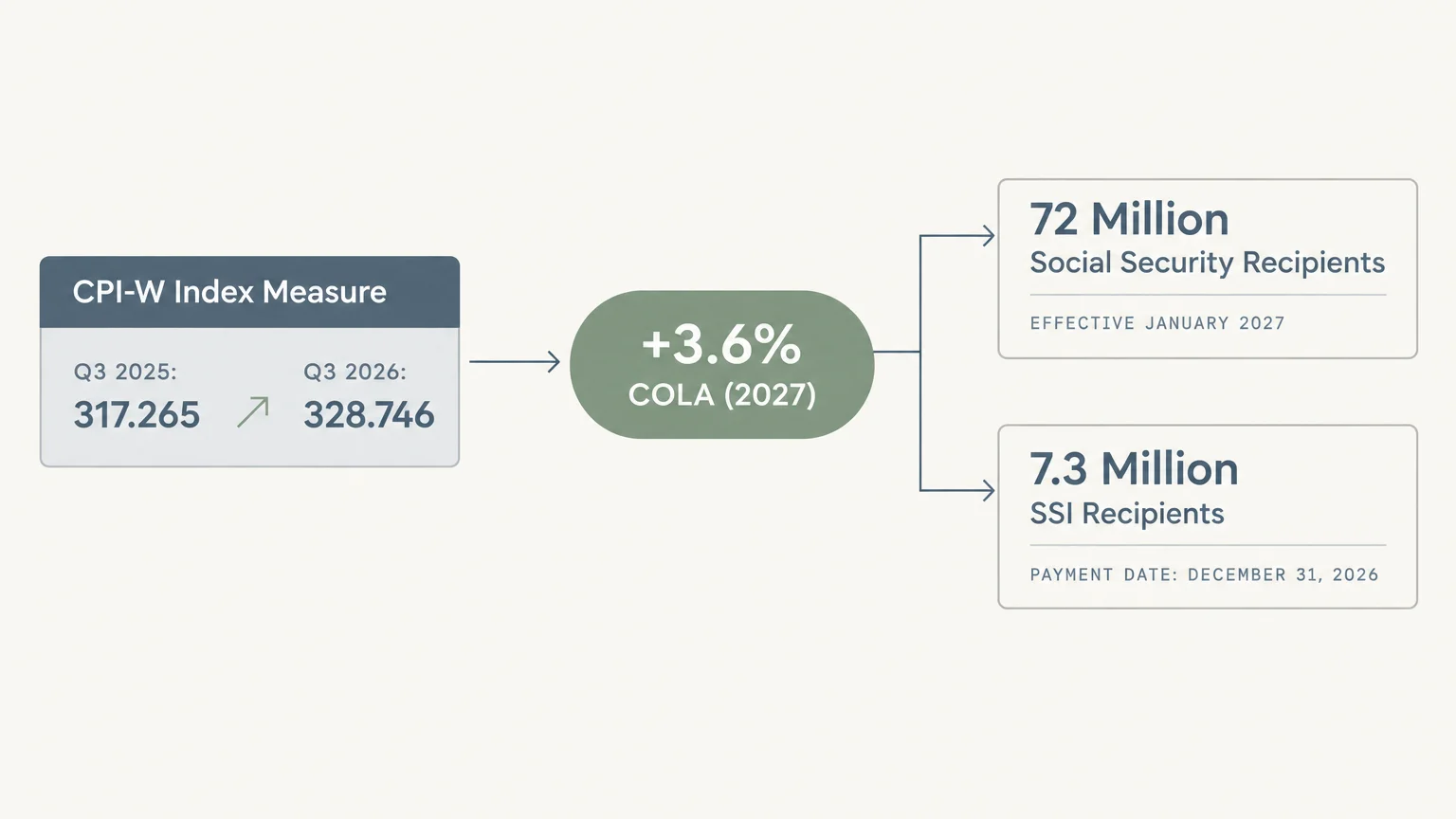
By statute, SSA calculates the annual adjustment using the Bureau of Labor Statistics Consumer Price Index for Urban Wage Earners and Clerical Workers (CPI-W). Between the third quarter of 2025 and the third quarter of 2026, that index climbed from 317.265 to 328.746.
That 3.6% rise applies to nearly 72 million Social Security beneficiaries beginning in January 2027. Roughly 7.3 million Supplemental Security Income (SSI) recipients see their higher payments arrive slightly earlier on December 31, 2026, bringing the total reach to about 76 million Americans.
For the average retired worker, SSA estimates the monthly benefit grows by about $75, moving from $2,095 to $2,170. If you claimed at full retirement age and earn the maximum benefit, your monthly cap rises from $4,152 in 2026 to $4,188 in 2027.
If you create a personal account on SSA’s online portal by November 18, 2026, you can view your personalized 2027 notice later this month. Paper notices go out in the mail throughout December 2026.
Working retirees under full retirement age also gain a little more breathing room before benefits face temporary withholding. In 2027, the annual earnings limit increases from $24,480 to $25,560, withholding $1 for every $2 earned above that ceiling.
In the calendar year you reach full retirement age, the higher earnings threshold climbs from $65,160 to $67,920, with $1 withheld per $3 over the cap. Once you reach full retirement age, no earnings limit applies, while the payroll tax wage base rises from $184,500 to $192,300.
What WEP and GPO Repeal Means for Your Base
Before H.R. 82 took effect, retirees who earned a pension from government work not covered by Social Security payroll taxes saw their Social Security benefits slashed. WEP cut a worker’s own earned retirement check, while GPO reduced spousal or survivor benefits by two-thirds of the government pension.
The Social Security Fairness Act eliminated both reductions retroactively for benefits payable after December 2023. Because your 2027 3.6% COLA multiplies against your restored base benefit rather than a penalized figure, your annual dollar increase grows noticeably larger.
SSA moved aggressively to clear the backlog of recalculated claims in 2025. On July 7, 2025, the agency announced it had completed over 3.1 million payments totaling $17 billion in retroactive benefits for roughly 2.8 million existing beneficiaries, five months ahead of schedule.
SSA also received over 278,000 new claims. Earlier CBO projections estimated average monthly boosts by December 2025 of $360 for WEP-affected workers, $700 for GPO-affected spouses, and $1,190 for surviving spouses.
Even so, most public workers never fell under those penalties in the first place. SSA notes that roughly 72% of state and local government employees work in jobs already covered by Social Security payroll taxes.
Why Pension COLAs Trail Behind in 2027
Unlike Social Security, your pension rarely mirrors the CPI-W index dollar for dollar. Whether your pension check keeps pace in 2027 depends entirely on which system pays your annuity.
For federal civilian retirees, the Office of Personnel Management (OPM) sets 2027 annuity adjustments effective December 1, 2026, reflected in January 4, 2027 payments. Annuities that began after December 31, 2025, receive prorated adjustments based on months on the rolls.
Retirees under the legacy Civil Service Retirement System (CSRS) and related plans receive the full 3.6% increase. By contrast, retirees under the modern Federal Employees Retirement System (FERS) receive only 2.6%.
That one-point gap stems from federal statute governing FERS COLAs whenever inflation exceeds 3%. Furthermore, standard FERS retirees do not receive any annual pension COLA until age 62, aside from disability, survivor, and special-provision categories.
State and local pension plans operate under an even wider patchwork of rules. According to the National Association of State Retirement Administrators (NASRA), roughly three-fourths of state and local public plans grant some form of automatic COLA, while others require legislative votes or funding triggers.
Many automatic state adjustments apply caps that blunt inflation spikes. In New York, for instance, the teachers’ retirement system caps annual COLAs between 1% and 3% and applies that rate only to the first $18,000 of the pension, yielding a 1.7% increase—at most $25.50 per month—starting in September 2026.
Private-sector defined-benefit pensions offer the weakest inflation defense of all. Most corporate plans pay fixed monthly amounts with zero COLA, and annuities managed by the federal Pension Benefit Guaranty Corporation (PBGC) are not indexed for inflation.
NASRA calculates that a fixed pension with no COLA loses one-third of its purchasing power over 20 years at just 2.0% annual inflation. Under actual consumer price inflation from 2006 through 2025, a frozen pension retained only 59% of its original buying power.
Medicare Deductions and Federal Tax Thresholds
Every January, automatic Medicare Part B deductions chip away at your Social Security raise before the deposit clears your bank. As of mid-November 2026, the Centers for Medicare & Medicaid Services (CMS) has not yet published final 2027 Part B rates.
In 2026, the standard Part B premium stands at $202.90 per month alongside a $283 annual deductible. The 2026 Medicare Trustees Report projects the 2027 standard Part B premium will climb to $209.50 per month—a $6.60, or roughly 3.3%, hike—with a $292 deductible.
If that projection holds, rising Part B premiums will absorb $6.60 of an average $75 Social Security increase, leaving roughly $68.40 per month before taxes. Federal hold-harmless rules stop Part B hikes from shrinking a beneficiary’s net Social Security payment below the prior year’s amount.
However, the Medicare Trustees note that about 30% of Part B enrollees lack hold-harmless protection. That excluded group includes high-income retirees paying Income-Related Monthly Adjustment Amounts (IRMAA), new enrollees, dual Medicaid beneficiaries, and pensioners whose Part B premiums are not deducted from Social Security.
Prescription drug rules also shift noticeably on January 1, 2027. Under CMS benchmarks, the Part D annual out-of-pocket spending cap rises from $2,100 to $2,400, while the maximum standard deductible climbs from $615 to $700.
CMS projects average stand-alone Part D premiums to edge up from $35.09 to $36 per month as a temporary stabilization program expires, while average Medicare Advantage drug premiums drop from $11.32 to $7 per month. Negotiated prices for 15 Part D medications also take effect on January 1, 2027.
Taxes present the final squeeze on combined checks. Under Internal Revenue Code Section 86, the Internal Revenue Service (IRS) taxes Social Security based on provisional income: adjusted gross income excluding Social Security, plus tax-exempt interest, plus half of your Social Security benefits.
Up to 50% of benefits become taxable once provisional income exceeds $25,000 for single filers or $32,000 for joint filers. Up to 85% becomes taxable above $34,000 single or $44,000 joint, and Congress has never indexed these thresholds for inflation.
Contrary to campaign slogans surrounding P.L. 119-21, the July 2025 tax law did not abolish taxes on Social Security or raise Section 86 brackets. Instead, for tax years 2025 through 2028, it created a temporary $6,000 deduction per taxpayer age 65 or older—$12,000 for eligible couples.
You can claim that bonus deduction whether you itemize or take the standard deduction, on top of the existing age-65 standard deduction. Yet it phases out by 6% of modified adjusted gross income above $75,000 single or $150,000 joint, vanishing completely at $175,000 and $250,000, and married-separate filers get nothing.
How Different Dual-Income Retirees Fare in 2027
Federal Retirees Under FERS Versus CSRS
A retired federal employee under FERS feels the 2027 divergence immediately. Because inflation topped 3%, your FERS annuity increases by 2.6% in January 2027 while your Social Security check grows by the full 3.6%.
If you retired under FERS before age 62 and have not yet reached your 62nd birthday, your pension receives 0% in 2027 unless you qualify under disability, survivor, or special-provision rules. Meanwhile, your higher combined income easily pushes provisional income past $34,000 single or $44,000 joint.
A legacy CSRS retiree experiences a dramatically different trajectory, especially after WEP and GPO repeal. If you earned enough covered quarters outside government work—or collect a spousal benefit—your Social Security base is no longer cut, and both your CSRS pension and Social Security rise 3.6%.
Watch your Medicare billing closely if you receive a CSRS pension with only a small restored Social Security benefit. If your Social Security payment is too small to cover the Part B deduction and you pay CMS directly or through OPM, the hold-harmless shield does not protect you.
State and Local Teachers, Firefighters, and Police
For retired public safety workers and teachers in non-covered states, 2027 brings another COLA cycle free of WEP and GPO reductions. If you saw a $360 to $1,190 monthly boost during the 2025 recalculations, your 3.6% increase in 2027 applies to that entire restored amount.
That jump creates an unfamiliar tax problem for many retired educators and municipal workers. A modest state pension paired with a newly restored Social Security spousal or survivor check can quickly push household income over the $32,000 or $44,000 joint provisional limits.
Because your state pension administrator withholds taxes based only on your annuity—and Social Security withholds nothing automatically—you could face an unexpected tax bill next April. You can prevent a surprise by submitting IRS Form W-4V to Social Security to withhold 7%, 10%, 12%, or 22%.
Before adjusting withholding, check whether the temporary $6,000 per-person senior deduction offsets your higher taxable Social Security share. If your modified adjusted gross income stays below $75,000 single or $150,000 joint, that extra deduction shields substantial pension and benefit income through 2028.
Private-Sector Pensioners and Frozen Annuities
If you retired from manufacturing, banking, or a unionized private employer, your pension probably pays the exact same dollar figure it did five or ten years ago. Every year without a pension COLA shifts more of your real living standard onto Social Security.
In 2027, your Social Security check rises 3.6% while your private pension stays flat at 0%. Suppose your pension and Social Security each start at $2,000 per month: your combined gross income rises by only 1.8%, or half the headline inflation rate.
Even worse, rising Medicare Part B and Part D costs take a larger bite out of your flat corporate check’s real value. If your Part B premium rises $6.60 and your Part D deductible jumps from $615 to $700, a smaller share of your Social Security COLA remains for groceries and utilities.

Oversight Gaps and Unfinished Fiscal Promises
Watching how federal and state agencies administer these overlapping checks reveals serious policy blind spots. First, keeping Section 86 tax thresholds frozen acts as an automatic, unvoted tax hike on middle-class dual-income retirees.
Every annual COLA pushes more pensioners across the $25,000 and $32,000 provisional lines simply because those numbers never rise with inflation. Lawmakers chose a temporary four-year deduction expiring after 2028 rather than fixing the underlying Section 86 formula.
Second, the late release of official Medicare Part B rates creates real budgeting friction. As of mid-November 2026, retirees still await final CMS confirmation while SSA prepares to post 2027 benefit notices online, forcing households to estimate net deposits using Trustees projections.
Third, the 2026 Social Security Trustees Report exposes an approaching cliff that directly threatens pensioners who rely heavily on Social Security to offset flat corporate or capped state annuities. Without congressional action before late 2032, incoming payroll taxes will cover only 78% of scheduled benefits.
An across-the-board 22% benefit cut in Q4 2032 would erase years of COLA gains and hit FERS and private-sector retirees hardest. Meanwhile, the widening 75-year actuarial shortfall—now 4.42% of taxable payroll, up from 3.82%—leaves Congress narrower room for painless fixes.
Frequently Asked Questions
When will I see my exact 2027 net Social Security deposit?
SSA posts personalized 2027 COLA notices in late November 2026 for beneficiaries who hold a personal online account created by November 18, 2026, and mails paper letters throughout December. Your first higher Social Security payment arrives in January 2027, while SSI payments start December 31, 2026.
Why is my FERS federal pension COLA only 2.6% when Social Security is 3.6%?
Federal law reduces the FERS COLA by one full percentage point whenever CPI-W inflation exceeds 3%, creating a 2.6% adjustment for 2027 compared to 3.6% for CSRS and Social Security. OPM pays that adjustment on January 4, 2027, though most FERS retirees under age 62 receive no COLA at all.
Did the 2025 tax law stop the IRS from taxing my Social Security and pension together?
No; P.L. 119-21 left IRS Section 86 rules intact, meaning up to 85% of your Social Security can still count as taxable income once your pension pushes provisional income over $34,000 single or $44,000 joint. Instead, it added a temporary $6,000 deduction per spouse age 65 or older for 2025 through 2028.
Could I still receive retroactive money from the WEP and GPO repeal?
SSA finished paying $17 billion in retroactive adjustments to roughly 2.8 million existing beneficiaries in July 2025, ahead of its original schedule. However, if you never applied for spousal or survivor benefits because GPO previously wiped out your payout, you can still file a new claim with SSA.
What to Monitor Heading Into 2027
Your first immediate deadline falls on November 18, 2026, if you want early online access to your 2027 Social Security benefit statement. Watch for CMS’s official announcement of the 2027 Medicare Part B premium and deductible to confirm whether the projected $209.50 monthly charge holds.
In December, compare your OPM or state pension statement against your Social Security notice and run a fresh provisional-income check before January tax withholding takes effect. If restored WEP or GPO benefits raised your annual total, file IRS Form W-4V early so quarterly estimates or April balances do not catch you off guard.
Over the longer horizon, track two looming legislative deadlines that will define dual-income retirement security. Congress must decide whether to extend the temporary $6,000 senior deduction before it expires after 2028, and lawmakers face intensifying pressure to close the Social Security shortfall before OASI reserves run dry in late 2032.