Players and Strategy: Who Shapes the 2027 Retirement Market
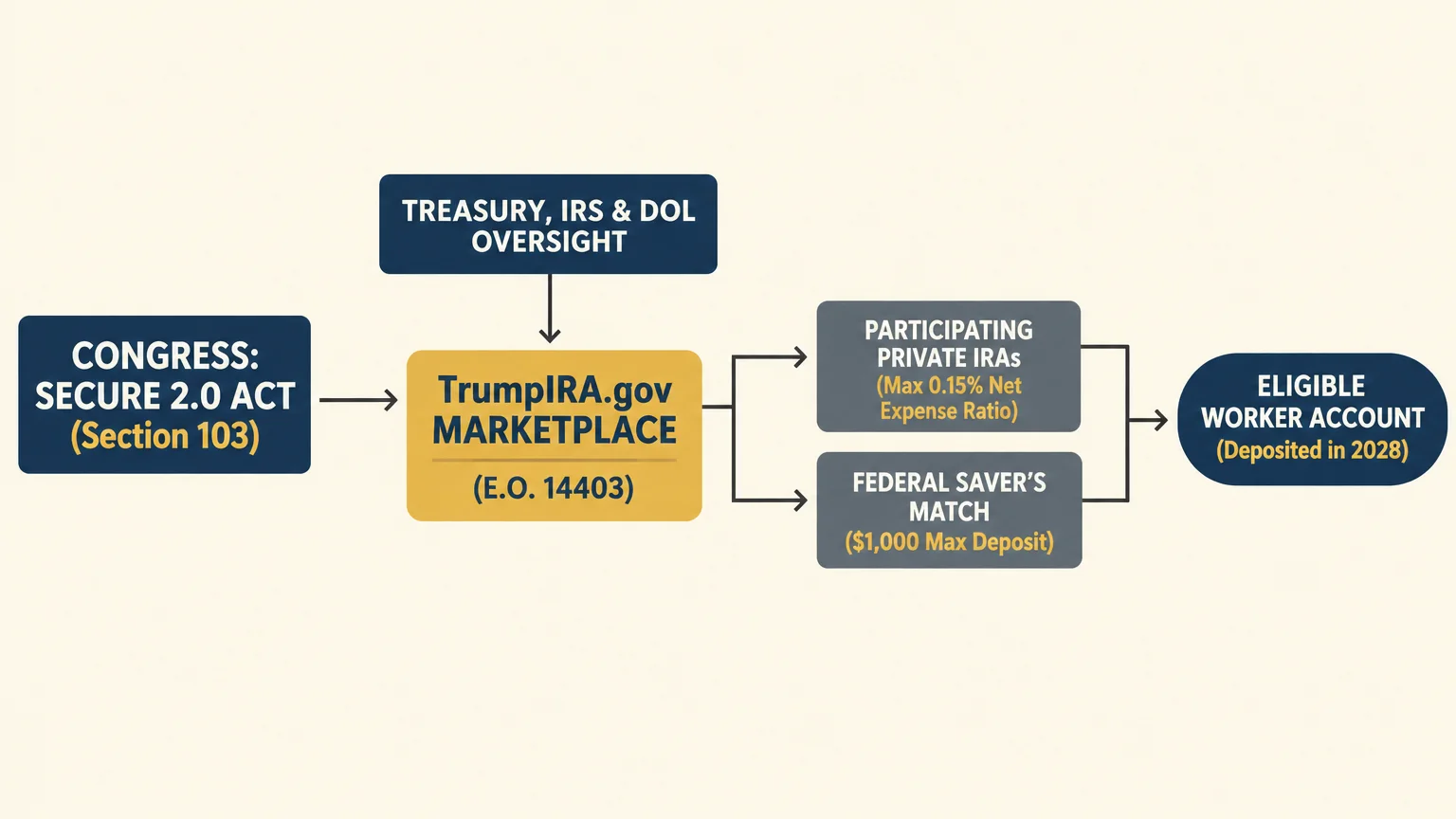
The rollout of TrumpIRA.gov illustrates how executive branding can reshape the public perception of bipartisan legislation. By attaching the presidential name to a federal comparison portal, the White House positions itself at the center of retirement policy.
Executive Order 14403 goes beyond building a website by instructing Treasury to draft legislative proposals that codify the TrumpIRA.gov framework. Codifying the portal in statute would lock in its design and prevent a future administration from dismantling it easily.
For private asset managers and financial custodians, the 0.15 percent expense cap creates both margin pressure and a lucrative customer funnel. Firms willing to absorb low fees gain direct visibility before millions of unbanked or uncovered savers.
Treasury’s requirement for index-based funds, target-date options, and principal-protection products favors large, diversified brokerages with high-volume infrastructure. Smaller providers that rely on high advisory fees or account minimums cannot meet the entry criteria.
Meanwhile, congressional Democrats have moved to reclaim credit for the match and expand its reach before the 2027 start date. On September 28, 2026, Sen. Ron Wyden of Oregon introduced the Saver’s Match Enhancement Act of 2026, numbered S. 5507.
Wyden’s bill proposes doubling the maximum annual federal match from $1,000 to $2,000 per eligible worker. It would also raise the income phase-out ranges to between $42,500 and $57,500 for single filers and between $85,000 and $115,000 for joint filers.
As of November 2026, S. 5507 remains pending in Congress without final passage. Even without new legislation, the bill signals an active partisan debate over whether the original 2022 income caps exclude too many working families.
Employers and workplace plan administrators form another critical pressure point in this ecosystem. Under federal rules, companies sponsoring 401(k), 403(b), or governmental 457(b) plans are not required to accept Federal Saver’s Match deposits.
Plan sponsors that decline to upgrade their payroll and recordkeeping systems push participating employees to maintain separate IRAs for matching funds. Your employer’s administrative choices directly affect how seamlessly you collect your federal bonus.
Philanthropic networks and community foundations could also enter the retirement market through a lesser-known clause in Executive Order 14403. The order directs Treasury and the IRS to clarify the tax treatment of charitable contributions made to IRAs for eligible workers.
If regulators establish clear, favorable rules, nonprofits or civic programs could seed retirement accounts for low-wage workers alongside the federal match. Until guidance arrives, however, charitable IRA funding remains an unresolved policy lever.
Policy Breakdown: How the $1,000 Federal Saver’s Match Works
Starting January 1, 2027, the Federal Saver’s Match replaces the older Saver’s Credit for contributions to retirement plans and IRAs. Contributions to ABLE accounts for individuals with disabilities remain eligible for the Saver’s Credit on Form 8880.
This shift fixes a major flaw in the previous credit, which was nonrefundable and only reduced federal income taxes owed. Because low-income workers often owe zero federal income tax, many received no benefit under the old rules.
Under the new structure, the federal government matches up to 50 percent of the first $2,000 you contribute each year. That formula yields a maximum match of $1,000 per person annually, or $2,000 combined for married couples filing jointly.
There is no minimum contribution required to qualify for a match. Even if you only manage to set aside $100 during 2027, the federal formula still calculates a matching payment based on your income bracket.
Timing matters when you plan your household cash flow for 2027. Although your contributions during calendar year 2027 earn the match, you claim the benefit on a new Internal Revenue Service Form 8880-A when filing 2027 returns in 2028.
Consequently, Treasury will not deposit the first round of Saver’s Match funds into retirement accounts until 2028. Treat the match as a delayed deposit rather than an instant paycheck boost.
Your Modified Adjusted Gross Income, or MAGI, determines whether you receive the full 50 percent match or a reduced share. For 2027, single filers and married individuals filing separately receive the full match at a MAGI of $20,500 or less.
For those same single and separate filers, the match phases out gradually between $20,501 and $35,499. Once your MAGI hits $35,500 or higher, your matching rate drops to zero.
Head of household filers receive the full 50 percent rate at a MAGI of $30,750 or less. Their benefit phases out between $30,751 and $53,249, disappearing completely at $53,250 and above.
Married couples filing jointly qualify for the full 50 percent match at a combined MAGI of $41,000 or less. Their phase-out window runs from $41,001 to $70,999, with eligibility ending at $71,000.
These statutory income thresholds remain fixed for the 2027 tax year. Starting in 2028, federal regulators will adjust the MAGI brackets annually for inflation.
Beyond income limits, you must satisfy four personal eligibility criteria to collect the match. You must be at least 18 years old by the end of the tax year, with no upper age cutoff.
You cannot be a full-time student as defined under Internal Revenue Code Section 152(f)(2), nor can another taxpayer claim you as a dependent. You must also be a U.S. resident for tax purposes, meaning nonresident aliens generally do not qualify.
Where you put your own savings offers wide flexibility, as contributions to Traditional IRAs, Roth IRAs, 401(k)s, 403(b)s, and governmental 457(b) plans all count. Under IRS Notice 2026-66, the 2027 annual IRA contribution limit stays at $7,500, plus a $1,100 catch-up for savers age 50 and older.
Meanwhile, the 2027 elective deferral limit for 401(k), 403(b), 457(b), and federal Thrift Savings Plan accounts rises to $25,500. Workers age 50 and older can add an $8,500 catch-up contribution, while savers ages 60 through 63 qualify for an $11,750 catch-up.
However, a strict statutory rule governs where the federal matching money lands. Under Internal Revenue Code Section 6433, Treasury must deposit the match into a non-Roth, pre-tax account such as a Traditional IRA or a consenting pre-tax workplace plan.
That pre-tax rule creates a hurdle if you exclusively save in a Roth IRA or your employer’s plan declines matching deposits. To solve this friction, Treasury and the IRS released Notice 2026-48 on August 7, 2026, proposing a workaround.
Notice 2026-48 suggests allowing Roth savers to route matching funds through a pass-through conduit Traditional IRA, followed by a taxable conversion into a Roth account. Formal regulations and Form 8880-A remain unpublished as of November 2026, so monitor IRS updates before converting funds.
If your calculated match comes out to less than $100, the law gives you a simpler choice. You can elect to receive that smaller match as a refundable tax credit directly on your return rather than routing it into a retirement account.
You also face strict penalties if you treat the matching account like a short-term emergency fund. While matching deposits are untaxed when they enter your account, withdrawals in retirement are taxed as ordinary income.
Withdrawing Saver’s Match funds before age 59 and a half can trigger both the standard 10 percent early withdrawal penalty under Section 72(t) and a separate Saver’s Match recovery tax under Section 6433(f)(6). In addition, taking retirement distributions before or during the contribution year can reduce your match-eligible contribution total.