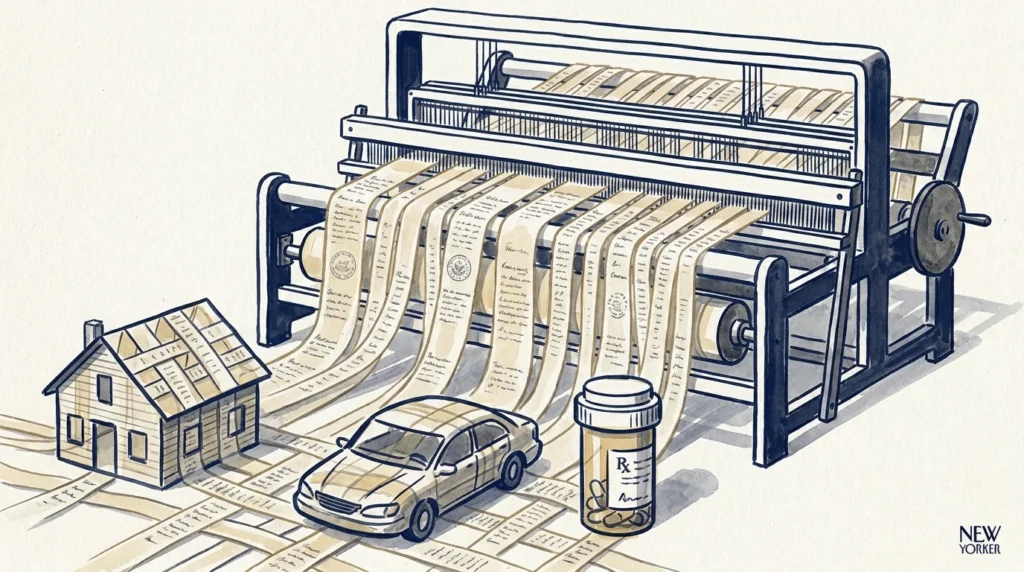
New AARP research warns that structural changes in the American economy have accelerated the Social Security funding crisis. Those shifts have shaved 25 years off the life of the program’s trust fund.
As wages concentrated at the top and shifted into untaxed investment returns, the system lost $10.8 trillion in potential payroll revenue. That missing cash leaves lawmakers with far less time to prevent automatic benefit cuts.
With retirement reserves now projected to run dry in late 2032, your financial security hinges on what happens next in Washington. Here is how the math broke down and what you should watch.
The November Warning That Redrew the Math
On November 10, 2026, the AARP Public Policy Institute released a study by researcher Richard W. Johnson examining decades of national income data. The findings challenge a common political talking point that demographic aging alone drives the Social Security shortfall.
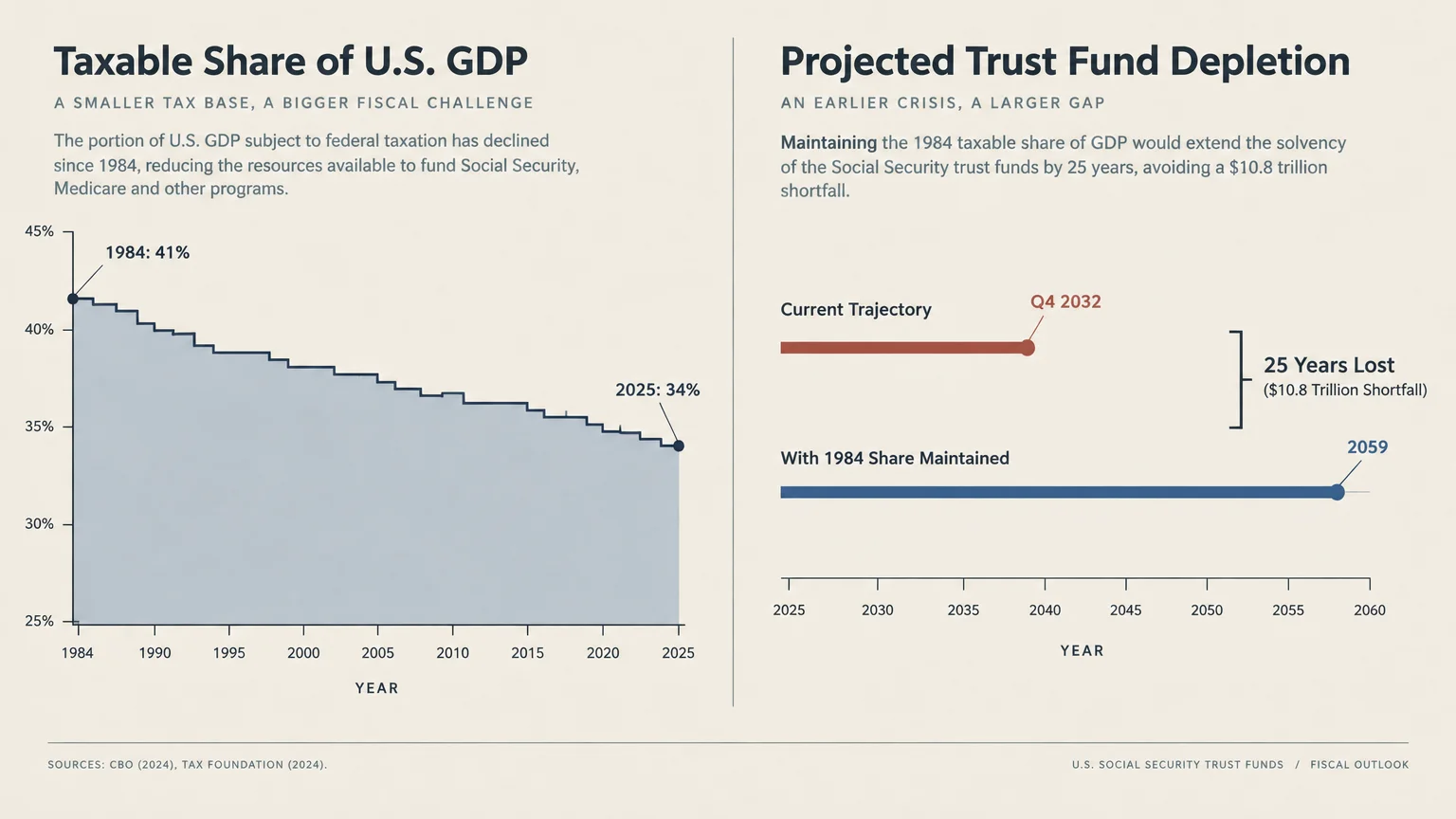
Using figures from the Social Security Administration and the Bureau of Economic Analysis, the report tracks how much of the U.S. economy actually funds retirement checks. In 1984, Social Security payroll taxes applied to 41% of gross domestic product.
By 2025, that taxable share had fallen to 34%, and analysts expect it to hover near that level for decades. That drop in the taxable economy represents an enormous stream of lost revenue.
Had payroll-taxable earnings stayed at 41% of gross domestic product between 1984 and 2034, Social Security would have collected $10.8 trillion more. That additional money would have funded full scheduled benefits until 2059.
Instead, the system faces a far tighter deadline. Reserves in the main retirement fund are now on track to run out in the fourth quarter of 2032.
AARP followed the study with a November 11, 2026 press release aimed squarely at newly elected and returning members of Congress. The timing immediately turned an actuarial report into an opening salvo for the next legislative session.
For decades, Washington leaders could treat Social Security reform as a distant problem for future lawmakers. The November data shows how slow economic drift quietly pulled the cliff much closer to your retirement window.
Every year Congress delays a funding fix narrows the menu of painless options. You cannot understand the coming congressional battles without looking at both the shrinking tax base and the political forces defending it.
Who Holds Leverage in Washington Right Now
Social Security policy never moves purely on spreadsheet projections. Power in Washington shifts when organized voter blocs collide with entrenched tax coalitions and fiscal watchdogs.
On one side sits AARP, backed by massive post-midterm voter sentiment. According to AARP polling released on November 11, 2026, 80% of all voters want Congress to protect Social Security from benefit cuts.
Among older voters, that demand climbs to 90%. Few domestic issues command that level of cross-party consensus after a contentious midterm cycle.
Yet strong support for protecting checks coexists with deep public skepticism. A June 2025 AARP survey found that 64% of U.S. adults felt not very or not at all confident in Social Security’s future.
When 64% of Americans doubt the system will deliver, lawmakers face rising pressure to prove they have a workable plan. Voters punish politicians who propose cuts, yet they also distrust leaders who ignore the looming deficit.
Meanwhile, independent fiscal groups shape the boundaries of acceptable policy options on Capitol Hill. Research from the Committee for a Responsible Federal Budget and the Brookings Institution regularly informs congressional committee hearings and budget scoring.
These organizations track how different tax increases or benefit adjustments affect long-term solvency and federal debt. Their competing estimates give lawmakers ammunition when drafting rival stabilization bills.
Post-Midterm Voter Pressure Meets Capitol Hill
Lawmakers returning to Washington after the 2026 midterms face a sharp gap between campaign promises and fiscal reality. Candidates across both parties routinely pledge never to touch benefits while also resisting broad tax hikes.
That political gridlock explains why recent congressional action actually widened the deficit rather than closing it. Congress passed major bills in 2025 that cut incoming tax revenue and expanded payouts without adding new payroll funding.
You can track how those legislative priorities play out by watching which committees hold hearings early next year. Tax-writing panels in the House and Senate control whether payroll cap changes ever reach the floor for a vote.
Lobbyists representing high-income earners and business pass-through entities fiercely guard the current limits on payroll taxation. Any proposal to tax investment income or lift the wage cap triggers immediate resistance from corporate trade groups.
At the same time, senior advocacy groups mobilize millions of constituents whenever retirement age hikes enter the conversation. That stalemate leaves lawmakers searching for revenue formulas that protect low- and middle-income workers while surviving floor votes.
How Economic Shifts Shrink the Payroll Tax Base
To grasp why the Social Security trust fund lost 25 years of solvency, you have to look at how Americans earn money. Social Security relies almost entirely on taxes levied on wages up to an annual cap.
Employees pay 6.2% of their eligible wages, and employers match that 6.2% contribution. Self-employed workers pay the combined 12.4% rate.
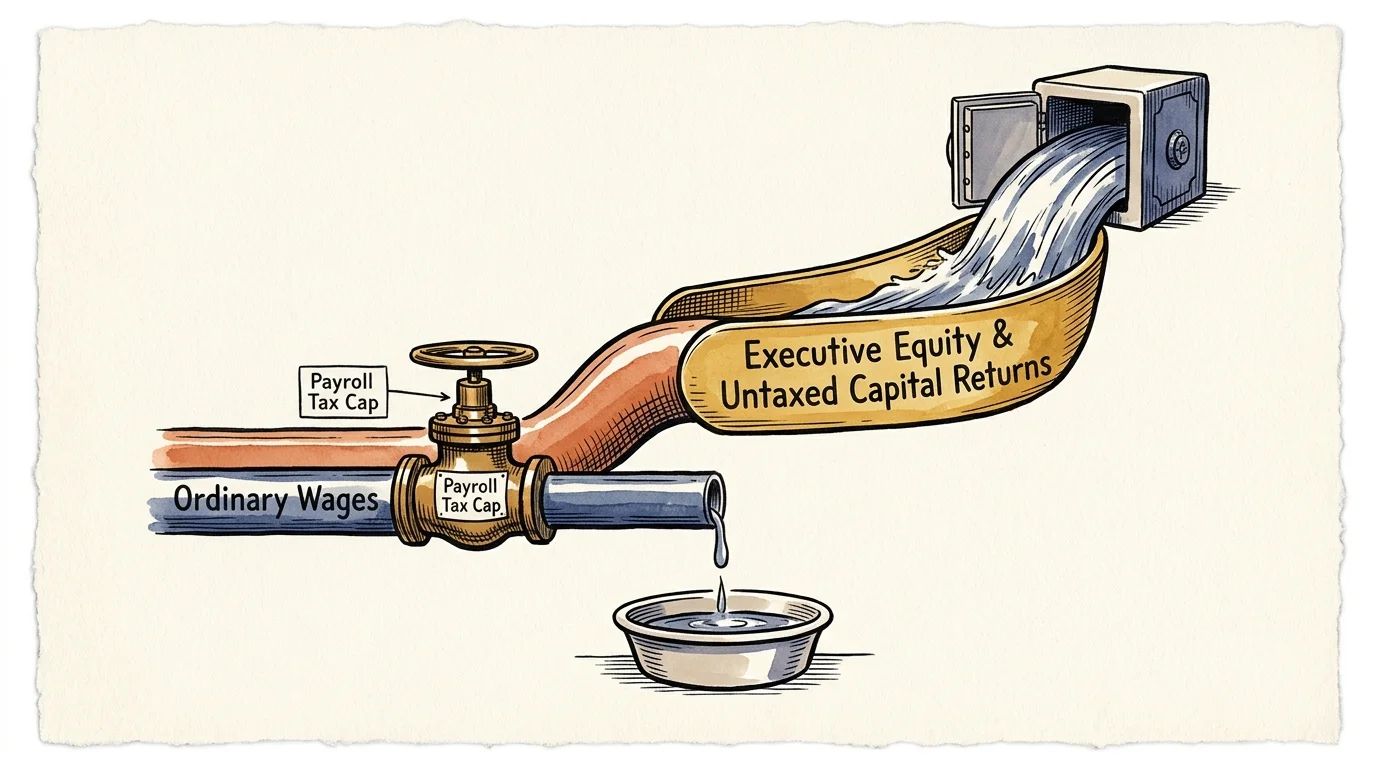
In 2026, those payroll taxes apply only to the first $184,500 a worker earns. That ceiling caps the maximum annual employee contribution at $11,439.
For 2027, the taxable maximum rises to $192,300, bringing the maximum employee tax to $11,922.60. Every dollar you earn above that threshold escapes Social Security payroll taxation completely.
Decades ago, that wage cap captured almost all covered earnings across the country. In 1983, roughly 90% of all covered wages fell below the taxable ceiling.
Since then, compensation for top executives and high-earning professionals has climbed far faster than average wages. Because the annual cap rises only with average wage growth, an expanding slice of top salaries now sits above the limit.
Research cited by the Bipartisan Policy Center and AARP shows that the cap now covers only about 83% of covered earnings. A growing share of national payroll slipped out of reach purely through rising wage inequality.
A second economic shift compounds that problem. A growing share of U.S. national income now flows into non-wage channels that Social Security never touches.
Corporate profits, investment returns, and pass-through business income are completely exempt from the 12.4% payroll tax. As capital income outpaced traditional paychecks over decades, Social Security’s funding base shrank relative to the overall economy.
You may work every week and pay payroll taxes on every single dollar you earn. Meanwhile, high-net-worth households generating income from stocks or business equity contribute nothing toward the program on those gains.
The Mechanics of Automatic Benefit Cuts
Many voters assume Congress can simply run a deficit to keep retirement checks whole if reserves run out. Federal statute explicitly blocks that option.
Under the Social Security Act, the program has no borrowing authority. It cannot pay benefits exceeding its remaining trust fund balances and incoming tax revenue.
When reserves hit zero, benefit reductions happen automatically by operation of law. No congressional vote is required to trigger a cut, though Congress must pass legislation to stop one.
The 2026 Social Security Trustees Report, released on June 9, 2026, moved the depletion date closer. Analysts now project the Old-Age and Survivors Insurance Trust Fund will exhaust its reserves in the fourth quarter of 2032.
That timeline sits one quarter earlier than the Trustees estimated in 2025. On September 17, 2026, the Congressional Budget Office confirmed that the retirement fund will run dry in fiscal year 2032.
Once the retirement trust fund empties in 2032, ongoing tax revenue will cover only 78% of scheduled benefits. That leaves retirees facing an immediate 22% across-the-board cut.
Technically, Social Security operates two separate accounts: the retirement fund and the Disability Insurance Trust Fund. The Disability Insurance fund remains completely solvent and is projected to pay 100% of scheduled benefits through at least 2100.
If Congress passed a law formally merging both funds, combined reserves would last until the third quarter of 2034, or fiscal year 2034 under budget office estimates. After combined depletion, incoming revenue would pay 83% of benefits, creating a 17% cut.
Even with a temporary fund merger, lawmakers would only buy a brief window of extra breathing room. Merging accounts redistributes existing reserves without adding a single dollar of new Social Security funding.
What Raising or Eliminating the Wage Cap Would Do
Because rising top earnings drove much of the shortfall, lifting the taxable wage cap sits at the center of Democratic and advocacy proposals. AARP research reported by CNBC measures exactly how much revenue that move would generate.
Eliminating the payroll tax cap completely, without increasing future benefits for top earners, would close 67% of Social Security’s 75-year shortfall. Other nonpartisan scorekeepers estimate a somewhat smaller impact.
The Committee for a Responsible Federal Budget estimates that eliminating the cap closes roughly half of the long-term gap. The Brookings Institution places the reduction at roughly three-fifths before accounting for economic feedback effects.
Even under the most optimistic scoring, taxing all wages above $192,300 does not fix the entire 75-year deficit on its own. Lawmakers would still need to address the remaining shortfall.
That math explains why policy experts also debate taxing non-wage income streams or pairing cap changes with modest tax rate adjustments. Understanding those trade-offs helps you spot empty promises during campaign season.
Whenever a politician claims a single tweak solves Social Security forever, check the numbers against independent 75-year projections. Real solvency requires closing a massive structural gap.
What the Shortfall Means for Your Household Budget
National budget figures feel abstract until you translate them into household cash flow. Right now, Social Security anchors the retirement security of tens of millions of families.
About 185 million workers paid Social Security payroll taxes in 2025. Those contributions supported 70 million beneficiaries by December 2025, rising to nearly 72 million by late 2026.
When you include Supplemental Security Income recipients, the agency serves roughly 76 million Americans. For a huge share of older adults, that monthly deposit is not supplemental spending money.
According to AARP data cited by Fortune, Social Security provides the majority of total income for 43% of seniors. Losing 22% of that income overnight would force millions of retirees out of their homes or into severe debt.
Calculations from the Committee for a Responsible Federal Budget show the real-world cost of an unaddressed 22% benefit cut in 2033. A typical newly retired dual-income couple would lose roughly $16,900 per year.
Higher-income dual earners would see annual benefits drop by roughly $22,300. Even a low-income dual-earner couple would forfeit about $10,200 every year, wiping out essential grocery and healthcare margins.
In the short term, checks are still rising to keep pace with living costs. On October 14, 2026, the Social Security Administration announced a 3.6% cost-of-living adjustment taking effect in January 2027.
That 2027 adjustment adds roughly $75 per month to the average retired worker’s check. Meanwhile, the maximum monthly benefit at full retirement age climbs from $4,152 in 2026 to $4,188 in 2027.
While that annual boost helps you absorb higher utility bills and insurance premiums today, it also increases total program outlays. Every inflation adjustment raises the baseline dollar figure that future payroll taxes must cover.
You can protect your household by stress-testing your retirement plan against a potential 17% to 22% reduction after 2032. Building extra personal savings or delaying retirement creates a private buffer against congressional inaction.
Why Fewer Workers Support More Retirees
Economic shifts did not happen in a vacuum; they collided directly with major demographic trends. Social Security works as a pay-as-you-go system where current workers fund current retirees.
In 1960, roughly 5.1 workers paid payroll taxes for every single beneficiary collecting checks. That broad base kept tax rates relatively low while the program expanded.
Today, that ratio has dropped to roughly 2.7 to 2.9 workers per beneficiary. By the 2070s, the ratio is projected to fall further to 2.2 workers per beneficiary.
The 2026 Trustees Report also revised key population assumptions downward. Trustees lowered their ultimate fertility forecast from 1.90 to 1.75 children per woman and projected lower net immigration.
Fewer births and slower immigration mean fewer future paychecks entering the payroll tax pipeline over the coming decades. As the workforce grows more slowly, each worker carries a heavier fiscal load to sustain scheduled benefits.
Legislative Trade-Offs and Trust Fund Transparency
Watchdog oversight requires looking closely at how Congress manages Social Security’s cash reserves right now. The program stopped running annual cash surpluses years ago.
Social Security outlays have exceeded non-interest tax revenue every year since 2010. Since 2021, costs have outpaced total program income even after counting interest earned on trust fund securities.
In 2025, the system collected $1,449 billion in total income. Payroll taxes supplied $1,323 billion, income taxes on benefits added $58 billion, and interest on Treasury reserves contributed $69 billion.
During that same year, Social Security spent $1,609 billion, with $1,597 billion going directly to benefits and $7 billion to administrative costs. Another $6 billion went to the Railroad Retirement financial interchange.
That gap created a $160 billion cash-flow deficit in 2025, pulling combined trust fund reserves down to $2,561 billion. For 2026, Trustees project costs of $1.697 trillion against $1.493 trillion in total income.
Over the full 75-year window from 2026 through 2100, the actuarial deficit jumped 16% in a single year. The shortfall climbed from 3.82% of taxable payroll in the 2025 report to 4.42% in 2026.
The Congressional Budget Office places that 75-year deficit even higher at 4.57% of taxable payroll, or 1.56% of gross domestic product. In present-value terms, the open-group unfunded obligation reached $29.3 trillion, up from $25.1 trillion a year earlier.
Recent legislation accounts for a noticeable share of that worsening ledger. Lawmakers delivered popular tax relief and benefit expansions in 2025 without identifying new revenue to offset the trust fund losses.
On January 5, 2025, Congress enacted the Social Security Fairness Act, repealing the Windfall Elimination Provision and the Government Pension Offset. Those rules previously reduced Social Security checks for roughly 2.8 million initially identified public-sector retirees with non-covered pensions.
By July 2025, the agency had completed over 3.1 million retroactive and adjusted payments totaling more than $17 billion. While public servants welcomed the repeal, higher benefit outlays directly sped up the retirement fund’s depletion date.
Six months later, on July 4, 2025, the One Big Beautiful Bill Act became law. It permanently extended 2017’s lower income tax rates and larger standard deduction while adding a temporary $6,000 senior deduction for people 65 and older.
Lower income tax liabilities for retirees reduce the income taxes collected on Social Security benefits. Because those benefit taxes flow straight back into the trust funds, the tax cut silently drained future Social Security revenue.
From a transparency standpoint, voters rarely hear how tax bills passed outside Social Security committees affect trust fund solvency. Tracking these secondary fiscal impacts helps you hold lawmakers accountable when they claim they are protecting the program.
Frequently Asked Questions About Social Security’s Future
When will Social Security actually run out of money?
Social Security will not run completely out of money, because workers will keep paying payroll taxes into the system every payday. However, the main retirement trust fund is projected to exhaust its backup cash reserves in late 2032.
Once those reserves hit zero, incoming tax revenue will still fund 78% of scheduled retirement and survivor benefits. Only the remaining 22% gap faces automatic cuts unless Congress acts before then.
Can Congress borrow money to prevent a 2032 cut?
Under current law, Social Security has no borrowing authority and cannot spend beyond its incoming tax revenue and remaining trust fund balance. The Treasury cannot simply issue new debt to cover the gap without an act of Congress.
To prevent cuts through borrowing or general fund transfers, lawmakers would have to pass new legislation changing the Social Security Act. That vote would also increase the broader federal budget deficit.
Will your 2027 benefits still go up despite the deficit?
Yes, trust fund shortfalls do not halt annual inflation adjustments while reserves still hold cash. Your monthly check will rise by 3.6% starting in January 2027, adding roughly $75 per month for the average retired worker.
Because the maximum retirement benefit at full retirement age increases to $4,188 per month in 2027, total program outlays will continue rising. Automatic reductions only apply once the trust fund actually reaches zero.
Does Disability Insurance face the same 2032 deadline?
No, the Disability Insurance Trust Fund operates under a separate legal ledger with healthier long-term cash flows. According to the 2026 Trustees Report, disability reserves can pay 100% of scheduled benefits through at least 2100.
Congress could pass a bill merging the retirement and disability trust funds to delay cuts until 2034. Doing so would pull resources away from disability reserves without solving the underlying shortfall.
Key Milestones to Watch in 2027 and Beyond
The next several months will show whether Washington treats AARP’s warning as a catalyst for negotiation or another talking point. Watch the opening weeks of the new Congress in January 2027 for committee assignments and bipartisan working groups.
If tax-writing committees refuse to schedule hearings on payroll cap reform or general revenue options, the 2032 deadline becomes significantly harder to meet smoothly. You should also review your annual Social Security statement online after the 3.6% adjustment takes effect in January.
Higher earners should prepare for the payroll tax cap rising to $192,300 in 2027, raising maximum employee contributions to $11,922.60. Also watch the 2027 Trustees Report to see if recent tax cuts pull the depletion date closer.
Across the country, 80% of voters expect Congress to defend Social Security without slashing earned checks. Staying informed on how economic shifts and legislative trade-offs shape the trust fund gives you the facts needed to hold your representatives accountable.