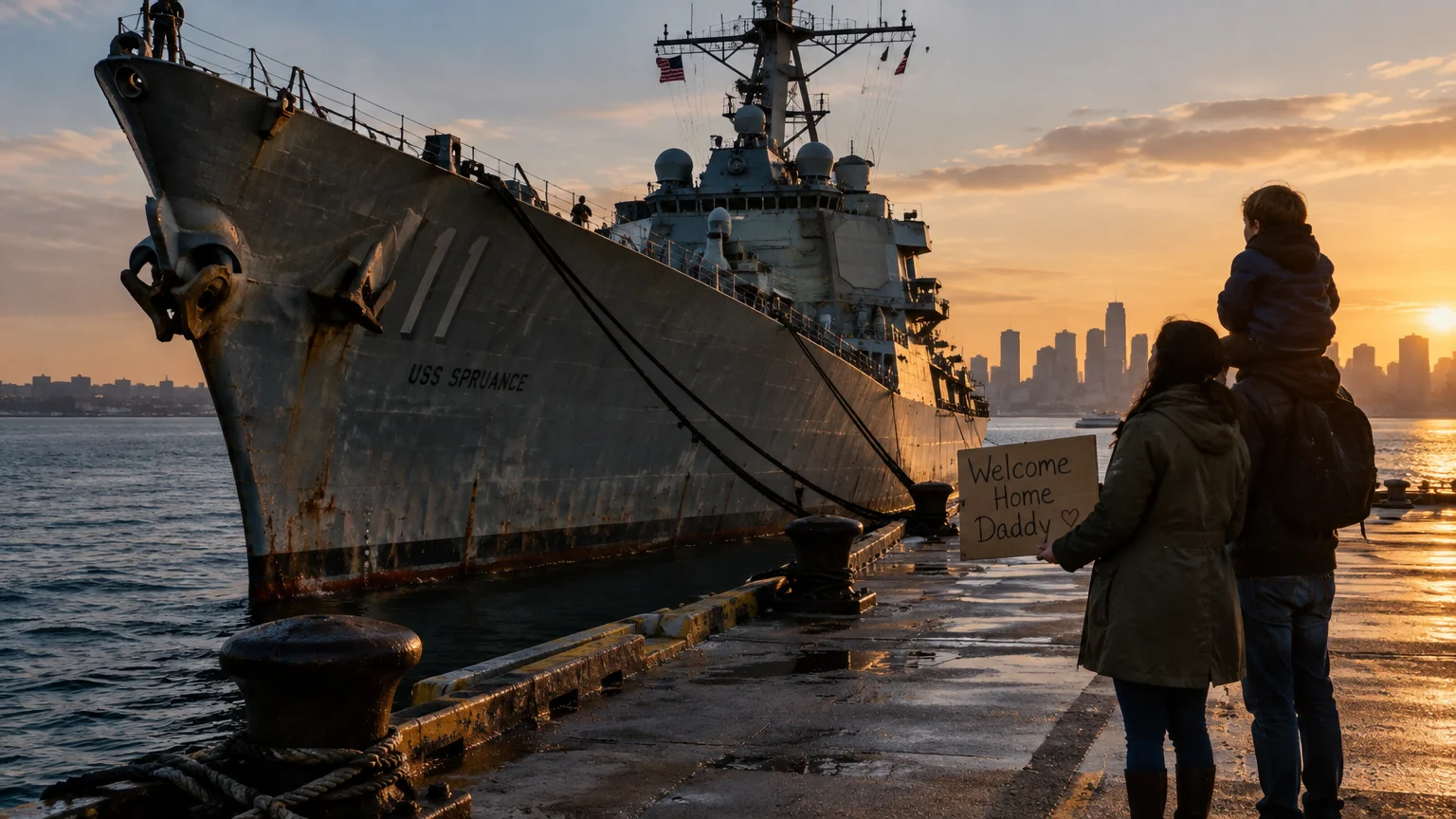
On November 13, 2026, the guided-missile destroyer USS Spruance returned to San Diego after a record 357-day deployment. That same day, Iran’s embassy in South Africa posted photos of two ship commanders on X alongside a chilling threat.
The diplomatic account named Cmdr. Leigh R. Tate and Lt. Cmdr. Jeffrey E. York, warning that Tehran would find them. That direct targeting pulls active-duty naval leaders into an expanding political and security confrontation.
Tracing how Washington and Tehran reached this flashpoint shows you where executive power, military readiness, and domestic safety protocols are shifting next.
Flashpoint Lead: A Historic Homecoming Meets a Direct Threat
Families gathered at Naval Base San Diego on Friday, November 13, 2026, to welcome home more than 300 sailors aboard the Arleigh Burke-class destroyer USS Spruance. The warship originally departed on November 21, 2025, for a planned seven-month cruise.
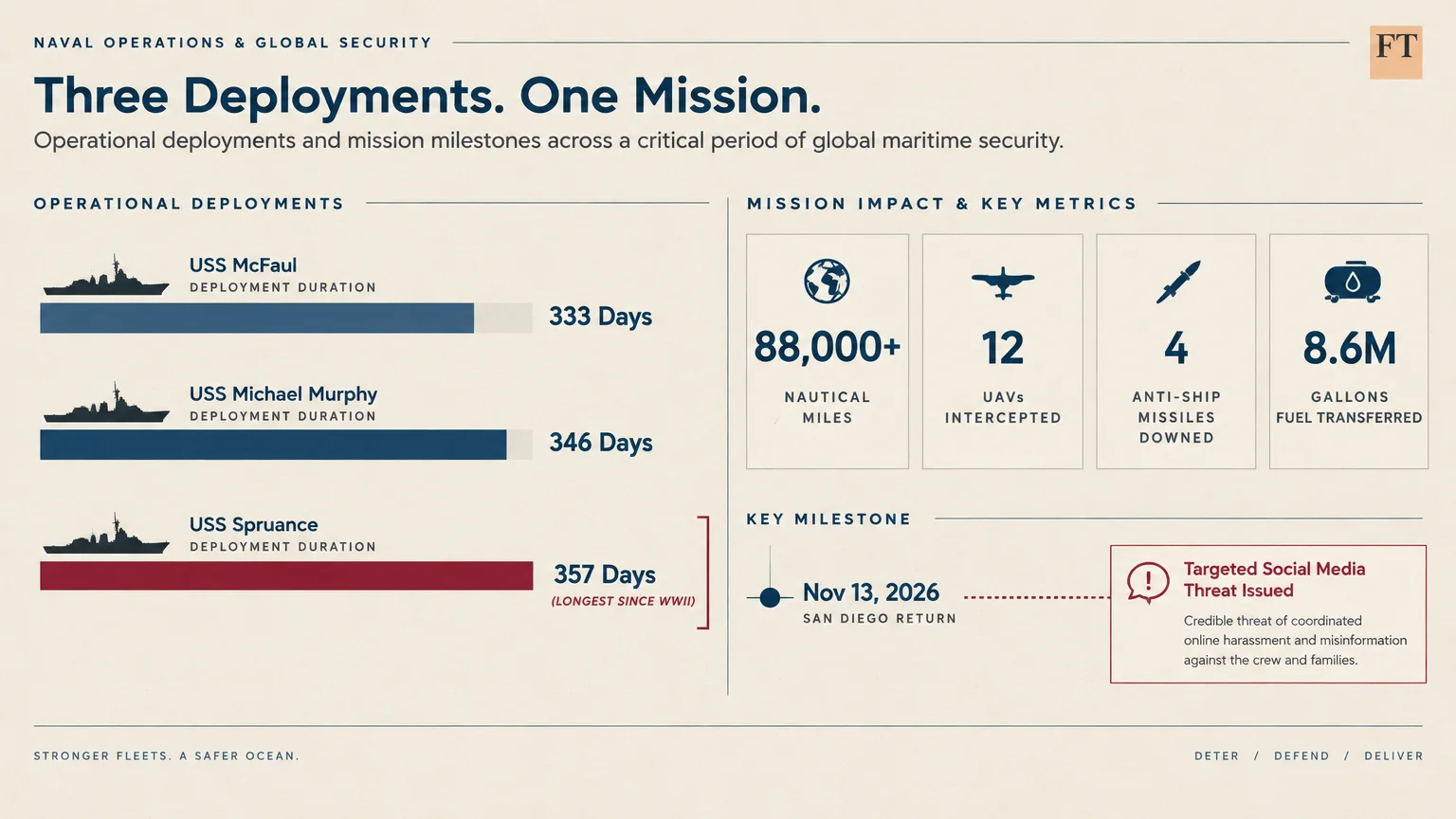
Instead, escalating regional combat stretched that mission to 357 days across the U.S. 3rd, 7th, and 5th Fleets. According to the U.S. Navy, that grueling timeline marked the longest deployment for an American destroyer since World War II.
You can see the intense operational pace across the surface fleet in back-to-back deployment records this fall. Spruance surpassed the 333-day run set by USS McFaul on October 27 and the 346-day voyage of USS Michael Murphy, which returned November 12.
While sailors stepped onto the California pier, the Iranian Embassy in South Africa used its X account, @IraninSA, to target Cmdr. Tate and Lt. Cmdr. York. Its post paired photographs of both officers with a blunt warning: “We will find you.”
The U.S. Navy’s November 13 homecoming announcement independently confirmed Cmdr. Tate as the ship’s commanding officer, while York serves as executive officer. Yet this was not the first time Tehran’s Pretoria mission singled out the two naval leaders online.
On March 28, 2026, the same embassy account called Tate and York “criminals” and asked, “Don’t they have children of their own?” That earlier post accused both officers of ordering three Tomahawk missile launches against an elementary school in Minab, Iran.
Timing the renewed threat to match Spruance’s public homecoming reveals a deliberate psychological strategy. Foreign adversaries now monitor routine military announcements to personalize hostilities against individual commanders rather than abstract institutions.
Spruance sailed as part of the USS Abraham Lincoln Carrier Strike Group before joining sustained combat under Operation Epic Fury, which the United States and Israel launched on February 28, 2026. Over the ensuing months, the destroyer steamed more than 88,000 nautical miles.
Between February and August 2026, the warship launched dozens of Tomahawk Land-Attack Cruise Missiles against Iranian military targets. Its crew also shot down 12 unmanned aerial vehicles and four anti-ship cruise missiles.
Operating near the Strait of Hormuz as Surface Action Group Commander, Spruance enforced maritime blockade compliance across 15 vessels. Its embarked HSM-71 helicopter detachment flew over 190 sorties, logging more than 1,150 flight hours.
The crew completed 43 underway replenishments that transferred 8.6 million gallons of fuel at sea, earning the Presidential Unit Citation and Combat Action Ribbon. You can monitor fleet homecoming announcements and unit citations directly on the U.S. Navy official portal.
Players and Strategy: Mapping Executive Defense and Iranian Pressure
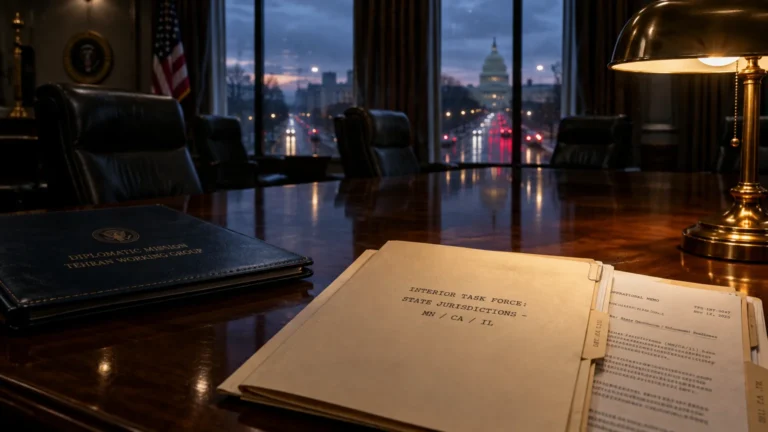
The threat against Cmdr. Tate and Lt. Cmdr. York did not emerge in isolation; it landed amid extraordinary security shifts inside Washington. Senior Trump administration officials have spent recent weeks relocating from private residences onto protected military bases.
On October 23, 2026, Director of National Intelligence Jay Clayton sent an unclassified memo to Secretary of State Marco Rubio, copied to CIA Director John Ratcliffe. Clayton warned that Iran had “substantially increased” efforts to target American personnel.
That intelligence assessment stated that lethal Iranian plots against U.S. citizens had reached “advanced stages” both in the Middle East and in other countries. Washington immediately began pulling vulnerable diplomatic staff out of regional posts.
Following Clayton’s warning and Houthi attacks, the State Department ordered non-emergency staff and families to depart Saudi Arabia. The department also reduced diplomatic staffing across the United Arab Emirates, Lebanon, Qatar, and Jordan.
By November 11, 2026, The New York Times and Reuters reported that Treasury Secretary Scott Bessent had moved from his Washington, D.C., home to a military base. A senior official described Iranian assassination threats against Bessent as reaching “more than an advanced stage.”
Two days later, Bessent confirmed the relocation on CNBC, explaining that he acted on U.S. Secret Service instructions. Since August 2026, Bessent has spearheaded the administration’s “Operation Economic Outcast” sanctions campaign against Tehran.
He is far from alone behind guarded perimeter fences. Secretary of State Marco Rubio, Defense Secretary Pete Hegseth, White House official Stephen Miller, and Attorney General Todd Blanche have also been residing on military bases or in protected housing.
Iran’s embassy in South Africa quickly weaponized those security relocations for propaganda on X. Its account mocked Rubio, Bessent, and Hegseth as being “confined to military bunkers for their own protection.”
President Donald Trump answered those mounting threats with stark deterrence rhetoric on November 12. Asked by radio host Hugh Hewitt how Washington would respond if Iran killed a senior official, Trump replied, “They will not exist very long, any longer.”
Behind that public sparring, federal law enforcement has accelerated criminal filings tied to Iranian operational networks. On November 10, 2026, the FBI added Islamic Revolutionary Guard Corps Quds Force operative Shahram Poursafi to its Most Wanted Terrorists list.
Federal prosecutors previously charged Poursafi in August 2022 over an alleged $300,000 murder-for-hire plot targeting former National Security Adviser John Bolton. On November 10, the Department of Justice also announced terrorism charges against three men linked to nearly 20 alleged plots across Europe and America.
Meanwhile, the Pentagon has expanded its naval coalition posture in the Middle East rather than pulling back. On Sunday, November 15, 2026, the aircraft carrier USS Theodore Roosevelt entered the U.S. Central Command area of responsibility.
That arrival puts three American carrier strike groups in the region—alongside USS George H.W. Bush and USS George Washington—plus the USS Boxer amphibious readiness group. More than 20,000 sailors and Marines now operate within a regional deployment of roughly 50,000 U.S. troops.
For power-mapping observers, housing Cabinet leaders on military installations alongside a three-carrier buildup concentrates crisis authority inside national security channels. You can follow ongoing federal indictments and counterterrorism actions on the Department of Justice official portal.
Policy Breakdown: Blockade Rules, War Powers, and Diplomatic Immunity
Understanding how two destroyer officers became targets requires decoding the legal rules governing America’s economic and naval pressure on Iran. Four overlapping policy frameworks now drive daily confrontations at sea, on Capitol Hill, and inside foreign capitals.
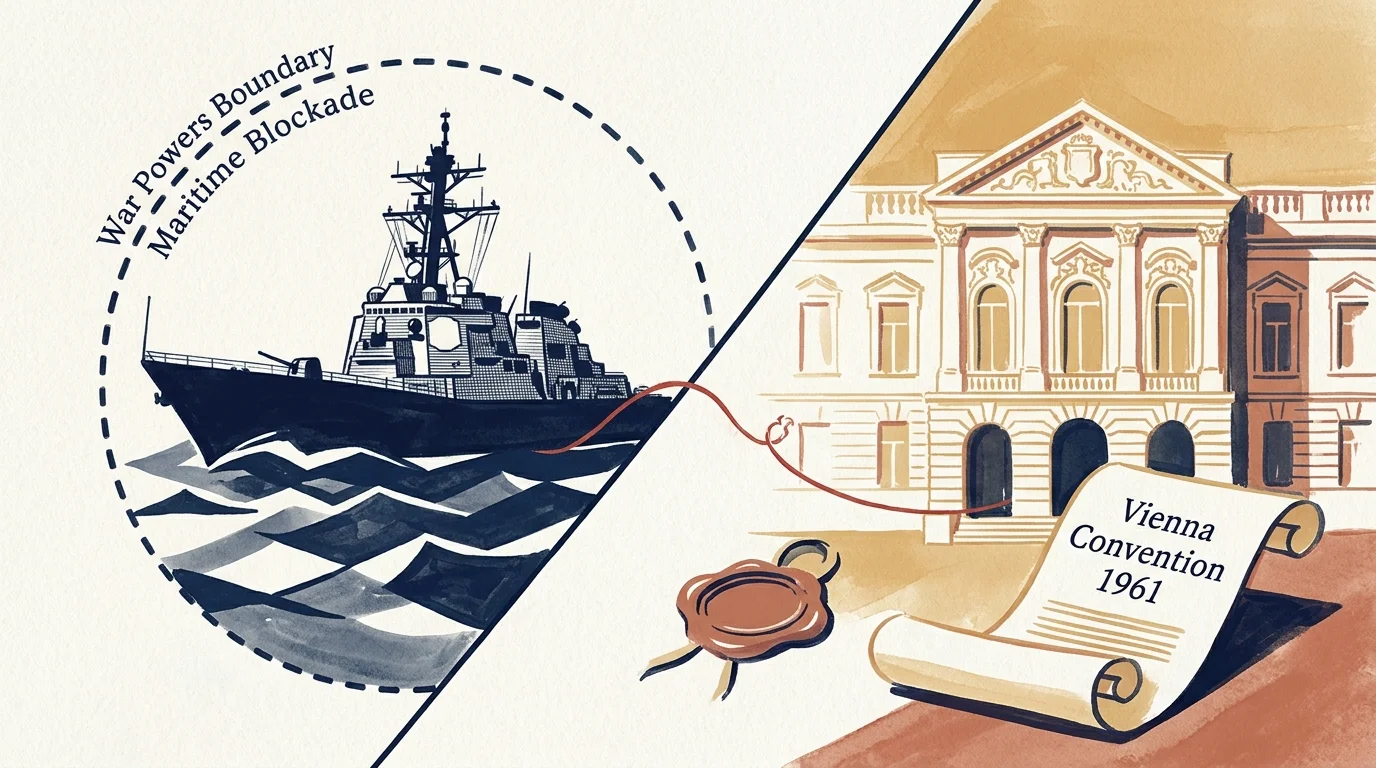
First, the maritime blockade cutting into Iranian oil revenues relies on executive war powers and strict interdiction rules. President Trump first ordered the blockade on April 13, 2026, suspended it under an interim June agreement, and resumed enforcement on July 14.
Overall, the blockade has denied Iran over $30 billion in crude oil exports, diverting nearly 150 ships and disabling five since July. Washington also created Task Force Iron Gate to extend interdiction across overland borders and the Caspian Sea.
Enforcing that blockade places ship commanders on the sharp edge of maritime escalations. On April 19, 2026, Spruance tracked the U.S.-sanctioned, Iranian-flagged cargo vessel M/V Touska near the Strait of Hormuz.
After six hours of ignored warnings, Spruance fired 5-inch rounds into the vessel’s engine room to disable its propulsion. U.S. Marines from the 31st Marine Expeditionary Unit then boarded and seized the ship.
Second, these prolonged strikes and interdictions test the balance between Article II executive authority and the War Powers Resolution of 1973. When an administration sustains months of combat without a new congressional authorization, legislative leverage narrows sharply.
Lawmakers primarily exercise oversight through defense spending riders, closed committee briefings, and statutory reporting demands rather than cutting off active mission funds. You can track pending war powers measures and defense bills on the Congress.gov legislative portal.
Third, Treasury’s “Operation Economic Outcast” sanctions campaign adds financial pressure alongside naval seizures. That dual-track design elevates Treasury Secretary Bessent into a frontline strategic target alongside uniformed commanders.
Fourth, the Iranian embassy’s posts expose a major gap between online harassment and traditional diplomatic rules under the Vienna Convention on Diplomatic Relations. Accredited embassy personnel enjoy broad immunity inside their host country.
Because @IraninSA operates out of South Africa, American authorities cannot arrest or expel the envoys managing that feed. Washington must instead press Pretoria to revoke diplomatic accreditation, seek platform enforcement on X, or impose secondary sanctions.
When host governments decline to penalize diplomats over social media intimidation, foreign missions gain an asymmetric shield for targeted threats. That dynamic leaves individual sailors vulnerable even after their ships rotate out of combat zones.
You can check regional security alerts and official travel warnings on the U.S. Department of State portal.
Finally, Pentagon public-affairs traditions face a growing clash with operational security standards. Navy press releases routinely publish commanding officers’ names and return schedules to celebrate crew morale and support recruitment.
Once an adversary issues targeted death threats, however, broadcasting officer identities and homeport dates creates real force-protection risks. Defense committees are likely to weigh tighter redactions for returning combat crews.
Constituent Impact: Military Families, Local Economies, and Energy Costs
High-level geopolitics often sounds abstract until you measure how a 357-day deployment reshapes daily life in defense communities like San Diego. Stretching a seven-month cruise to nearly a full year strains families, employers, and local support networks.
More than 300 Spruance sailors missed family milestones while steaming 88,000 nautical miles under active missile threat. Their homecoming followed USS Michael Murphy’s 346-day deployment on November 12 and USS McFaul’s 333-day cruise in late October.
Repeatedly pushing surface-ship deployments past 11 months creates tangible readiness and retention pressures across the fleet. Sailors weighing reenlistment must now calculate not only extended sea tours, but also the risk of foreign governments publishing their names online.
Look closely at the language @IraninSA used in March 2026 when it asked whether Tate and York had children of their own. That rhetoric aims squarely at military spouses and children living near domestic ports.
Base security teams, the FBI, and municipal police around homeports like San Diego face heightened counter-surveillance demands when returning officers are publicly named. Protecting service families at home requires tighter coordination across federal and local agencies.
San Diego’s shipyards and defense contractors also absorb immediate workloads when warships return from nearly yearlong combat cruises. Months of high-speed operations, 43 refuelings, and live missile firings require intensive maintenance overhauls before Spruance can sail again.
Outside military bases, American diplomats and private citizens across the Middle East face disrupted assignments and abrupt evacuations. State Department pullbacks in Saudi Arabia, the UAE, Lebanon, Qatar, and Jordan upended schools, contracts, and consular services overnight.
Escalating hostilities over the November 14–16 weekend underscored those risks for Americans remaining in the Gulf. Iranian drone attacks targeting a U.S. base and radar site in Bahrain prompted an urgent U.S. Embassy security alert there.
That same weekend, U.S. forces struck Iranian missile launchers in southern Iran on Sunday night while six oil tankers reportedly caught fire in the Strait of Hormuz. With the strait largely closed since February 28, global shipping lanes remain severely choked.
Even if you live far from a Navy pier, energy disruption in the Strait of Hormuz hits your household budget. Blocking over $30 billion in Iranian oil exports while commercial tankers burn drives up marine insurance rates and fuel volatility.
At home, housing multiple Cabinet secretaries on military bases also carries real operational costs for taxpayers and defense agencies. Secret Service protective details and military security units must divert personnel, secure communications, and residential infrastructure indefinitely.
When top officials govern from fortified installations, routine civic access to executive agencies narrows as well. Constituents and journalists alike encounter taller security barriers around leaders shaping economic sanctions and regional war policy.
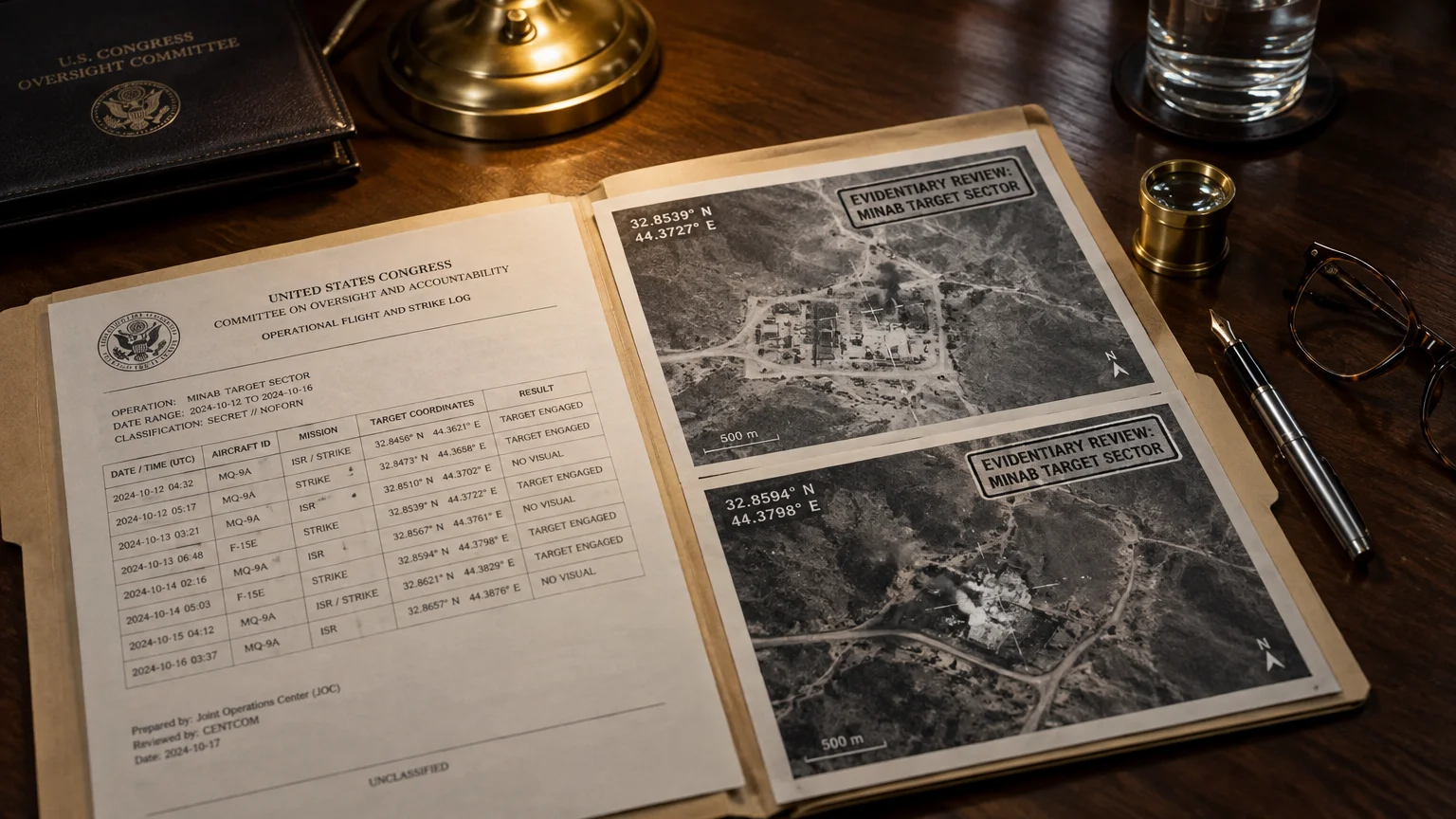
Oversight and Ethics: The Minab Strike Inquiry and Evidentiary Gaps
Any watchdog review of Iran’s threats against Cmdr. Tate and Lt. Cmdr. York must separate documented facts from wartime propaganda. Tehran’s embassy justified singling out both officers by blaming them for a deadly February 28 strike in Minab, southern Iran.
On that opening day of Operation Epic Fury, a missile struck the Shajareh Tayyebeh Elementary School in Minab, adjacent to an IRGC naval compound. Reported casualty totals vary across Iranian and international accounts.
The Iranian Embassy in South Africa claimed 168 children died in the blast. Meanwhile, a September 18, 2026 report by the UN Independent International Fact-Finding Mission cited Iranian officials putting the toll at least 156 people, including 120 children and 26 teachers.
Earlier Iranian official statements cited by The Guardian put the total death toll at least 175. What remains clear is that heavy civilian casualties occurred right beside a major Iranian military compound.
In March 2026, Defense Secretary Pete Hegseth confirmed that the U.S. military was investigating the Minab incident. Subsequently, The New York Times and Reuters reported that a preliminary U.S. military inquiry pointed toward an American targeting mistake.
According to those preliminary reports, U.S. forces likely hit the school with a Tomahawk missile because planners relied on obsolete intelligence data. Six months later, United Nations investigators issued a far sharper legal rebuke.
In September 2026, UN investigators found “reasonable grounds to believe the United States committed the war crime of launching indiscriminate attacks.” The Trump administration rejected that UN assessment.
Here is the vital fact-check regarding Tehran’s threat: the U.S. military still has not published final investigation findings on Minab. Moreover, Iran’s specific allegation that Cmdr. Tate and Lt. Cmdr. York personally chose the target or ordered the strike has not been established.
Under standard U.S. naval targeting procedures, Tomahawk Land-Attack Cruise Missile missions are planned and vetted at higher operational headquarters rather than chosen unilaterally by a destroyer’s bridge team. Ship commanders execute verified launch orders sent down the chain of command.
That operational reality exposes a damaging transparency gap inside the Pentagon. By withholding final battle-damage assessments and targeting-error reviews eight months after February 28, defense officials leave a volatile information vacuum.
Adversaries exploit that silence to assign personal blame to individual captains and executive officers whose warships fired Tomahawks during the campaign. Delayed disclosure also prevents Congress and voters from verifying whether outdated targeting databases were corrected.
At the same time, Iran maintains its own transparency blockade against international monitors. Tehran has refused International Atomic Energy Agency inspections until the war ends, while threatening U.S. bases in Europe as recently as November 11.
You can review human rights and fact-finding releases directly on the United Nations official portal to weigh international findings against Pentagon statements. Demanding documented evidence from both sides remains essential when civilian casualties fuel retaliatory threats.
Frequently Asked Questions on Timelines, Precedent, and Outcomes
Why did Iran’s embassy target two ship officers instead of only Cabinet officials?
Naming tactical commanders exploits public Navy homecoming announcements to generate psychological pressure across the wider fleet. Tehran linked Cmdr. Tate and Lt. Cmdr. York to the unverified Minab accusation to personalize retaliation against active-duty service members and their families.
That tactic complements threats against senior policymakers like Treasury Secretary Bessent, whom @IraninSA mocked for moving onto a military base. Together, those moves aim to signal that neither Washington officials nor deployed warfighters are beyond reach.
Can the United States prosecute or expel Iranian diplomats in South Africa over the post?
American prosecutors cannot directly arrest accredited Iranian diplomats stationed inside South Africa due to diplomatic immunity. Only South Africa, as the host nation, holds authority to expel personnel operating the @IraninSA account.
Washington can, however, pursue DOJ terrorism indictments against Quds Force operatives, as it did with Shahram Poursafi and three suspects charged on November 10. U.S. officials can also press Pretoria diplomatically and seek platform action.
What do 357-day deployments reveal about U.S. Navy capacity right now?
Back-to-back record cruises by Spruance, Michael Murphy, and McFaul show how heavily Middle East combat and blockade duty are straining the surface fleet. Sustaining three carrier strike groups and roughly 50,000 troops in the region tests maintenance schedules and retention.
When warships sail five months past planned seven-month cruises, future deployment readiness shrinks. Lawmakers on congressional defense committees must weigh immediate CENTCOM deterrence against mounting shipyard overhaul backlogs.
What is the legal status of the Minab school strike investigation?
As of mid-November 2026, the U.S. military has not published final investigation findings into the February 28 strike. Preliminary reporting by The New York Times and Reuters indicated a likely Tomahawk mistake caused by obsolete targeting intelligence.
Meanwhile, the UN fact-finding mission’s September 18 report cited reasonable grounds for an indiscriminate-attack war crime, an assessment rejected by the Trump administration. Until final Pentagon files emerge, accountability questions and Iran’s claims against Tate and York remain unresolved.
Outlook: Critical Milestones to Monitor Next
On November 16, 2026, UN Secretary-General António Guterres urged both sides to end a dangerous “neither peace nor war” stalemate. Tracking several concrete milestones over the coming weeks will help you see whether tensions cool or widen further.
First, watch how the Pentagon updates force-protection rules and public-affairs disclosures for returning ships. Look for whether the Navy curtails officer biographies and homecoming dates while DNI Clayton’s “advanced stages” threat warning stays active.
Second, monitor whether defense leaders publish final investigation findings on the February 28 Minab school strike. Releasing verified targeting records will shape both congressional oversight and Washington’s diplomatic posture following the September UN report.
Third, track Pretoria’s response to @IraninSA’s repeated online threats targeting uniformed U.S. officers. Any decision by South Africa to censure or expel embassy staff—or continued silence—will reveal how much diplomatic shelter Tehran retains abroad.
Fourth, follow congressional oversight hearings on War Powers, Task Force Iron Gate, and the costs of housing Cabinet secretaries on military bases. Lawmakers face mounting questions about open-ended hostilities continuing without new legislative authorization.
Fifth, watch operational flashpoints near the Strait of Hormuz and Bahrain following USS Theodore Roosevelt’s November 15 arrival. Three carrier strike groups in CENTCOM deliver immense firepower, yet they also multiply targets for Iranian drone and missile retaliation.
Finally, track whether Iran maintains its refusal of IAEA nuclear inspections while threatening U.S. bases in Europe. As long as diplomatic off-ramps stay frozen and officials govern from fortified bases, every warship coming home sails into an active political crossfire.