Is a 3.6% raise enough?
For many retirees, 3.6% will feel like it only keeps pace. It won’t put them ahead. The raise is meant to match inflation, not beat it, and the measure it uses may not reflect what older Americans actually spend money on.
The CPI-W tracks the spending of working households. Retirees spend a bigger share of their budget on health care and housing, costs that have often risen faster than overall prices. Advocacy groups have long pushed for a different index, the CPI-E, built around the spending of people 62 and older. Congress has not adopted it.
Analysts have also pointed out that even a bigger raise doesn’t go far. Mary Johnson, an independent Social Security and Medicare policy analyst, said the average increase “may get us one fill-up at the gas station,” according to 401(k) Specialist.
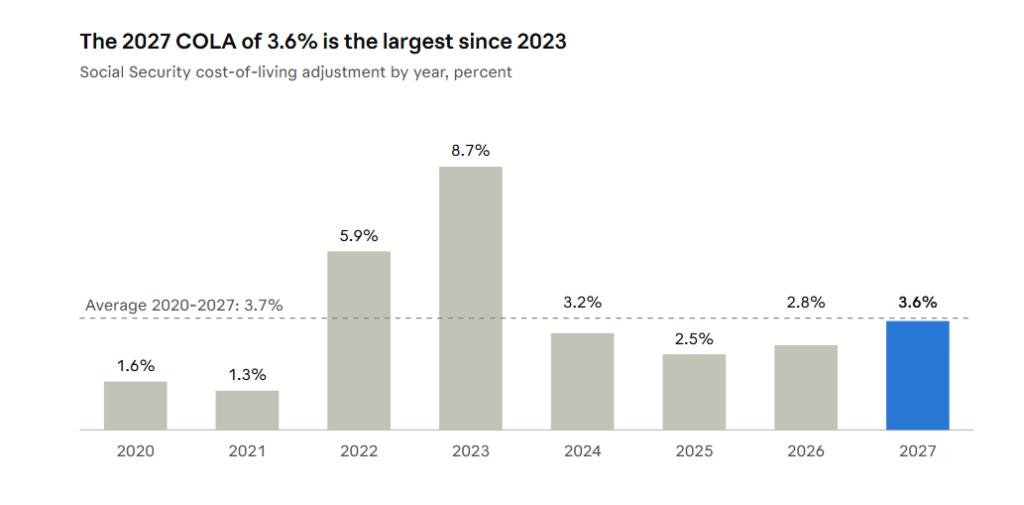
Still, 3.6% is solid by historical standards. The same report notes it is slightly above average, tied for 18th among the 52 COLAs since raises were linked to the Consumer Price Index in 1975. Recent years show how much the number can swing: from 1.3% in 2021 to 8.7% in 2023 and back down to 2.5% in 2025. The chart below shows each year since 2020.
What to do now to make the most of your raise
The raise arrives automatically, but a few steps before January can help you keep more of it.
1. Check your COLA notice. Create or sign in to your my Social Security account at ssa.gov to see your exact 2027 benefit as soon as it’s posted in late November. Make sure the amount matches what you expect.
2. Look at your net amount, not just the gross. Once the 2027 Part B premium is confirmed, subtract it, plus any Part D or Medicare Advantage premium, from your new benefit. That figure is what you can actually budget with.
3. Review your Medicare coverage before December 7. Medicare open enrollment ends December 7. A cheaper drug or Medicare Advantage plan can save more than the COLA adds. Compare plans at Medicare.gov or with your State Health Insurance Assistance Program (SHIP), which offers free counseling.
4. Check your tax withholding. If federal tax is taken out of your benefit, or you pay estimated taxes, confirm that the raise doesn’t leave you short at tax time. You can change withholding with IRS Form W-4V.
5. See if you qualify for help. If your income is limited, a Medicare Savings Program may pay your Part B premium. Extra Help can lower your drug costs. Both can be worth far more than the COLA itself.
6. Update your budget. Write the new monthly amount into your budget for January. Put any increase toward the costs that are rising fastest for you, whether that’s groceries, utilities or insurance.
7. If you’re still working, plan around the earnings limit. If you’re under full retirement age, keep an eye on your 2027 earnings so benefits aren’t withheld unexpectedly.
The bottom line
The 2027 COLA gives a $1,500 check about $54 more a month, a $2,000 check about $72 more and a $3,000 check about $108 more. That’s $648, $864 and $1,296 over the year.
If you’re on Medicare, expect a small part of that to go to a higher Part B premium. Under the current projection that’s about $6.60 a month, though the final number could be higher. Watch your my Social Security account in late November for your exact new amount. Then use the weeks before January to review your Medicare plan, your tax withholding and your budget, so more of this year’s raise stays in your pocket.