

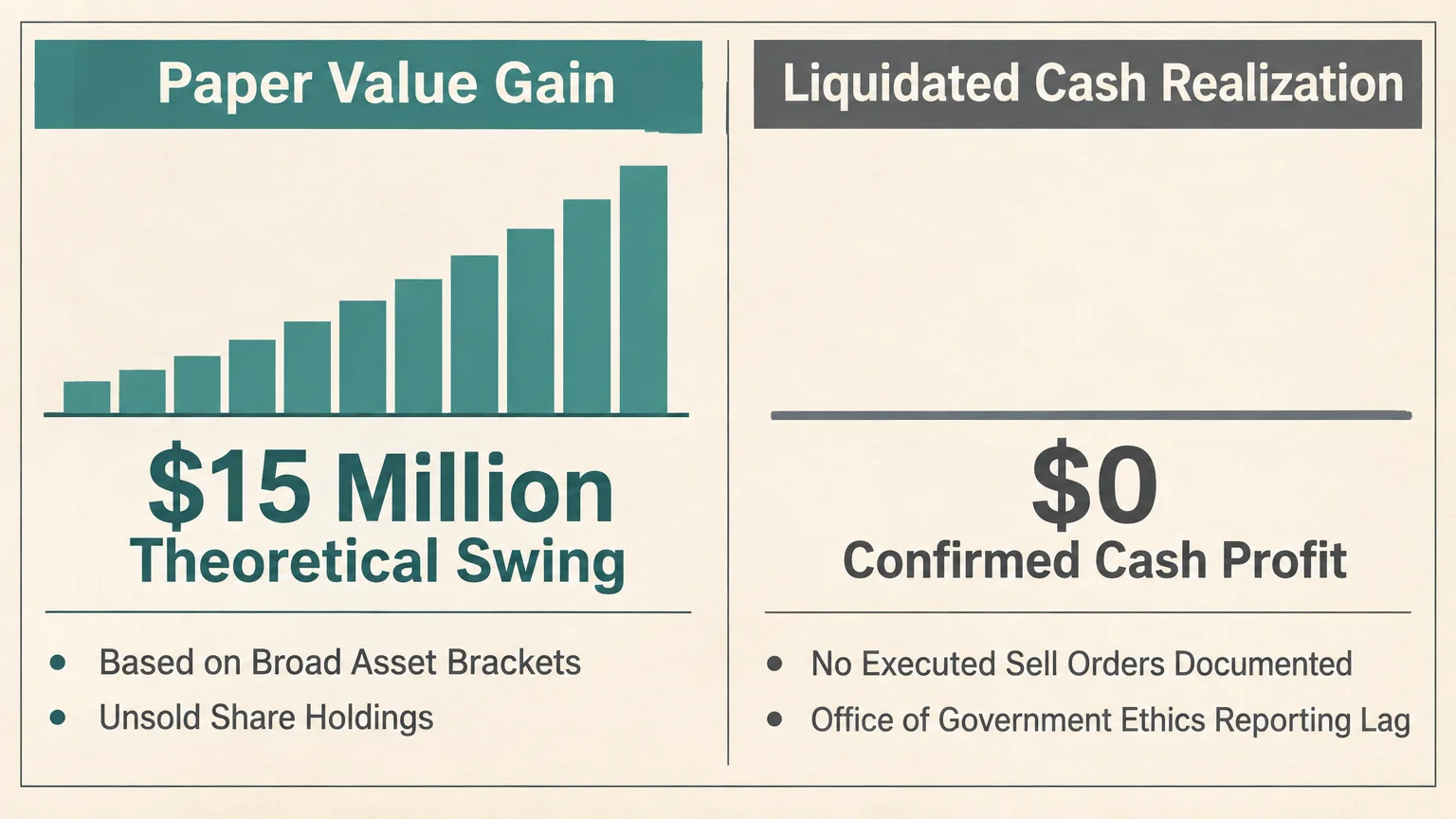
Viral headlines claim President Donald Trump pocketed $15 million after backing Jensen Huang’s return as Nvidia CEO, according to analyses by the Financial Times and CBS News. That figure measures a theoretical single-day paper gain rather than confirmed cash profits.
Public filings from the U.S. Office of Government Ethics confirm Trump’s accounts held substantial Nvidia stock through September 2026. However, federal disclosure lags and wide reporting brackets hide his exact share count and any trades made during November’s leadership crisis.
Knowing how these estimates work helps you separate verified financial records from viral exaggeration. Below, you will find a full breakdown of the numbers, the timeline, and the federal ethics rules governing presidential investments.

Claim Synopsis: Where the Million Figure Originated
On November 24, 2026, the Financial Times published calculations estimating that Nvidia’s massive Monday stock rally could have added up to $15 million to President Trump’s holdings. Follow-up reporting from Inc. and CBS News placed the upper-bound single-day estimate between $14.6 million and $14.8 million.
The story gained immediate traction on social media because of the timing. Just three days before the rally, Trump had publicly supported reinstating Huang after the Nvidia chief’s abrupt resignation earlier in the month.
Shortly after Nvidia’s board reversed course on November 23, Trump told CNBC that he had personally spoken to board members and convinced them to bring Huang back. Critics seized on the $15 million number as proof that presidential intervention directly enriched the White House.
Supporters countered that Trump’s portfolio is managed by outside financial institutions using automated index models. Meanwhile, several outlets—including the Financial Times, IBTimes UK, and BigGo—stressed that the $15 million estimate reflects an unverified paper gain rather than realized cash.
When you see a viral dollar figure tied to a politician’s stock portfolio, you need to check what the public paperwork actually proves. In this case, the underlying ethics filings leave critical gaps that neither side can fully resolve today.
Methodology Note: How We Verified the Numbers and Filings
To evaluate this claim, we cross-referenced primary federal disclosure records with independent financial analyses from multiple news organizations. Our review centered on Periodic Transaction Reports and annual disclosures filed with the U.S. Office of Government Ethics.
We compared Trump’s disclosed Nvidia asset ranges and transaction logs from 2024 through September 2026 against Nvidia’s closing share prices in October and November 2026. We also examined reporting from The Washington Post, CBS News, BBC, Reuters, and Newsweek to verify trading frequency.
For the legal context, we reviewed statutory exemptions under federal conflict-of-interest laws alongside reporting deadlines under the Ethics in Government Act and the 2012 STOCK Act. Finally, we checked public statements from Trump, White House spokesperson Davis Ingle, Nvidia’s board, and bipartisan senators.
Where federal forms use broad valuation brackets rather than exact share counts, we present the full mathematical range rather than a single midpoint. That transparency allows you to see both the lowest plausible impact and the highest theoretical upside.
Evidence Check 1: Does the Million Estimate Represent Realized Profit?
How Analysts Calculated the Upper-Bound Gain
Federal disclosure forms do not require filers to list exact share quantities. Instead, the Office of Government Ethics requires officials to report asset values and individual trades inside broad dollar brackets.
Using those disclosed ranges through September 30, 2026, both the Financial Times and CBS News calculated that Trump’s accounts held anywhere from 32,000 to 370,000 shares of Nvidia stock. That wide spread produces dramatically different answers when you multiply shares by November’s price jump.
On Monday, November 23, Nvidia’s stock surged 31.48% to close at $165.05 per share, adding roughly $950 billion to $954 billion in market value. At the bottom end of 32,000 shares, Trump’s stake would have gained about $1.3 million that day.
At the absolute ceiling of 370,000 shares, the rally would have added nearly $15 million—or $14.6 million to $14.8 million depending on the exact pricing snapshot—pushing the total stake past $61 million. Both figures are mathematically sound projections based on the September cutoff.
However, presenting $15 million as an established fact skips the $13.7 million gap between the minimum and maximum possibilities. You should always treat maximum-range disclosure estimates as a ceiling rather than a confirmed total.
Paper Gains Versus Earlier Losses and Quick Pullbacks
Even if Trump’s accounts held the full 370,000 shares on November 23, an unrealized stock rebound is not the same as cash profit. You only lock in profit when you sell shares above your purchase price.
According to the Financial Times, if Trump held that maximum 370,000-share position, his Nvidia holdings had lost $42 million from their prior peak before Monday’s rebound. Nvidia shares had hit a 52-week high of $243.37 on October 6 before sliding sharply during the leadership scandal.
Even after surging 31.5% on November 23, Nvidia’s closing price of $165.05 remained 5.0% below its November 11 close of $173.73 and 32.2% below its October peak. In other words, the Monday bounce recovered only part of a much steeper autumn decline.
More importantly, those paper gains began shrinking almost immediately. On Tuesday, November 24, Nvidia shares fell 5.86% to close at $155.38, erasing roughly a quarter of Monday’s jump in a single session.
By premarket trading on Wednesday, November 25, the stock slid another 6.2%, trading between $146.78 and $153.66 in early snapshots. Anyone citing the $15 million single-day gain without noting the prior $42 million drawdown and subsequent pullback gives you an incomplete picture.
Evidence Check 2: What Trump’s Financial Disclosures Reveal and Conceal
Inside the November 2026 Periodic Transaction Report
To understand what Trump actually owned heading into November, you have to examine his latest Periodic Transaction Report. Trump signed that 25-page filing on November 1, 2026, and submitted it to the Office of Government Ethics on November 5.
Ethics officials certified the report on November 9 and released it to the public on November 19, 2026—just four days before Nvidia reinstated Huang. The document details 751 transactions across stocks, bonds, and funds executed during September 2026.
Altogether, those September trades aggregated between roughly $40.9 million and $148.1 million across Trump’s investment accounts. Within that massive trading volume, Nvidia trades appear only through September 24, with overall portfolio valuation cutoffs ending on September 30.
Newsweek and Reuters reviewed the September Nvidia entries closely. Newsweek reported that Trump’s accounts bought up to $380,000 in Nvidia stock during September—while Reuters tallied purchases at $265,000—and sold up to $15,000.
Notably, up to $350,000 of those purchases occurred on September 2, 2026, the exact day Nvidia agreed to acquire the artificial intelligence platform Hugging Face for roughly $12.9 billion. Those details show active, ongoing trading in Nvidia shares throughout late summer.
A Two-Year Surge in Nvidia Holdings
Trump’s exposure to Nvidia grew dramatically between late 2024 and late 2026. According to his 2025 annual financial disclosure—received by ethics officials in late June 2026—his Nvidia stake jumped dramatically in a single year.
Reporting from PBS NewsHour and CBC showed Trump held $615,000 to $1.3 million in Nvidia stock at the end of 2024. By the end of 2025, that stake had climbed to between $12.5 million and $58 million, which ABC News summarized as “at least $12 million” and CBS News reported as “$13 million to $58 million”.
Multiple newsrooms tracked the heavy trading behind that buildup. The Washington Post counted 44 Nvidia trades between January and September 2026—29 purchases totaling $6 million to $17 million and 15 sales totaling $4 million to $12 million—implying holdings of $6 million to $71 million by September 23.
Looking across a wider timeframe, CBS News identified more than 100 Nvidia transactions worth $27 million to nearly $98 million between January 2025 and September 2026. Similarly, the BBC reported 85 separate Nvidia purchases worth $23 million to $86 million over two years, alongside 19 sales realizing $3.5 million to $10.2 million since Trump returned to office.
The Critical October and November Blind Spot
While those records establish a massive Nvidia footprint through September 30, they tell you nothing about October or November 2026. Under current reporting schedules, zero public transaction data exists for the period surrounding Huang’s resignation and return.
If Trump’s portfolio managers trimmed or liquidated his Nvidia stake during October’s sell-off or after Huang resigned on November 12, Trump would have gained little or nothing on November 23. Conversely, if his accounts bought shares during November’s dip, his paper gain could differ from September’s baseline.
Because the Financial Times and CBS News calculations assume his September 30 holdings stayed unchanged for seven turbulent weeks, the $15 million figure remains an educated projection. You will only know his true November position when his next Periodic Transaction Report becomes public.

Evidence Check 3: Did Trump’s Intervention Trigger Nvidia’s Rebound?
Timeline of Jensen Huang’s Departure and Reinstatement
To assess Trump’s role, you need to trace the rapid chain of events that shook Nvidia over four weeks. On October 29, 2026, The New York Times reported that U.S. authorities investigated Chinese businesswoman Alice Huang over suspected intelligence ties and potential export violations.
Alice Huang was a former executive at Singapore-based Megaspeed and had engaged in an affair with Jensen Huang; Nvidia closed at $213.66 the day that investigation became public. Two weeks later, on November 12, Jensen Huang resigned as president, CEO, and board director following disclosures of multiple extramarital affairs involving Alice Huang and company subordinates.
Nvidia named Chief Financial Officer Colette Kress as interim CEO, and the stock dropped 4.34% to close at $166.19. On November 17, Board Chair Harvey Jones told investors on an earnings call that directors had unanimously accepted the resignation and “does not intend to reinstate Jensen as CEO”.
Markets punished the uncertainty, pushing Nvidia down 14.01% on Friday, November 20, to close at $125.53—a 27.7% slide from November 11. That same day, Trump publicly endorsed bringing Huang back to lead the semiconductor giant.
Over the weekend, the board reversed its stance entirely and reinstated Huang on Monday, November 23. Directors announced they had received “input from senior levels of the United States government” and concluded Huang’s return posed “no national security risk” while an independent investigation continues.
Trump’s Public Statements Versus White House Portfolio Claims
Trump left little doubt about his involvement during a November 23 phone interview with CNBC. Describing his conversations with Nvidia’s leadership, he stated, “I spoke to them, let me put it that way. And I convinced them … I made the deal”.
He added, “The board decided to do what we wanted them to do”, framing the reinstatement as an administration victory. When asked whether the prior week’s steep stock losses influenced his decision to step in, Trump answered, “probably so”.
Those candid remarks sparked immediate ethical scrutiny because of his personal Nvidia stake. In response, White House spokesperson Davis Ingle defended the president’s financial arrangements as completely insulated from his official actions.
Ingle explained that third-party institutions independently manage Trump’s stock and bond holdings inside discretionary accounts. According to the White House, those managers rely on computer-based model portfolios that replicate broad benchmarks like the Schwab 1000.
Ingle insisted that “neither President Trump nor any member of his family has any ability to direct, influence, or provide input” on investment choices or timing. However, there is a critical distinction: Trump has not placed his assets into a qualified blind trust.
Without a blind trust, Trump signs the public disclosures listing those holdings. Even if automated models buy and sell shares without his input, knowing he holds tens of millions in Nvidia undermines claims of complete financial separation.
Evidence Check 4: Are Presidential Stock Trades Legal Under Federal Ethics Rules?
The Presidential Exemption Under 18 U.S.C. § 208
Many readers assume a president faces the same conflict-of-interest bans as cabinet secretaries or federal agency staff. In reality, federal criminal law treats the presidency very differently.
Under 18 U.S.C. § 208 and 18 U.S.C. § 202(c), the President and Vice President are explicitly exempt from the federal criminal conflict-of-interest statute. Congress codified that exemption in 1989, following a 1974 Justice Department constitutional interpretation.
Regular executive branch employees cannot participate in official matters that directly affect their personal financial holdings, or they must divest those stocks. The president, by contrast, is legally exempt from both the criminal statute and Office of Government Ethics impartiality rules.
That legal reality means Trump did not break federal conflict-of-interest statutes by speaking with Nvidia’s board while holding Nvidia stock. Legality, however, does not shield a president from political backlash or congressional oversight.
STOCK Act Rules and Missed Filing Deadlines
While exempt from divestment mandates, the president remains subject to strict financial transparency rules. Under the Ethics in Government Act and the 2012 STOCK Act, covered officials must disclose securities trades exceeding $1,000.
Specifically, the law requires filing a Periodic Transaction Report within 30 days of learning about a covered trade and no later than 45 days after the transaction date, unless officials grant an extension. The STOCK Act also explicitly bars using nonpublic government information for private financial gain.
Here, the timeline raises unanswered procedural questions. Newsweek observed that Trump’s filing received on November 5 included trades executed on September 1—more than 60 days before he signed the paperwork on November 1.
The publicly released report showed no formal extension or waiver explaining the gap beyond 45 days. If you track accountability, watching whether ethics officials enforce or clarify those statutory deadlines matters just as much as watching stock prices.
Bipartisan Congressional Scrutiny and Upcoming Hearings
Concerns over Nvidia’s governance and export controls extend far beyond partisan lines. On November 23, the same day Huang returned, the Commerce Department placed Megaspeed—the Singapore firm tied to the original investigation—on its trade blacklist.
Lawmakers from both parties swiftly questioned how the administration cleared Huang’s return so quickly while national security inquiries remained active. Republican Senators John Cornyn, John Curtis, Pete Ricketts, Kevin Cramer, and Tom Cotton joined Democratic Senators Elizabeth Warren, Chuck Schumer, and Ruben Gallego in raising security and conflict concerns.
Congress has already locked in a high-stakes oversight schedule for December 2026. Jensen Huang is scheduled to testify behind closed doors before three House committees on December 1, followed by an appearance before the Senate Banking Committee on December 3.
Commerce Secretary Howard Lutnick will follow with testimony on December 10, 2026. Those hearings will test what security assurances the administration gave Nvidia’s board and whether financial holdings played any role in the government’s messaging.

Pattern Watch: Recurring Narratives Around Political Stock Claims
When high-profile politicians intersect with Wall Street rallies, viral commentary frequently repeats three predictable distortions. Recognizing these patterns helps you evaluate future stock claims faster and more accurately.
First, commentators routinely convert upper-bound disclosure ranges into exact dollar headlines. Saying a report proves a $15 million windfall ignores the fact that federal forms allow ranges so wide that the true number could be $1.3 million—roughly eleven times smaller.
Second, partisan posts often confuse unrealized paper gains with cash in the bank. Daily stock spikes can evaporate within 48 hours, as Nvidia’s 5.86% Tuesday drop and 6.2% Wednesday premarket slide clearly demonstrated.
Third, viral threads frequently conflate ethical norms with criminal statutes. Calling an action a legal violation when the presidency is statutorily exempt under 18 U.S.C. § 208 muddies a real policy debate over blind trusts and disclosure transparency.
On the flip side, dismissing all conflict concerns simply because third-party managers run model portfolios misses the core accountability issue. When a president knows he owns up to $58 million or more in a single company, public policy decisions inevitably invite scrutiny.
Accountability Guidance: What You Should Monitor Next
Because public records currently stop at September 30, 2026, this story remains only half-told. You can verify the rest of the financial trail by watching three specific developments over the coming weeks.
First, look for Trump’s next Periodic Transaction Report covering October and November 2026 trades at the Office of Government Ethics website. Under the 45-day reporting window, any November Nvidia purchases or sales should appear by late December 2026 or early January 2027.
Second, follow the December 3 Senate Banking Committee hearing with Jensen Huang and the December 10 testimony from Commerce Secretary Howard Lutnick. Written transcripts and committee exhibits should clarify who inside the government communicated with Nvidia’s board between November 20 and November 23.
Third, monitor whether Congress introduces legislation narrowing the presidential exemption under 18 U.S.C. § 208 or mandating qualified blind trusts for future administrations. Watching legislative text rather than cable-news soundbites gives you the clearest view of real reform.
Frequently Asked Questions
How does LightOnPolitics rate claims based on estimated stock ranges?
We evaluate claims by checking whether the headline matches what primary financial disclosures actually support. When an estimate relies on an unverified upper-bound bracket and assumes unchanged holdings, we classify the claim as needing context rather than confirming it as realized profit.
Why do reputable outlets like the Financial Times and CBS News give slightly different figures?
Federal ethics forms list asset values and trades in wide brackets rather than exact share numbers. Different newsrooms calculate share counts using slightly different trading-day price assumptions, producing minor variations such as $14.6 million, $14.8 million, or up to $15 million.
What happens if new disclosures show Trump sold his Nvidia stock before November 23?
If upcoming Periodic Transaction Reports show Trump’s accounts exited Nvidia during October or early November, we will update this verification package immediately with a timestamped correction note. Transparent fact-checking requires revising conclusions whenever lagged primary filings close an information gap.
Will this article be updated after the December congressional hearings?
Yes, we track scheduled oversight testimony and subsequent Office of Government Ethics certifications. Once Huang’s December 3 testimony, Lutnick’s December 10 appearance, and the November trade filings enter the public record, we will append verified findings directly to this report.
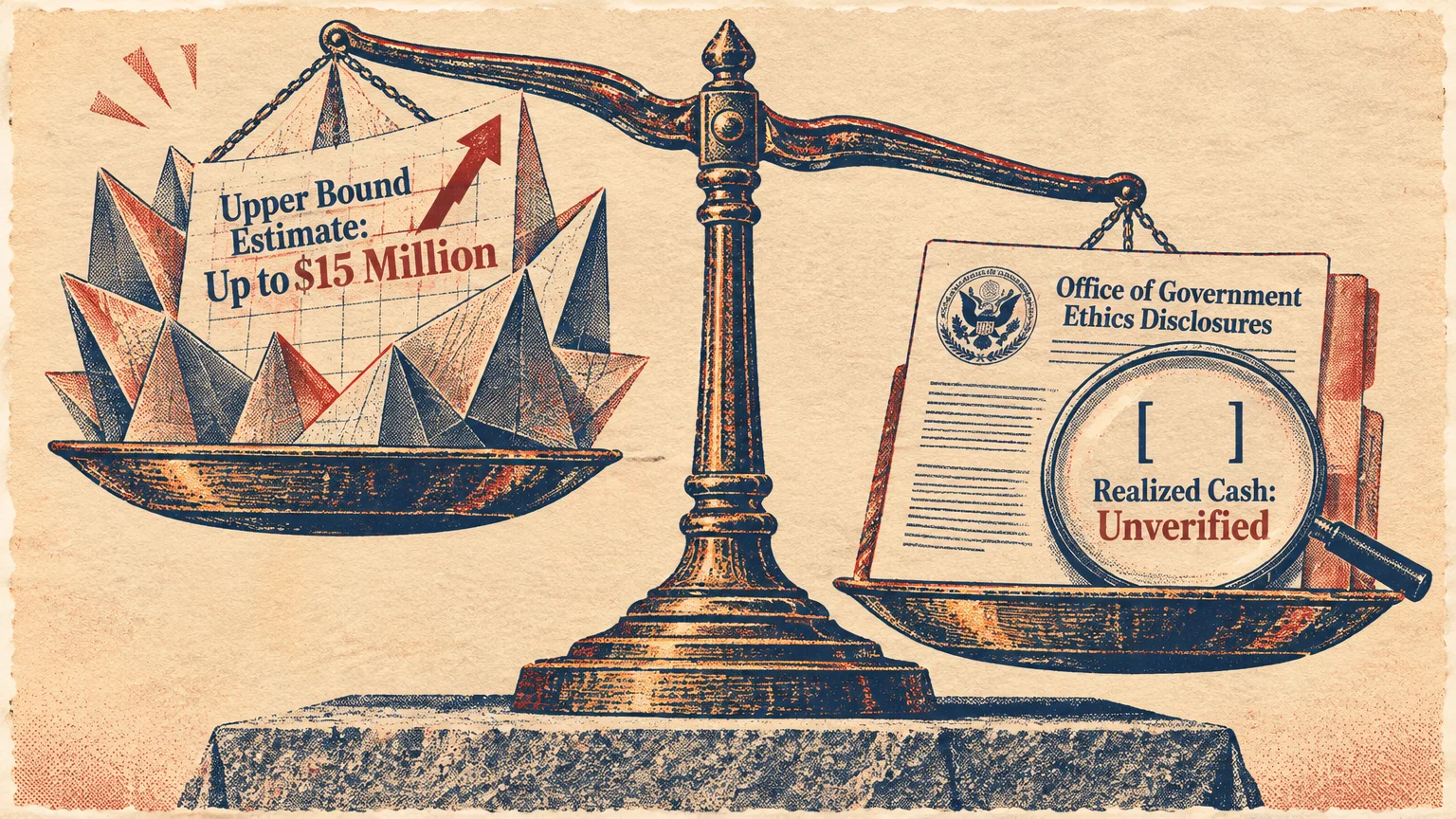
Final Verdict: Accurate Upper-Bound Estimate, Missing Context on Realized Cash
The claim that President Trump could have gained up to $15 million from Nvidia’s November 23 surge is mathematically plausible as an upper-bound paper estimate, but misleading if presented as confirmed cash profit. Calculations by the Financial Times and CBS News accurately reflect the maximum 370,000-share ceiling implied by September 30 ethics filings.
At the same time, those same filings allow for a minimum gain of just $1.3 million and exclude all trading activity in October and November 2026. Moreover, any Monday rebound followed an estimated $42 million peak-to-trough decline and shrank again during Tuesday and Wednesday pullbacks.
While Trump told CNBC he convinced Nvidia’s board to reinstate Jensen Huang, federal conflict laws exempt the presidency, and the White House states independent index managers control his trades. Until November’s disclosure forms and December’s Senate testimony arrive, you should view the $15 million figure as a theoretical ceiling—not proof of a cash payday.



u528qj