State and federal tax changes taking effect this year will directly impact your paycheck and household budget, fundamentally altering how much you keep and how much you owe. As lawmakers aggressively rewrite the tax code to address ballooning deficits and fund new infrastructure, everyday taxpayers face a labyrinth of shifting deductions and revised income brackets. Navigating these fiscal reforms requires understanding exactly which provisions sunset and which take permanent root in your financial life. From the expiration of standard deduction bumps to newly minted energy credits, the current public policy landscape demands strict attention to your bottom line. You must recognize how these structural shifts dictate your tax liability to protect your earnings effectively.
Background and Timeline of Fiscal Reform
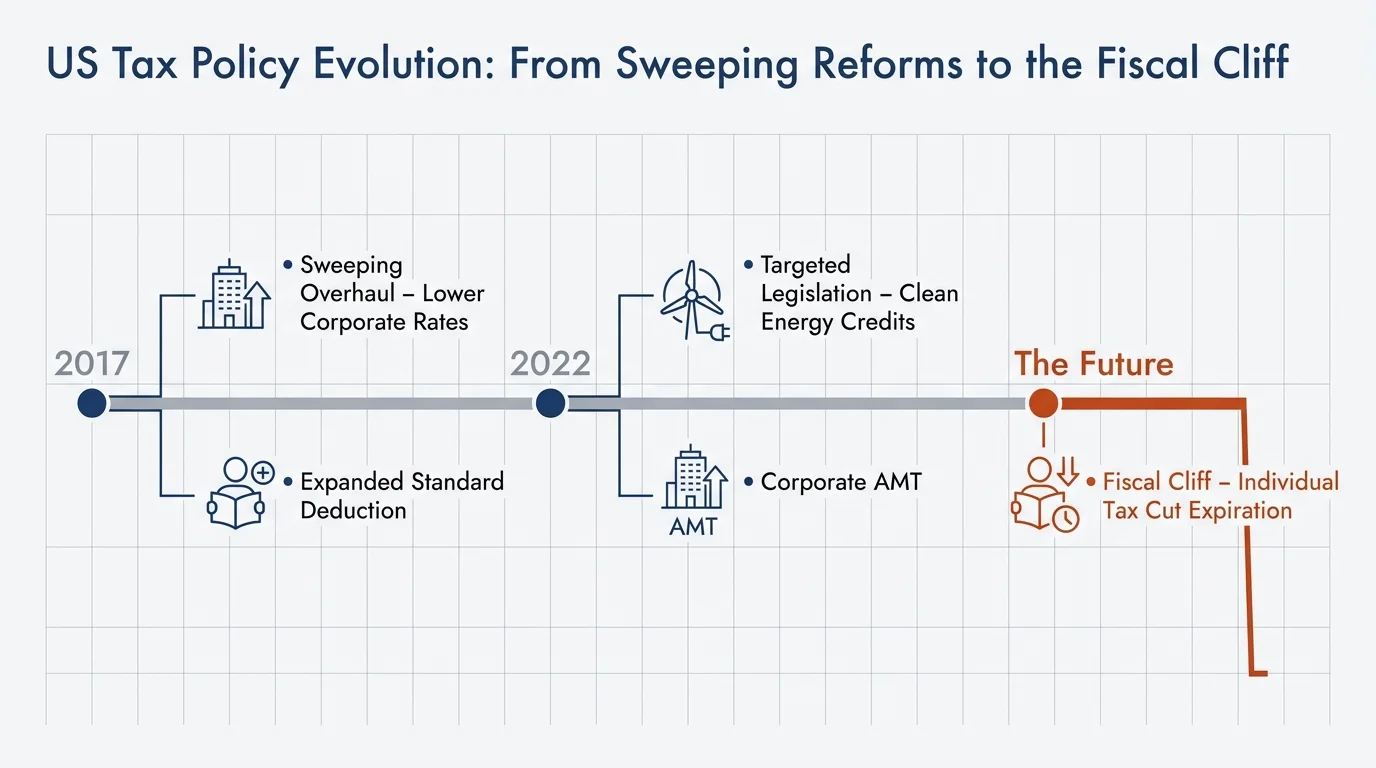
To grasp the magnitude of today’s shifting tax landscape, you must trace the legislative actions that built our current framework. The modern era of tax policy largely stems from the sweeping overhaul passed in late 2017. That legislation dramatically lowered corporate tax rates, expanded the standard deduction for individuals, and introduced strict caps on specific itemized deductions. However, lawmakers utilized a procedural mechanism known as reconciliation to pass the bill, which required them to place expiration dates on nearly all individual tax cuts to comply with federal deficit rules. Those temporary provisions created a massive fiscal cliff that currently drives the urgency in congressional tax committees.
Fast forward to the summer of 2022, and the federal government initiated another massive structural shift through the passage of targeted inflation and infrastructure legislation. This newer package introduced long-term clean energy tax credits, established a new alternative minimum tax for the largest corporations, and implemented a novel excise tax on corporate stock buybacks. While politicians marketed these changes as top-level corporate reforms, the secondary effects predictably trickled down into consumer markets. You are now experiencing the delayed impact of these consecutive legislative eras colliding—the older individual tax cuts are preparing to expire just as the newer corporate tax structures take full effect.
The Congressional Budget Office routinely monitors these overlapping timelines, warning that the simultaneous expiration of past tax cuts and implementation of new fiscal mandates will severely disrupt baseline revenue projections. Lawmakers face immense pressure to address these overlapping policies before taxpayers endure a sudden, unexpected spike in their baseline tax liabilities. The resulting timeline guarantees that public policy debates over taxation will dominate the legislative calendar for the foreseeable future, dictating how the government collects revenue and distributes economic incentives.

Core Analysis of Tax Policy Mechanics
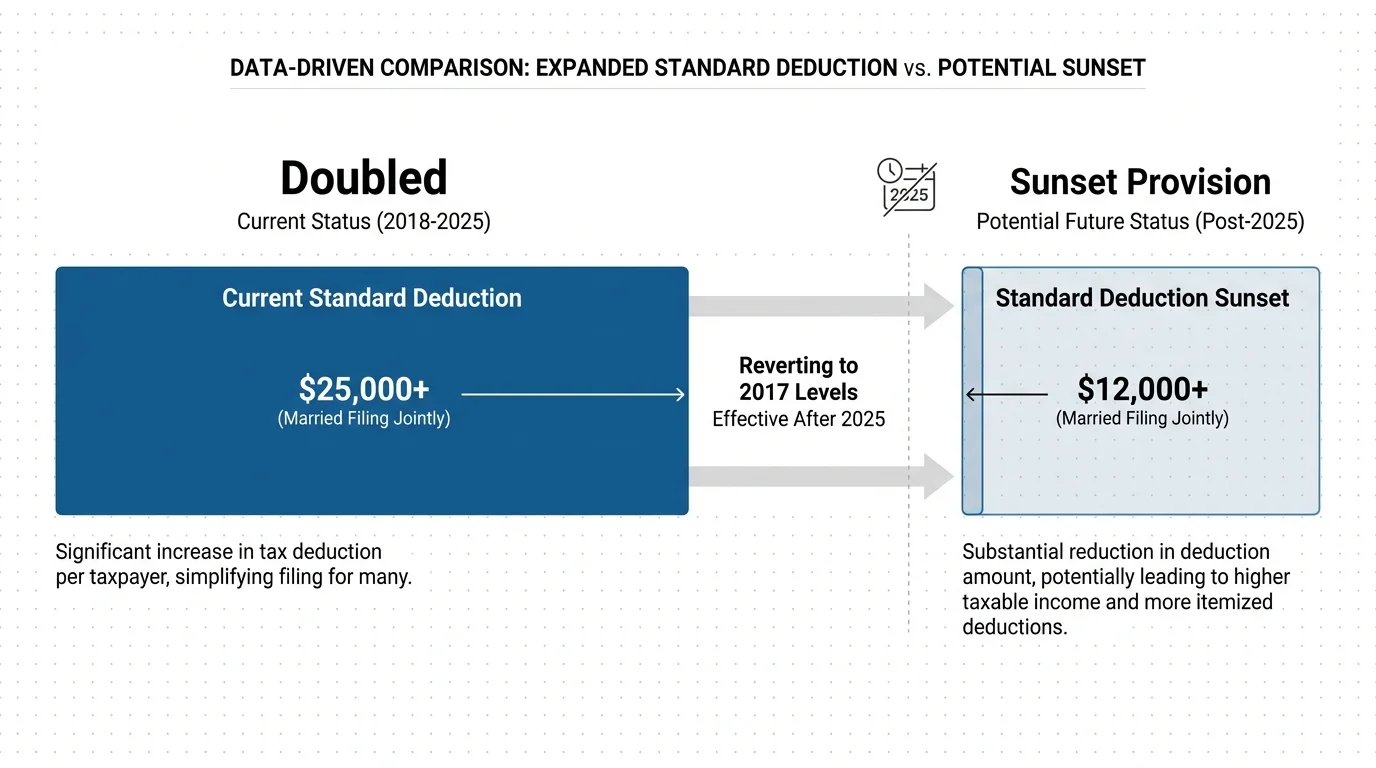
Understanding the actual mechanics of these tax changes requires looking past the political rhetoric and examining the raw mathematical formulas that dictate your liability. The most critical component affecting the average taxpayer is the impending expiration of the expanded standard deduction. Over the past several years, the vast majority of filers stopped itemizing their deductions because the standard deduction essentially doubled. If Congress allows this provision to sunset, the baseline amount you can deduct from your taxable income will plummet. Millions of taxpayers will suddenly find themselves forced to meticulously track charitable contributions, mortgage interest, and medical expenses just to avoid a massive tax hike.
Shifting Income Brackets and Deductions
Beyond the standard deduction, the actual income brackets dictate exactly how much of your paycheck flows to the federal government. Current policies feature wider brackets and lower marginal rates, allowing you to earn more money before bumping into a higher tax tier. When these temporary brackets expire, the thresholds will compress. Even if your salary simply keeps pace with inflation, this compression will trigger a phenomenon known as bracket creep. You will earn more nominal dollars, but those dollars will push you into higher, more punitive tax brackets, effectively decreasing your real purchasing power.
The expiration timeline also targets the controversial State and Local Tax limitation, widely known as the SALT cap. Currently, you cannot deduct more than a specific, fixed amount of your state income and local property taxes on your federal return. For residents in high-tax jurisdictions, the removal of this cap might provide significant relief; for those in states with lower taxes, the shift merely alters the broader federal revenue base, potentially forcing lawmakers to seek tax revenues from other sources to offset the difference.

Corporate Rates and the Consumer Burden
While individual tax brackets directly shape your take-home pay, new corporate tax policies indirectly dictate your daily living expenses. Recent public policy changes imposed an alternative minimum tax on massive corporations, ensuring they pay a baseline percentage of their financial statement income regardless of their claimed deductions. Additionally, companies now face an excise tax when they repurchase their own stock. Proponents argue these measures ensure baseline corporate fairness. However, corporations rarely absorb these costs entirely. Economic data demonstrates that businesses offset these new tax liabilities by raising the prices of everyday goods, stalling wage growth, or reducing future hiring. Therefore, even if your individual tax rate remains static, you end up bearing a significant portion of the corporate tax burden at the grocery store checkout line and the gas pump.

The Impact Lens on Household Budgets
To view these fiscal changes through a practical lens, consider the reality of a median-income household attempting to balance a monthly budget. Imagine you recently decided to upgrade your home heating system. Under the newer public policy provisions, you can claim a substantial federal tax credit for installing an energy-efficient heat pump. This direct credit lowers your federal tax liability dollar-for-dollar, providing an immediate, tangible benefit to your household finances. The government intentionally designed this specific mechanism to alter consumer behavior by rewarding green energy investments.
However, your broader economic environment rarely remains so simple. While the federal government offers incentives, your local and state governments continually adjust their own revenue models. Over recent years, numerous states have aggressively transitioned from progressive income tax systems to flat tax models. These state-level fiscal reforms promise lower overall income tax rates for residents. When your state income tax drops, you immediately see a slightly larger paycheck. But local municipalities rely heavily on state revenue sharing to fund essential services like schools, police, and road maintenance.

Real Economic Consequences for Families
When state revenues decline due to flat-tax implementations, local governments frequently bridge the resulting funding gap by raising local property taxes or introducing new municipal levies. You might celebrate a reduction in your state income tax only to face a staggering increase in your annual property tax bill. Independent nonpartisan researchers, such as the Tax Policy Center, actively track this push-and-pull dynamic between different levels of government. Their data highlights a stark reality: tax policy does not exist in a vacuum. A cut at one level of government almost inevitably creates a corresponding revenue demand at another, forcing you to continually reassess your total financial exposure.
Accountability, Transparency, and Government Oversight
Whenever the government alters the tax code, questions regarding enforcement and accountability naturally follow. Recently, lawmakers allocated tens of billions of dollars to the Internal Revenue Service to modernize aging technological infrastructure and aggressively expand tax enforcement capabilities. The stated public policy objective centered on closing the tax gap—the difference between taxes legally owed and taxes actually collected—by targeting wealthy tax evaders and large corporate entities utilizing complex, offshore tax shelters.
This massive influx of funding generated intense public scrutiny regarding transparency. Taxpayers reasonably fear that increased enforcement resources will eventually trickle down to middle-class workers and small business owners who lack the resources to combat prolonged audits. To provide essential oversight, the Treasury Inspector General for Tax Administration continuously audits the IRS to ensure the agency applies its new funding according to legislative mandates. Their oversight reports serve as a vital transparency mechanism, revealing whether the IRS actually prioritizes high-wealth audits or relies on automated, correspondence-based audits that historically ensnare lower-income individuals claiming the Earned Income Tax Credit.
The Government Accountability Office also plays a crucial role in evaluating tax policy effectiveness. By investigating how smoothly the government rolls out new tax credits and whether the IRS handles taxpayer data securely, these oversight bodies ensure that the mechanics of tax collection remain fair and transparent. You must pay attention to these oversight reports, as they provide unbiased data regarding your real risk of facing an audit and the actual performance of the agencies tasked with managing your money.
Frequently Asked Questions
Question: Why are my individual tax brackets and standard deductions projected to change so drastically?
Answer: The sweeping tax cuts passed in 2017 utilized a legislative process that required the individual tax provisions to carry strict expiration dates. Unless current lawmakers actively pass new legislation to extend these provisions, the tax code will automatically revert to its pre-2017 parameters. This reversion means narrower tax brackets, higher marginal rates, and a significantly reduced standard deduction, which will force millions of everyday taxpayers to fundamentally change how they file their annual returns.
Question: Do the new state-level flat tax initiatives actually reduce my overall financial burden?
Answer: The answer depends entirely on the corresponding actions of your local government. While transitioning to a flat tax generally lowers the specific state income tax rate you pay, state governments often reduce local revenue sharing to balance their own budgets. Consequently, your city or county government may dramatically increase local property taxes or sales taxes to fund schools and emergency services. You must evaluate your total tax burden—combining local, state, and federal obligations—rather than looking solely at your state income tax rate.
Question: Will the recently increased IRS funding lead to more audits for middle-class households and small business owners?
Answer: The official directive from the Treasury Department explicitly mandates that the IRS focus its new enforcement funding on high-net-worth individuals, large corporations, and complex partnerships, rather than increasing audit rates for those earning under a specific threshold. However, historical data shows that automated correspondence audits frequently impact lower-income filers. Government watchdog agencies continuously monitor the IRS to ensure they adhere to their stated mandates, but you should always maintain meticulous financial records regardless of your income bracket.
Question: What concrete actions can I take right now to protect my household income from these shifting public policies?
Answer: You should proactively review your current W-4 withholdings to ensure you are neither drastically overpaying nor underpaying the federal government based on the latest tax bracket adjustments. Additionally, if you plan to make significant home improvements or vehicle purchases, carefully research the specific eligibility requirements for newly established green energy tax credits. Consulting a certified tax professional before the end of the calendar year will help you maximize your available deductions before the fiscal landscape shifts again.
A Forward Look at the Tax Landscape
As the expiration dates for massive tax provisions approach, lawmakers face an incredibly tight legislative timeline. The outcome of upcoming federal elections will dictate which political coalition controls the narrative—and the math—during these inevitable fiscal negotiations. If lawmakers fail to reach a consensus, the automatic reversion of the tax code will trigger one of the largest effective tax increases in modern history, fundamentally reshaping the American economic landscape. You will witness fierce debates over corporate minimum taxes, the expansion of the child tax credit, and the final fate of the standard deduction.
You cannot afford to treat tax policy as an abstract political argument; these impending legislative decisions will directly extract capital from your paycheck. Monitor the oversight reports detailing IRS enforcement strategies, track the state-level shifts toward flat taxes, and critically evaluate the secondary economic impacts of corporate tax adjustments. By actively engaging with these public policy mechanics and adjusting your financial planning today, you position yourself to navigate the upcoming fiscal turbulence with confidence and protect the wealth you work diligently to build.