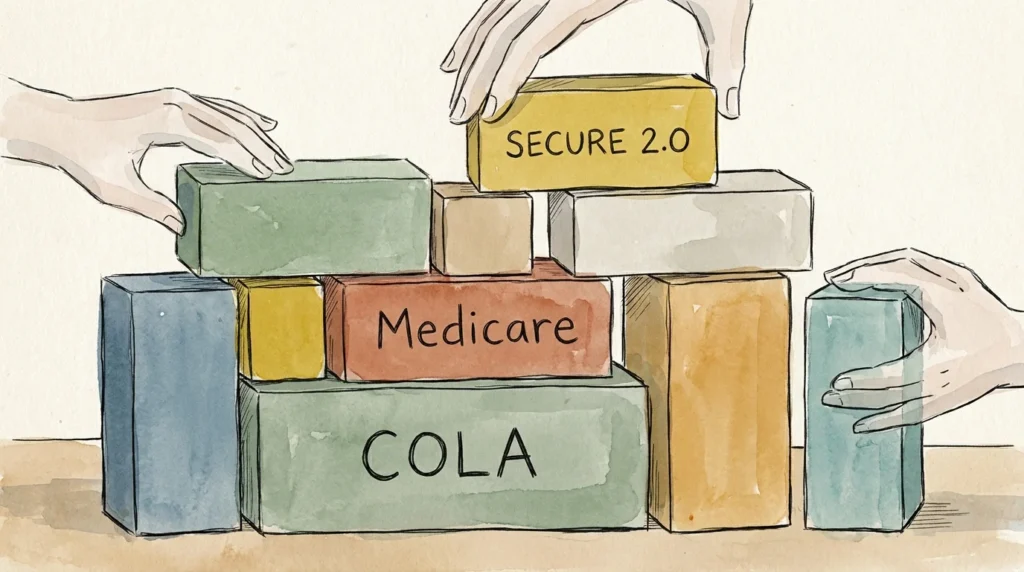
Federal statutes and agency regulations govern your Social Security checks, determining exactly how much money lands in your bank account each month. Recent legislative battles and administrative rulings have significantly reshaped these calculations.
Navigating the modern retirement landscape requires an exact understanding of these evolving statutory limits. You cannot afford to rely on outdated assumptions when planning your household financial future.
This comprehensive guide breaks down the ten essential legal and regulatory facts you must understand right now. Learn how recent statutory updates directly influence your monthly benefits, payroll deductions, and retirement timeline.

The Flashpoint: Capitol Hill Clashes Over Entitlement Policy
Political warfare over federal retirement policy reached a dramatic boiling point following high-stakes negotiations across Capitol Hill. Lawmakers passed landmark legislation that altered decades of established pension rules while igniting fierce debate over fiscal solvency.
Partisan factions clashed over spending priorities, revenue models, and agency enforcement mandates. The resulting statutes restructured key operational guidelines that dictate how the federal government administers your earned retirement benefits.
Meanwhile, the executive branch implemented revised administrative rules to manage massive operational overhauls. These administrative decisions directly control benefit processing speeds, disability eligibility standards, and taxable wage limits across the nation.
Behind the floor debates and committee markups lies a pressing financial reality. Federal policymakers must balance escalating retirement rolls against finite payroll tax revenue as statutory trust fund deadlines rapidly approach.
Power Players: Coalitions, Donors, and Administrative Pushback
A shifting web of political coalitions drives the current battle over Social Security regulations. Bipartisan caucuses formed unexpected alliances with organized labor to force long-delayed legislative votes on public pension reforms.
Public sector unions, representing millions of teachers and first responders, spent years lobbying lawmakers to overturn historic benefit penalties. Their concerted push overcame entrenched resistance from fiscal deficit hawks who warned against adding unfunded liabilities.
At the same time, pro-business lobbying groups focused on blocking proposed expansions to payroll taxes. Wealthy donors and trade associations consistently mobilized campaign resources to protect higher earners from increased tax rates.
Agency leadership at the Social Security Administration found itself caught directly in the crosshairs. Officials struggled to implement complex statutory mandates while managing persistent staffing shortages and congressional oversight inquiries.
Grassroots senior advocacy organizations countered corporate lobbying by activating millions of voting retirees. Their relentless pressure campaigns ensured that any discussion of statutory benefit cuts remained politically hazardous for vulnerable incumbents.
Fact 1: Full Retirement Age Reaches Its Permanent Statutory Limit
For decades, federal law gradually raised the Full Retirement Age to compensate for increasing American life expectancies. Under the historic 1983 Social Security Amendments, that gradual phase-in reached its final statutory milestone in 2026.
If you were born in 1960 or later, your Full Retirement Age is now permanently fixed at age 67. You cannot claim your full, unreduced retirement benefit until you reach this exact legal age.
Choosing to claim benefits early at age 62 triggers severe, permanent financial consequences. The law imposes a permanent 30% reduction on your monthly primary insurance amount if you claim at the earliest opportunity.
Spousal benefits claimed at age 62 suffer an even steeper permanent cut of 35%. You permanently lock in these reduced monthly payments for the remainder of your retirement life.
Conversely, delaying your retirement claim past your Full Retirement Age yields substantial statutory bonuses. Federal law credits you with delayed retirement credits worth 8% per year for every year you wait up to age 70.

Fact 2: The Social Security Fairness Act Reshapes Public Pensions
On January 5, 2025, the president signed into law the landmark Social Security Fairness Act, known formally as H.R. 82. You can review the enacted statutory language directly through the Congress legislative tracking portal.
This monumental statute repealed both the Windfall Elimination Provision and the Government Pension Offset. These two controversial rules had curtailed benefits for non-covered public servants for more than four decades.
The legislative victory restored full Social Security benefits for roughly 3.2 million retired public-sector workers across the country. Impacted beneficiaries include retired teachers, firefighters, municipal employees, and police officers who earned non-covered government pensions.
Crucially, the legislation provided retroactive benefit adjustments dating back to January 2024. Eligible retirees, surviving spouses, and dependent family members gained substantial lump-sum corrections alongside increased monthly payments.
This reform eliminated the painful dual-benefit penalty that previously wiped out spousal and survival protections. Surviving spouses of public servants can now access their full earned spousal benefits without statutory government pension offsets.
Fact 3: Annual COLA Adjustments Determine Your Purchasing Power
Federal regulations mandate an annual Cost-of-Living Adjustment to protect your benefits from persistent consumer inflation. The Social Security Administration benchmarks this adjustment against third-quarter consumer price index data every autumn.
For 2026, the statutory Cost-of-Living Adjustment was set at 2.8%, providing a modest lift to monthly checks. That adjustment reflected moderating price increases across key retail, housing, and energy sectors nationwide.
Economic conditions shifted rapidly throughout the following fiscal year. In October 2026, the Social Security Administration announced that the Cost-of-Living Adjustment for 2027 will increase to 3.6%.
This 3.6% boost takes effect in January 2027 for nearly 72 million Social Security beneficiaries. Furthermore, 7.3 million Supplemental Security Income recipients will receive their increased checks on December 31, 2026.
The 2027 increase raises the average retirement benefit check by about $75 per month. While these statutory adjustments preserve nominal purchasing power, rising healthcare premiums and living costs continue to strain household budgets.
Fact 4: The Payroll Tax Cap Dictates High-Earner Contributions
Federal law funds retirement benefits through dedicated Old-Age, Survivors, and Disability Insurance payroll taxes. Employees contribute a statutory 6.2% tax on their gross wages, matched by another 6.2% contribution from their employers.
If you work as an independent contractor or run a small business, you pay the full self-employed rate of 12.4%. However, federal statute limits this tax burden through an annually adjusted wage base cap.
In 2026, workers pay the payroll tax only on covered earnings up to $184,500. Any dollar you earn above that specific statutory ceiling remains completely exempt from Social Security payroll taxes.
Federal formulas dictate that this ceiling rises alongside national average wage growth. For 2027, the statutory wage base limit climbs to $192,300, requiring higher-income professionals to contribute taxes on an additional $7,800 in earnings.
Progressive lawmakers repeatedly introduce legislation to eliminate or lift this earnings ceiling to shore up program solvency. However, business coalitions and conservative leaders continue to resist expanding payroll taxes on high earners.
Fact 5: The Retirement Earnings Test Temporarily Claws Back Income
If you decide to claim benefits before reaching your Full Retirement Age while continuing to work, federal law restricts your earned income. The Retirement Earnings Test mandates automatic benefit withholdings once your wages exceed specific statutory thresholds.
For workers who remain under their Full Retirement Age throughout 2026, the exempt earnings limit is $24,480, or $2,040 per month. The Social Security Administration withholds $1 in benefits for every $2 you earn above that limit.
In 2027, this lower annual earnings limit rises to $25,560, which equals $2,130 per month. You must closely track your earned wages to prevent unexpected withholding notices from the agency.
A more generous statutory threshold applies during the specific calendar year in which you achieve Full Retirement Age. In 2026, that upper limit is $65,160, or $5,430 per month, for months before reaching full age.
For 2027, this threshold increases to $67,920, or $5,660 per month. Under this rule, the agency withholds only $1 for every $3 you earn above the statutory cap.
Beneficiaries must remember that these withheld funds do not disappear permanently. Once you reach Full Retirement Age, the agency recalculates your monthly benefit upward to account for the withheld months.
Fact 6: The 35-Year Formula Shapes Your Baseline Benefit
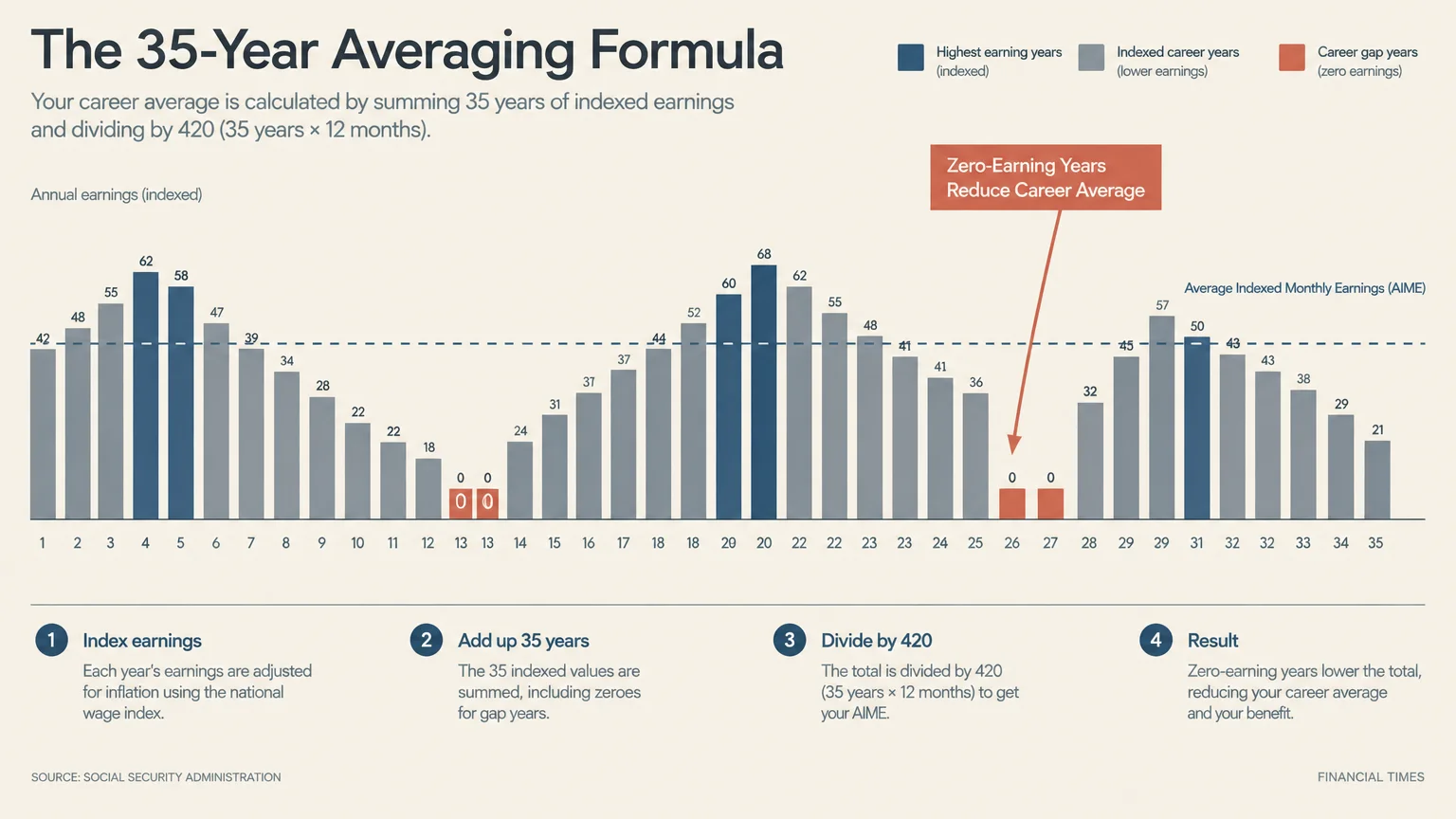
Your primary insurance amount does not reflect what you contributed during your final years in the workforce. Instead, federal regulations calculate your monthly benefit based on your highest 35 years of indexed earnings.
The Social Security Administration indexes your historical annual wages to national wage trends before applying statutory formula bend points. This mathematical framework replaces a larger percentage of pre-retirement earnings for lower-income workers.
If you worked fewer than 35 years in covered employment, the agency enters a zero for each missing year. Even a single zero year in your earnings ledger can significantly depress your lifetime monthly benefits.
Qualifying for any retirement benefit at all requires you to accumulate at least 40 work credits throughout your career. You can earn a statutory maximum of four credits per calendar year.
In 2026, you earn one work credit for every $1,890 of covered earnings, meaning $7,560 secures your full four credits. For 2027, the threshold increases to $1,970 per credit, requiring $7,880 in annual earnings.
Fact 7: Maximum Monthly Payouts Require Decades of Peak Taxes
Beneficiaries frequently ask about the absolute maximum monthly check payable under federal law. Receiving the top tier payout requires an extraordinary career of sustained top-bracket earnings across 35 separate working years.
You must earn at or above the maximum taxable earnings limit for 35 distinct years to qualify for the highest possible payout. Failing to hit the cap in even a few years will lower your calculated check.
For a worker retiring precisely at Full Retirement Age, the maximum monthly benefit is $4,152 in 2026. This statutory maximum increases slightly to $4,188 per month for workers claiming at full age in 2027.
Workers who maximize their earnings and delay claiming until age 70 unlock the absolute highest tier of federal retirement benefits. In 2026, the maximum monthly payment for a worker claiming at age 70 is $5,181 per month.
While relatively few Americans achieve this top benefit, tracking these figures illustrates the statutory mechanics of delayed claiming credits. Delaying your claim remains the single most effective legal mechanism for maximizing guaranteed monthly income.
Fact 8: The Senior Tax Deduction Alters Retirement Tax Liabilities
Federal taxation of Social Security benefits remains a persistent flashpoint for retirees and fiscal policymakers. Enacted on July 4, 2025, the One Big Beautiful Bill Act, Public Law 119-21, introduced sweeping revisions to federal tax statutes.
However, the new law did not eliminate underlying federal income taxes on Social Security benefits as some advocates had anticipated. Up to 85% of your benefits remain taxable if your combined income exceeds established statutory limits.
Those statutory thresholds remain completely unindexed for inflation, hitting single filers with combined incomes over $34,000. Married couples filing jointly face taxation on up to 85% of their benefits once combined income exceeds $44,000.
To alleviate this tax burden, the 2025 statute created a temporary senior deduction applicable for tax years 2025 through 2028. Single filers age 65 and older can deduct up to $6,000 from their federal taxable income.
Married couples filing jointly where both spouses are 65 or older can claim a temporary deduction of up to $12,000. This temporary tax relief reduces net obligations without dismantling the underlying Social Security trust fund revenue stream.

Fact 9: Substantial Gainful Activity Thresholds Limit Disability Earnings
Strict statutory definitions govern the Social Security Disability Insurance program, requiring recipients to demonstrate an inability to perform substantial work. The agency enforces this rule through rigid Substantial Gainful Activity monthly earnings thresholds.
If you receive disability benefits and earn above these statutory limits, the agency may terminate your monthly payments. For non-blind disability beneficiaries, the Substantial Gainful Activity threshold is $1,690 per month in 2026.
In 2027, that monthly earnings ceiling for non-blind individuals increases to $1,770 per month. Exceeding this amount triggers administrative reviews regarding your continuing disability eligibility.
The law establishes a higher monthly threshold for individuals who meet the statutory definition of blindness. Blind beneficiaries can earn up to $2,830 per month in 2026, and that limit rises to $2,950 per month in 2027.
Beneficiaries testing their ability to work can utilize a statutory Trial Work Period without immediately losing their monthly benefits. The earnings threshold that counts toward a Trial Work month is $1,210 in 2026, rising to $1,270 in 2027.
Fact 10: Trust Fund Insolvency Projections Accelerate the Fiscal Clock
The financial integrity of the Social Security system faces an urgent statutory deadline that Congress can no longer ignore. Long-term demographic trends and shifting tax revenues continue to erode the reserves held within the federal trust funds.
Released in June 2026, the official Social Security Trustees Report delivered a stark warning regarding reserve depletion dates. The trustees projected that the Old-Age and Survivors Insurance Trust Fund will deplete its asset reserves in the fourth quarter of 2032.
This depletion date moved forward from 2033 in the prior report, driven partly by lower tax revenues from the 2025 legislation. Without congressional intervention before late 2032, the system will face automatic benefit reductions under current governing statutes.
If the OASI reserve depletes in late 2032, incoming payroll taxes will only cover 78% of scheduled retirement benefits. That shortfall would force an immediate, across-the-board 22% cut for all retirement beneficiaries.
The report also evaluated the combined Old-Age, Survivors, and Disability Insurance trust funds, which face full depletion by 2034. At that point, incoming revenues would support only 83% of scheduled benefit disbursements.
Nonpartisan researchers at the Congressional Budget Office have corroborated these timeline pressures across recent fiscal reports. Lawmakers must choose between raising payroll revenue, adjusting statutory retirement ages, or restructuring benefit formulas.
Constituent Impact: How Changing Regulations Divide Communities
Regulatory shifts and statutory thresholds do not exist in an abstract economic vacuum. These rules reshape daily household finances for tens of millions of seniors, surviving spouses, and workers across the nation.
In Sunbelt retirement havens, escalating property taxes and private healthcare expenses collide directly with the static taxation thresholds. Single seniors earning modest pensions find themselves pushed into taxable brackets because the $34,000 threshold has never changed.
The repeal of the Windfall Elimination Provision brought immediate, life-changing financial relief to public servants in states like Texas and California. Thousands of retired teachers who lost spousal benefits finally received retroactive payments that restored their economic independence.
Working-class families in rural manufacturing hubs face distinct challenges under the permanent increase of the retirement age to 67. Blue-collar laborers performing physically punishing work often cannot wait until full age, forcing them to accept permanent 30% benefit cuts.
For younger workers entering the labor force, trust fund insolvency projections create pervasive cynicism regarding future benefits. Polling data indicates that young Americans increasingly doubt whether scheduled Social Security benefits will exist when they retire.

Oversight, Ethics, and Administrative Bottlenecks
Behind statutory mandates lies the sprawling operational machinery of the Social Security Administration. The agency has struggled under persistent administrative burdens, creating severe customer service backlogs and processing delays for applicants.
Congressional oversight committees have repeatedly questioned agency leadership regarding extended wait times for disability hearings. Applicants frequently wait over a year for an administrative law judge to review contested disability claims.
Inquiries from federal watchdogs highlighted severe customer service breakdowns across regional field offices and telephone support centers. Beneficiaries attempting to report wage changes or clarify earnings test withholdings routinely encounter dropped calls and contradictory guidance.
Meanwhile, government ethics watchdogs monitor potential conflicts of interest among private consulting firms contracted to modernize administrative software. Delays in rolling out automated benefit calculation systems have cost taxpayers tens of millions of dollars in supplemental appropriations.
You can verify your historical earnings record and monitor administrative determinations directly through the official Social Security Administration web portal. Auditing your personal earnings record annually ensures the agency calculates your future benefits using accurate wage records.
Frequently Asked Questions About Social Security Rules
When will the Social Security Administration apply the 2027 COLA?
The agency applies the 3.6% Cost-of-Living Adjustment to monthly benefits starting with checks disbursed in January 2027. This adjustment will increase average retirement benefits by approximately $75 per month for nearly 72 million beneficiaries.
If you receive Supplemental Security Income, federal rules disburse payments on the nearest preceding business day when holidays interfere. Consequently, 7.3 million SSI recipients will see their increased payment arrive on December 31, 2026.
How does the repeal of WEP and GPO handle retroactive payments?
Under the Social Security Fairness Act signed on January 5, 2025, benefit adjustments are retroactive to January 2024. The agency automatically recalculates records for roughly 3.2 million affected public-sector retirees and surviving spouses.
If you qualify for restored payments under this statute, the agency issues retroactive lump sums directly to your account. You do not need to file a new application unless the agency contacts you for updated employment documentation.
Does the senior tax deduction wipe out all taxes on benefits?
No, the One Big Beautiful Bill Act of 2025 did not eliminate the underlying taxation of Social Security benefits. Up to 85% of your benefits remain subject to federal taxation if your income exceeds established thresholds.
However, the law introduced a temporary senior deduction of up to $6,000 for singles and $12,000 for couples. This temporary deduction, active for tax years 2025 through 2028, helps offset taxable income for filers age 65 and older.
What automatic cuts take effect if Congress misses the 2032 deadline?
If Congress fails to pass solvency legislation before the fourth quarter of 2032, federal statutes mandate automatic cuts. The Old-Age and Survivors Insurance Trust Fund will deplete its reserves, leaving only incoming payroll revenue.
Incoming payroll taxes will only cover 78% of scheduled retirement benefits, resulting in an automatic 22% reduction in checks. If combined trust funds exhaust reserves by 2034, only 83% of scheduled benefits will be payable.
Outlook: Critical Milestones for the Legislative Agenda
The ticking clock on trust fund reserves will dominate congressional economic agendas over the coming legislative sessions. Lawmakers face an inescapable choice between revenue increases, benefit restructuring, or comprehensive bipartisan compromise.
Key committee hearings in both chambers of Congress will scrutinize long-term actuarial estimates and tax revenue projections. Lawmakers from both parties will face intense pressure from senior advocacy groups to protect core benefit formulas.
Concurrently, the temporary senior deduction established under the 2025 tax statute expires after tax year 2028. Its impending expiration will trigger a fierce legislative showdown over whether to extend senior tax relief permanently.
You should closely monitor these legislative developments as congressional leaders negotiate upcoming federal budget packages. Understanding the legal and regulatory rules governing your Social Security benefits empowers you to safeguard your long-term retirement security.