
Senator Bernie Sanders wants to boost your Social Security check by $200 every month. His legislative blueprint delivers an extra $2,400 per year directly to millions of current and future American retirees.
The proposal promises to fund this expansion while safeguarding full retirement benefits for the next seventy-five years. It targets high-income earners by applying payroll taxes to all annual compensation above $250,000.
You face an impending benefit cliff if Washington fails to resolve trust fund shortfalls within the decade. Here is an unvarnished analysis of whether this sweeping progressive expansion can actually survive Capitol Hill.
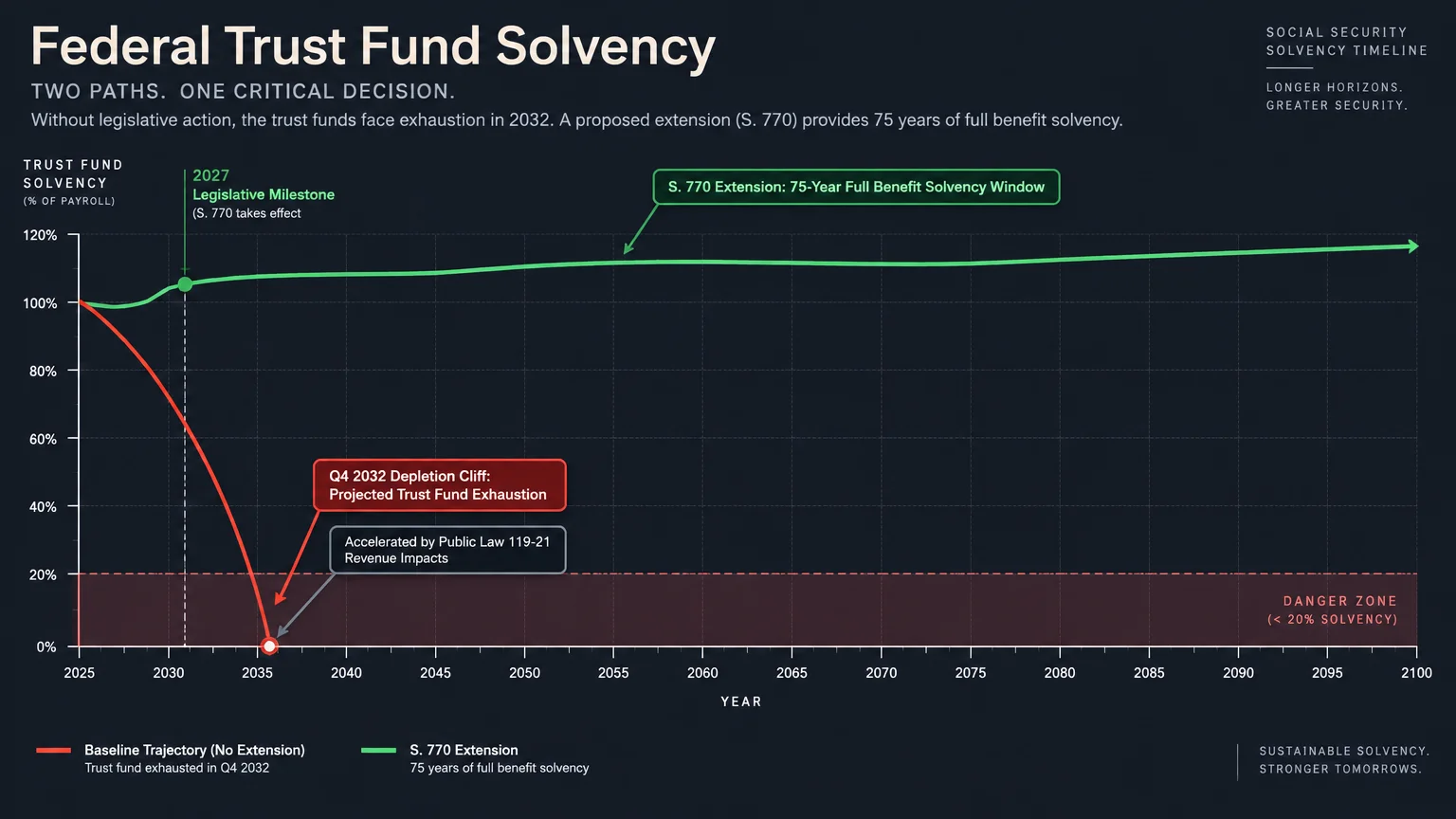
The Flashpoint: Sanders Targets the Looming Solvency Cliff
Following the November 3, 2026 midterm elections, congressional balance tipped toward razor-thin margins. Senator Sanders wasted no time shifting the legislative focus toward older Americans and federal entitlement solvency.
On November 7, 2026, Sanders announced that passing the benefit expansion stands as his preeminent legislative goal for the upcoming legislative session.
He is poised to take over as Chair of the Senate Finance Subcommittee on Social Security, Pensions, and Family Policy in January 2027. That gavel grants him formal control over hearings, witness testimony, and committee agendas.
His primary vehicle is the Social Security Expansion Act (S. 770), co-sponsored by Massachusetts Senator Elizabeth Warren. Representatives Jan Schakowsky and Val Hoyle introduced companion legislation in the House of Representatives.
The announcement arrived against a ticking fiscal clock that threatens every retired household in America. Long-term demographic pressures have accelerated the drawdowns on federal trust reserves.
The Social Security and Medicare Trustees released their annual report on June 9, 2026. Their findings painted an increasingly urgent picture for the nation’s primary social safety net.
Trustees accelerated the projected depletion date for the Old-Age and Survivors Insurance Trust Fund into the fourth quarter of 2032. That development moved the insolvency window forward from earlier estimates.
Federal actuaries cited shifting economic conditions alongside lower projected fertility and immigration rates as key drivers. Legal changes also accelerated the depletion timeline.
Congress enacted the “One Big Beautiful Bill Act” (Public Law 119-21) in July 2025. By lowering tax liabilities for certain seniors, that statute simultaneously reduced tax revenues dedicated to the trust funds.
Sanders seized on this worsened solvency outlook to frame his bill as both an expansion and a rescue package. He rejects the traditional bipartisan framework that pairs revenue increases with benefit cuts.
Seniors across the nation are already adjusting household budgets to navigate elevated living costs. Food, prescription medication, and property insurance continue to absorb disproportionate shares of retirement checks.
Understanding the interplay between federal trust funds and congressional maneuvers helps you anticipate future policy shifts. You cannot afford to rely on campaign promises without analyzing the legislative hurdles ahead.
Players and Strategy: The Battle Across Capitol Hill
Passing structural entitlement changes demands a sophisticated coalition across both chambers of Congress. Sanders is marshaling labor unions, progressive think tanks, and retiree advocacy groups to pressure moderate lawmakers.
Retiree advocacy organizations and progressive grassroots networks have intensified their public campaigns across key swing states. They argue that persistent living costs require an immediate adjustment to monthly retirement guarantees.
Labor federations view this fight as a referendum on wealth distribution and middle-class economic security. Their political action committees are targeting lawmakers who resist corporate or high-income tax increases.
Lobbying coalitions representing corporate employers and high-income executives are preparing counter-campaigns on Capitol Hill. They argue that doubling down on entitlement taxes harms overall economic competitiveness.
These business advocacy groups will lobby moderate senators to block floor consideration of the bill. Their strategy focuses on highlighting potential risks to investment capital and private sector hiring.
The Progressive Coalition and Grassroots Mobilization
Sanders and Warren argue that the program’s funding challenges stem from an unfair tax cap rather than overspending. They maintain that the wealthiest Americans should not stop paying into the program early in the calendar year.
Grassroots organizers emphasize that an extra $200 per month prevents vulnerable seniors from slipping beneath the poverty line. Many recipients currently balance escalating prescription costs against basic utility expenses.
Progressive lawmakers plan to use subcommittee hearings to showcase personal testimony from seniors struggling with fixed incomes. These public sessions aim to make opposition politically costly for lawmakers in competitive districts.
The coalition also points out that Social Security forms the primary income source for a majority of older Americans. Expanding the baseline check provides immediate economic stimulus across local communities.
Advocacy groups are running targeted digital ad campaigns in states with large retiree populations. They aim to make protecting and expanding benefits a litmus test for the upcoming legislative cycle.
You can see how progressive strategists intend to frame any opposition as an attack on earned benefits. This messaging seeks to force moderate lawmakers to choose between tax hikes on the wealthy and benefit reductions.
Congressional Leadership and Filibuster Politics
Despite progressive enthusiasm, the legislative arithmetic in the Senate remains steep. The bill faces unified opposition from Republican lawmakers who reject tax increases on high earners and business income.
Conservative leaders argue that higher payroll taxes would depress business investment and discourage job growth. They advocate instead for gradually raising the retirement age or trimming future benefit formulas for high earners.
Procedural barriers present an even steeper obstacle than partisan disagreements. Under Senate rules, advancing substantive Social Security legislation requires 60 votes to overcome an inevitable filibuster.
Lawmakers cannot easily bypass this 60-vote threshold using the budget reconciliation process. The Byrd Rule specifically prohibits provisions altering Social Security from inclusion in reconciliation measures.
President Donald Trump has repeatedly vowed to veto any tax-raising measure that reaches his desk. Without substantial Republican crossover support, progressive sponsors cannot assemble a veto-proof two-thirds majority in either chamber.
Moderate lawmakers from both parties often express skepticism about expanding total program obligations while trust funds face insolvency. They argue that fiscal prudence demands stabilizing the existing benefit structure before promising higher payouts.
This political reality leaves the bill in a familiar congressional holding pattern. Sanders can command public attention through hearings, but converting that attention into statutory law requires bipartisan concessions.
Policy Breakdown: How the Social Security Expansion Act Works
The Social Security Expansion Act restructures both incoming revenue streams and outgoing payment formulas. You need to understand how these proposed statutory changes alter the program’s foundation.
The legislation addresses systemic solvency while simultaneously boosting checks for both current and incoming retirees. Sanders describes the plan as a comprehensive rebalancing of the social contract.
Lifting the Payroll Tax Cap on High Earners
The current system applies the 12.4% payroll tax, split equally between workers and employers, only up to a set annual cap. In 2026, workers only pay that tax on their first $184,500 of earnings.
On October 14, 2026, the Social Security Administration announced that the taxable wage cap rises to $192,300 in 2027. Only about 6% of covered workers earn compensation exceeding that taxable maximum.
Under current law, high-income earners stop contributing to the retirement system once their earnings hit that threshold. An executive earning several million dollars pays the exact same payroll tax dollar amount as an upper-middle earner.
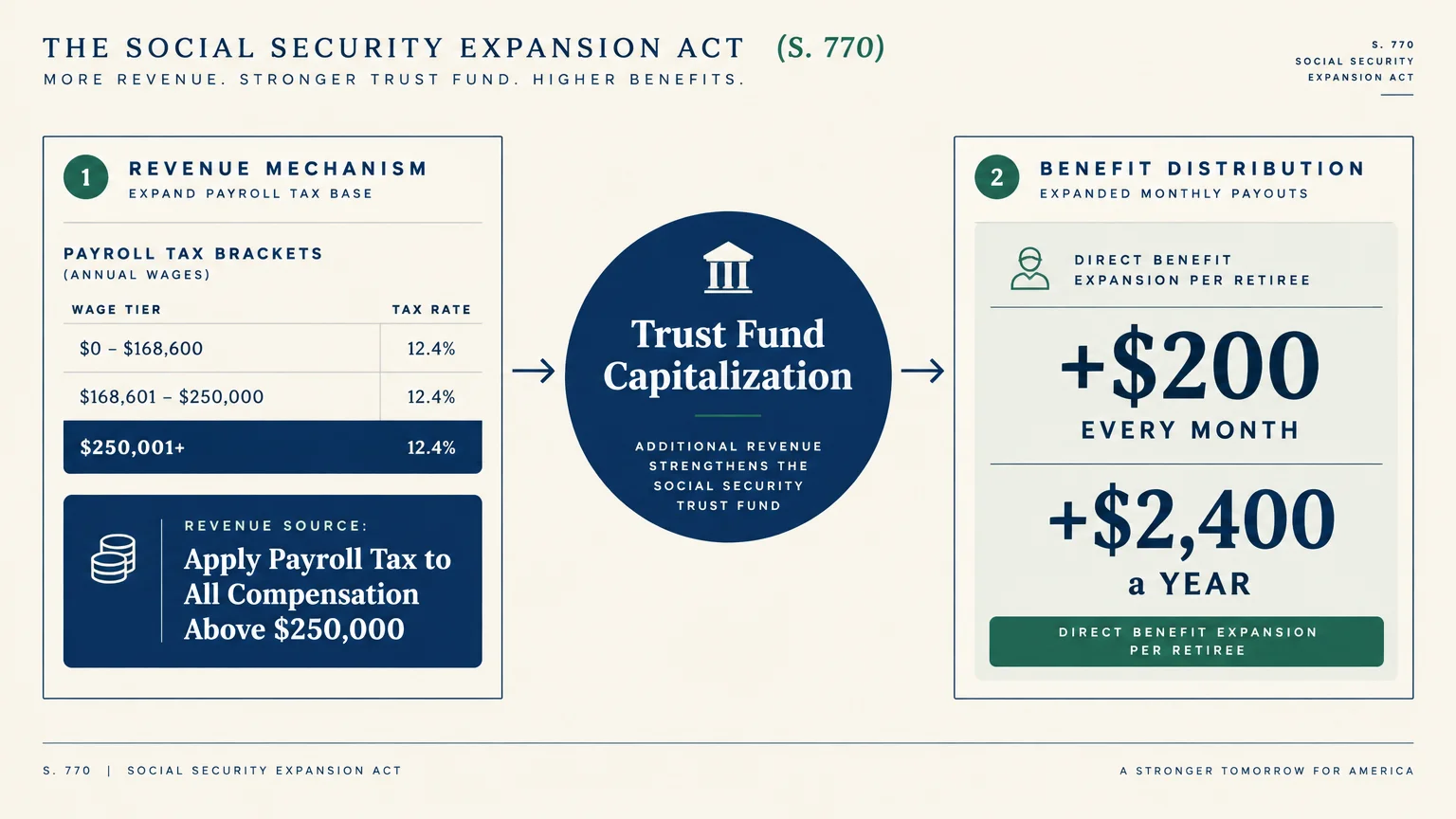
Sanders’s bill institutes a concept known as “scrap the cap.” It re-applies the 12.4% payroll tax on all individual wages and self-employment earnings exceeding $250,000.
This structure creates a temporary doughnut hole between the statutory cap and $250,000. As wage inflation pushes the standard taxable cap upward, that gap will gradually close entirely.
The bill also targets passive wealth by expanding the Net Investment Income Tax. It raises that rate from 3.8% to 16.2% for individual filers making over $200,000 and joint filers earning over $250,000.
This provision effectively layers a 12.4% assessment onto capital gains, dividends, and business profits. The bill routes 62% of those newly collected investment tax receipts directly into the Social Security Trust Fund.
By taxing unearned investment income alongside standard paychecks, the bill dramatically expands the revenue base. Proponents argue this modernizes the funding model to capture modern forms of wealth accumulation.
The bill’s dual approach to wages and investment earnings represents a fundamental structural departure from historical norms. Social Security has historically functioned almost exclusively on wage-based payroll contributions.
Channeling Net Investment Income Tax proceeds into the trust fund creates a brand-new precedent for entitlement financing. Lawmakers on both sides of the aisle recognize this as a transformative structural shift.
The Formula Shift: Boosting the Primary Insurance Amount
To deliver the promised $2,400 annual increase, the bill modifies how the government calculates your initial benefit. It updates the Primary Insurance Amount formula used by the Social Security Administration.
Under existing law, the formula applies three progressive percentages across specific wage thresholds known as bend points. The formula credits 90% of your average indexed monthly earnings up to the first threshold.
The Sanders legislation raises that first calculation factor from 90% to 95%. It also raises the dollar level of the first bend point itself.
This adjustment lifts monthly payouts by an average of $200 across the board. Every eligible recipient receives the same dollar bump, providing the largest proportional boost to lower-wage workers.
The maximum monthly benefit for a worker retiring at full retirement age reached $4,152 in 2026. That cap climbs to $4,188 in 2027 under current statutory rules.
Under the proposed reform, that baseline climbs further for every beneficiary, regardless of when they claimed benefits. Current retirees would see their checks adjusted upward upon statutory enactment.
Adopting the CPI-E for Annual Living Adjustments
The legislation fundamentally overhauls how the federal government calculates the annual Cost-of-Living Adjustment. The current formula relies on the Consumer Price Index for Urban Wage Earners and Clerical Workers.
Critics argue that index reflects spending habits of working-age urban employees rather than aging retirees. Working adults spend more on commuting and technology, whereas seniors allocate substantially more to healthcare and housing.
The bill mandates the use of the Consumer Price Index for the Elderly (CPI-E). This specialized metric gives greater weight to medical expenses, prescription drugs, and home energy bills.
For 2027, the SSA announced a 3.6% COLA based on the standard index. That raise increases the average retired worker’s benefit by roughly $75 per month.
Average monthly payments will rise from approximately $2,095 in 2026 to $2,170 starting in January 2027. Progressive reformers contend a CPI-E calculation would preserve retiree purchasing power far more effectively over time.
Over a multi-decade retirement, even a fraction of a percentage point increase in annual adjustments compounds significantly. This compounding provides a meaningful hedge against the specific inflationary pressures that older Americans encounter.
Constituent Impact: What the Changes Mean for Your Wallet
Policy debates on Capitol Hill directly dictate whether your household finances stay afloat. Understanding the tension between proposed benefit hikes and impending insolvency cuts gives you a practical planning edge.
A monthly increase of $200 provides meaningful relief against cumulative grocery and utility price increases. For millions of single retirees, that adjustment determines whether they can afford prescribed medications.
You must balance the optimism of legislative proposals against the hard statutory timelines currently governing your benefits. Planning your retirement requires evaluating both best-case legislative outcomes and baseline statutory projections.
Immediate Monthly Gains for Low and Middle Earners
The flat $200 monthly increase disproportionately benefits seniors who worked in lower-wage careers. A recipient currently collecting $1,200 monthly would experience a direct 16.6% boost to their regular income.
That additional capital injects predictable purchasing power into local economies. Beneficiaries spend those funds immediately on necessary goods, supporting neighborhood businesses and healthcare providers.
The legislation preserves existing earned benefits while ensuring that future retirees do not face a degraded standard of living. It also provides structural protections for widow benefits and disabled workers.
Self-employed individuals earning high incomes would face significant additional obligations under the proposed revenue provisions. In 2027, the maximum annual employee payroll tax reaches $11,922.60, or $23,845.20 for self-employed workers.
Scrapping the cap would force high-earning professionals and business owners to pay that 12.4% rate on every dollar above $250,000. That represents a substantial fiscal shift for top-tier income earners.
If you run a small business or work as an independent consultant, this change directly impacts your tax liabilities. You would need to adjust quarterly estimated payments to account for the uncapped payroll liability.
If you currently rely on Supplemental Security Income or minimum Social Security benefits, every additional dollar matters. The flat-dollar increase directly helps lower-income retirees who struggle to meet basic nutritional needs.
Financial advisors urge pre-retirees to evaluate their anticipated income streams under varying legislative scenarios. Incorporating different benefit projections into your retirement roadmap prevents unpleasant financial surprises down the road.
The Looming Automatic Cut If Lawmakers Fail to Act
While Sanders pushes for expansion, doing nothing carries devastating financial consequences for your retirement. The federal government operates Social Security under strict statutory balance rules.
According to the Social Security Trustees Report, the OASI trust fund will deplete its cash reserves during the fourth quarter of 2032.
When that exhaustion occurs, the program can only pay out what it collects through ongoing payroll taxes. Incoming revenues will only cover approximately 78% of scheduled retirement benefits.
That funding shortfall triggers an automatic 22% benefit cut for all retired workers across America. A retiree receiving $2,170 per month would see their check slashed by nearly $477 overnight.
If actuaries measure the Old-Age and Disability Insurance funds together, reserves run dry in the third quarter of 2034. At that point, the system could only disburse 83% of scheduled payments, forcing a 17% cut.
This impending reduction creates an unprecedented retirement crisis for millions who lack substantial private savings. Washington’s paralysis does not maintain the status quo; it guarantees an automatic benefit reduction.
You should calculate your projected retirement income assuming that 2032 reduction as a worst-case baseline. Taking steps to build independent savings provides essential insurance against congressional inaction.

Oversight and Ethics: Budget Scoring, Watchdogs, and Tax Reality
Nonpartisan oversight agencies scrutinize any major overhaul to evaluate long-term financial stability. Actuaries and budget analysts have closely examined the fiscal architecture underpinning Sanders’s bill.
The SSA Office of the Chief Actuary analyzed the Social Security Expansion Act. Their formal actuarial evaluation confirmed that the bill extends system solvency for at least 75 years.
That 75-year window covers the entirety of the federal government’s long-range demographic projection model. Raising the payroll tax cap and capturing investment gains eliminates the projected multi-trillion-dollar financing deficit.
Watchdog groups emphasize that relying heavily on investment surtaxes carries distinct economic risks. Capital gains realizations fluctuate significantly depending on market performance and broader macroeconomic cycles.
A prolonged stock market downturn could produce lower tax collections than federal actuaries predict. In contrast, standard payroll taxes on earned wages provide a far more dependable revenue stream.
Opponents also point out that the legislation severs the traditional link between contributions and benefits for high earners. Under the bill, top earners pay taxes on income above $250,000 without earning any additional retirement credits.
Critics argue this transforms Social Security from a universal contributory social insurance model into a redistributive welfare program. Proponents counter that high earners already enjoy extensive tax advantages on private retirement accounts.
Budget analysts also examine how the expanded investment surtax interacts with state income taxes. High earners in high-tax states could face top marginal tax rates exceeding 50% under the combined tax codes.
Watchdog organizations continue to push lawmakers for transparent hearings on these distributional impacts. Lawmakers must balance the necessity of program solvency against the broader economic effects of significant tax restructuring.
Government accountability watchdogs also scrutinize administrative readiness at the Social Security Administration itself. The agency faces operational backlogs and customer service staffing challenges that could complicate major statutory overhauls.
Implementing an overhaul of the Primary Insurance Amount formula requires substantial software updates and administrative retraining. Lawmakers must allocate dedicated funding to ensure the agency can execute complex statutory changes smoothly.
Frequently Asked Questions
Will Congress pass the $2,400 Social Security increase this session?
Enacting the legislation into law during the current session remains extremely unlikely. Although Senator Sanders will hold hearings as subcommittee chair, the bill faces insurmountable obstacles in both chambers.
Passing the measure requires 60 votes in the Senate to defeat a Republican filibuster. Furthermore, President Trump remains firmly opposed to tax hikes on high earners and investment gains.
You should view this legislation primarily as a positioning document for ongoing national entitlement debates. It establishes the progressive negotiating baseline rather than an imminent statutory reality.
How would the proposed payroll tax changes affect high earners?
Workers currently stop paying the 6.2% employee payroll tax once their earnings reach $184,500 in 2026 and $192,300 in 2027. Under S. 770, the 12.4% tax re-applies to all earnings exceeding $250,000.
High-income filers would also see their Net Investment Income Tax rate rise from 3.8% to 16.2%. That creates a significant new tax obligation on capital gains, dividends, and passive partnership income.
High earners would not receive higher monthly retirement benefits in exchange for these additional tax payments. The legislation channels those extra contributions directly into funding baseline increases and long-term trust solvency.
Why would switching to the CPI-E formula alter your yearly raise?
The CPI-E tracks the specific spending habits of households aged 62 and older. It assigns heavier weight to medical care, prescription drugs, and housing costs than the standard CPI-W formula.
Because healthcare and residential costs generally rise faster than everyday consumer goods, the CPI-E typically produces higher annual adjustments. Over decades, this compounded growth protects retirees from eroding purchasing power.
While the difference in any single year might appear modest, cumulative increases preserve living standards over long retirements. You would experience greater financial stability against late-life healthcare cost spikes.
What happens to your monthly check if lawmakers take no action?
If Congress fails to enact structural solvency reforms, the primary retirement trust fund faces exhaustion in late 2032. The program would then depend entirely on incoming tax revenues.
Those incoming revenues will only cover roughly 78% of scheduled benefits. Consequently, every Social Security recipient would suffer an automatic 22% benefit cut starting in 2032.
This statutory cliff gives lawmakers a hard deadline to negotiate an eventual compromise. Doing nothing guarantees a sharp standard-of-living reduction for tens of millions of vulnerable American households.
Legislative Outlook: Key Milestones to Watch in Washington
While immediate passage is unlikely, the political battle will shape entitlement policy for years to come. You should monitor several key milestones as the debate progresses on Capitol Hill.
In January 2027, Sanders assumes the gavel of the Senate Finance Subcommittee on Social Security. He will immediately schedule high-profile public hearings to build momentum and highlight retirement poverty.
Watch for competing legislative proposals from moderate Democrats and conservative Republicans. Some bipartisan lawmakers favor establishing an independent fiscal commission to negotiate trust fund solutions behind closed doors.
Pay close attention to whether any centrist lawmakers endorse lifting the payroll cap without adopting the full benefit expansion. A compromise might apply taxes above $250,000 solely to shore up solvency without funding the $2,400 hike.
The next major public milestone occurs when the Social Security Trustees release their 2027 annual report. If economic growth slows, the trust fund depletion date could creep even closer.
Every year Congress delays action, the fiscal adjustments necessary to balance the system become more severe. Lawmakers will eventually face an inescapable choice between broad benefit reductions and substantial revenue increases.
You should track roll-call votes and committee hearings closely to see where your representatives stand. Protecting your personal retirement timeline requires understanding the legislative mechanics shaping the future of Social Security.
You should review your annual Social Security statement online through the agency’s official portal. Verifying your recorded earnings history ensures that your baseline calculation remains accurate regardless of legislative outcomes.
Staying informed on subcommittee hearings allows you to gauge whether bipartisan consensus is emerging. Grassroots constituent input often forces lawmakers to prioritize entitlement solvency before catastrophic deadlines hit.