Florida property disputes can escalate quickly into costly legal battles or code enforcement penalties. Knowing your statutory boundary rights stops neighbor conflicts before they land you in county court.
State lawmakers and appellate judges have reshaped the rules governing trees, boundary fences, homeowners associations, and property squatters. These state mandates directly control what you and your neighbors can legally build, trim, or enforce.
This power-mapping guide outlines your legal standing across five essential property doctrines. Use these clear statutory standards to protect your residential rights and safeguard your home investment against aggressive neighbor actions.
The Legislative Flashpoint Reshaping Neighborhood Power
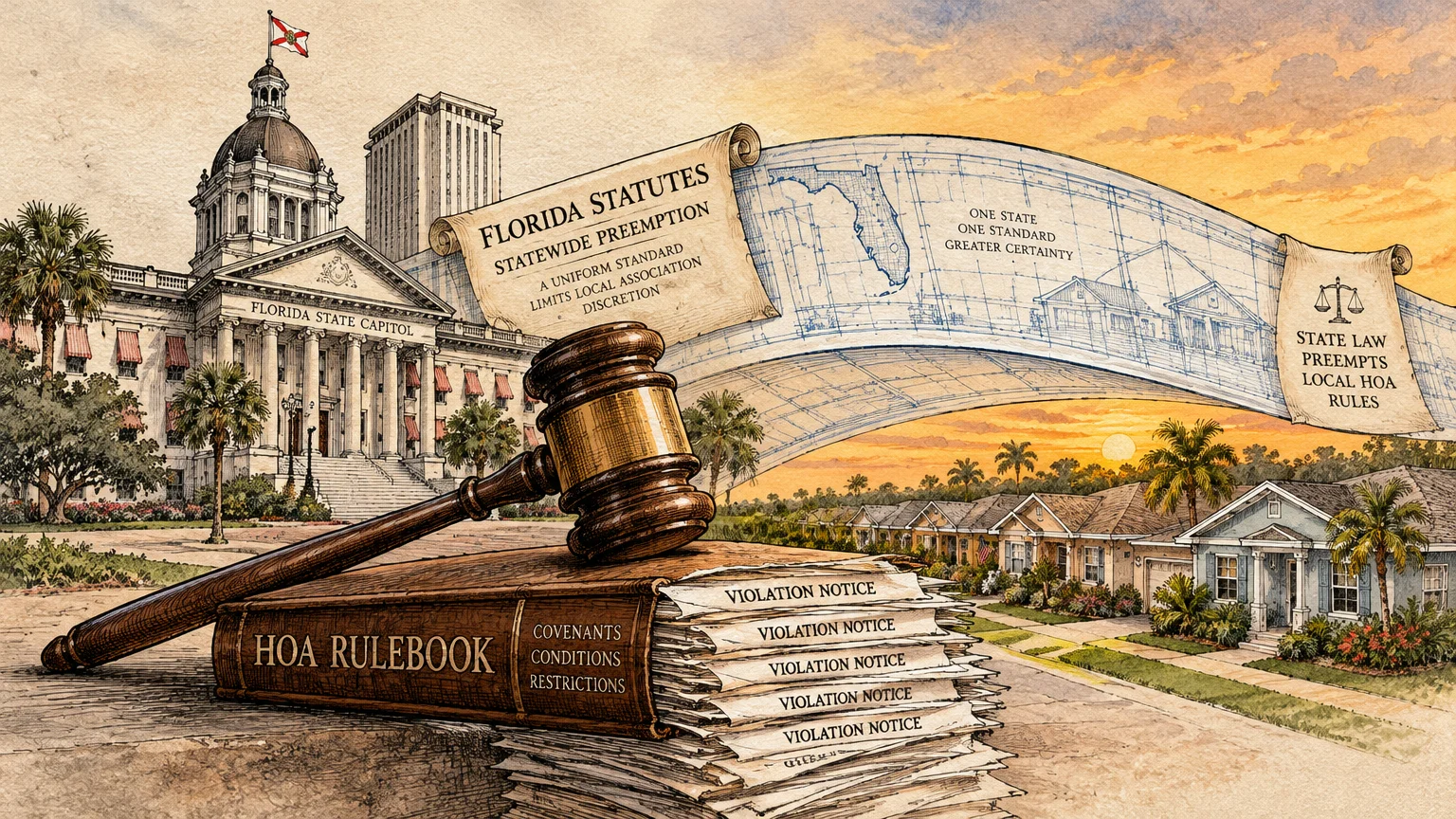
Tallahassee lawmakers recently enacted sweeping statutory reforms altering the balance between private ownership and neighborhood governance. The Capitol prioritized individual homeowner autonomy over association mandates and protracted courtroom delays.
State leaders targeted persistent flashpoints where ambiguous common law previously left homeowners vulnerable to predatory fines and bureaucratic delays. These legislative interventions created enforceable statewide guardrails across residential communities.
Disagreements over overhanging branches, disputed boundary fences, and driveway parking frequently overwhelm local county dockets. State officials responded by curbing municipal discretion and establishing explicit statutory boundaries.
The legislative debate exposed deep divisions between commercial developers, management companies, and individual property owners. Reform advocates argued that unchecked association boards routinely infringed on fundamental property liberties.
Opponents cautioned that reducing local regulatory authority could undermine neighborhood aesthetic standards. They argued that statewide mandates weaken the contractual covenants that protect property values in master-planned subdivisions.
Despite heavy pushback from management associations, statutory revisions passed with strong bipartisan support. You now possess concrete statutory protections against arbitrary enforcement and neighbor encroachment.
Navigating these rights requires examining both statutory updates and binding judicial precedents. Understanding where your boundaries lie is the first step toward defending your land.
Coalitions, Lobbies, and the Politics of Land Rights
Behind every Florida property statute lies an intense political struggle among influential corporate lobbies and grassroots activists. Real estate management trade groups historically fought to preserve broad disciplinary authority over residential subdivisions.
These corporate lobbies represent community managers who profit from processing violations and issuing administrative penalties. They spent substantial resources lobbying key legislative committees to preserve their oversight powers.
In contrast, grassroots property owner coalitions mobilized voters to demand legislative relief from abusive fines. Homeowners shared accounts of aggressive association boards penalizing residents for basic property uses.
Real estate investor associations also formed influential coalitions with property managers to demand stronger squatter removals. They successfully lobbied the Legislature to bypass traditional civil court eviction backlogs.
Meanwhile, tenant rights advocates urged caution regarding rapid administrative evictions without direct judicial review. They warned that overly aggressive removal policies could compromise tenant procedural rights during bona fide lease disputes.
Agricultural lobbies maintained an active presence in legislative debates concerning boundary fence maintenance. The Florida Farm Bureau ensured that residential subdivision statutes did not disrupt agricultural livestock containment standards.
The resulting statutory compromises reflect the evolving political power of everyday homeowners across Florida. Lawmakers delivered essential consumer protections while preserving core remedies against genuine property infringements.
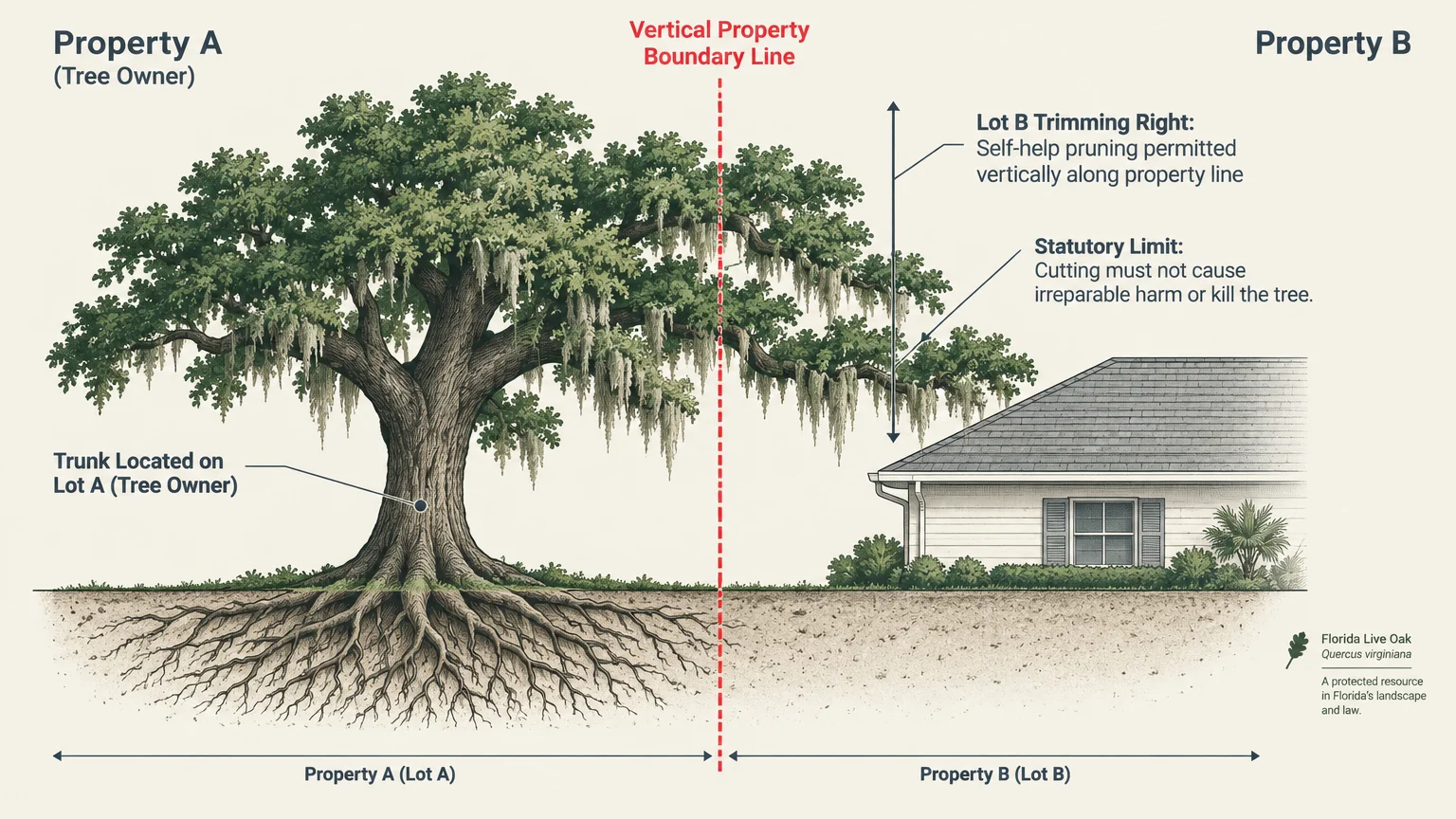
Law 1: Overhanging Tree Branches and Falling Debris
Subtropical storms and rapid plant growth make tree boundaries a constant source of friction across Florida neighborhoods. Homeowners often assume their neighbor must pay for leaves, branches, or seeds falling across the boundary line.
Florida common law establishes a very different legal reality. According to binding Florida appellate court opinions, healthy trees do not constitute an actionable legal nuisance.
The landmark Third District Court of Appeal ruling in Gallo v. Heller established this enduring doctrine. The Fourth District Court of Appeal reaffirmed the standard in the 2010 case Scott v. McCarty.
Under these decisions, a property owner is not legally liable for natural debris falling from a healthy tree. If your neighbor’s healthy oak sheds leaves across your lawn, you are solely responsible for cleanup.
You do retain an absolute legal right to trim encroaching branches and roots back to your property line. However, Florida law requires you to complete this trimming entirely at your own expense.
You cannot legally step onto your neighbor’s property to perform tree trimming without express permission. Crossing the boundary line without consent exposes you to civil trespass claims and potential property damage liability.
Furthermore, you must exercise reasonable care when trimming encroaching branches or cutting underground roots. If your aggressive trimming destabilizes or kills a healthy tree, your neighbor can sue you for replacement damages.
The liability framework changes completely if the encroaching tree is dead or visibly diseased. Under Florida negligence law, a property owner who ignores a hazardous tree bears financial liability for foreseeable damage.
If a dead tree collapses onto your roof or vehicle, the owner’s failure to remove it constitutes negligence. You should always document diseased trees by sending certified written notice to your neighbor before disaster strikes.
Law 2: Property Lines and Adverse Possession Risks
Misplaced boundary fences, sheds, and widened driveways create severe legal hazards when left unaddressed. Over time, an unchecked encroachment can allow a neighbor to claim permanent legal ownership of your land.
This legal transfer occurs through adverse possession under strict standards set in the Florida Statutes official database. Florida law requires an encroaching occupant to satisfy demanding criteria across seven consecutive years.
Under Fla. Stat. § 95.16, adverse possession under color of title requires a recorded written instrument. The claimant must demonstrate that an official deed or court decree mistakenly granted them the disputed parcel.
Most suburban neighbor boundary encroachments occur without color of title under Fla. Stat. § 95.18. To claim ownership without a deed, a neighbor must prove open, notorious, and hostile possession for seven years.
The Florida Legislature established strict statutory hurdles to deter bad-faith land grabs without title documents. The encroaching party must pay all outstanding property taxes on the disputed land within one year of taking possession.
The occupant must also continue paying all municipal and county taxes for the entire seven-year statutory duration. Missing a single annual tax payment permanently defeats their claim to your land.
Furthermore, the claimant must file Form DR-452 with the county property appraiser within 30 days of paying initial taxes. These standardized Florida Department of Revenue property forms alert county officials to disputed boundary descriptions.
You can instantly defeat an adverse possession claim by granting formal, revocable written permission to your neighbor. Hostile possession requires an absence of owner consent, meaning written permission prevents title transfer.
Ordering a certified boundary survey remains the most effective tool for resolving structural encroachments early. Identifying misplaced fences early allows you to negotiate formal boundary agreements before statutory deadlines approach.
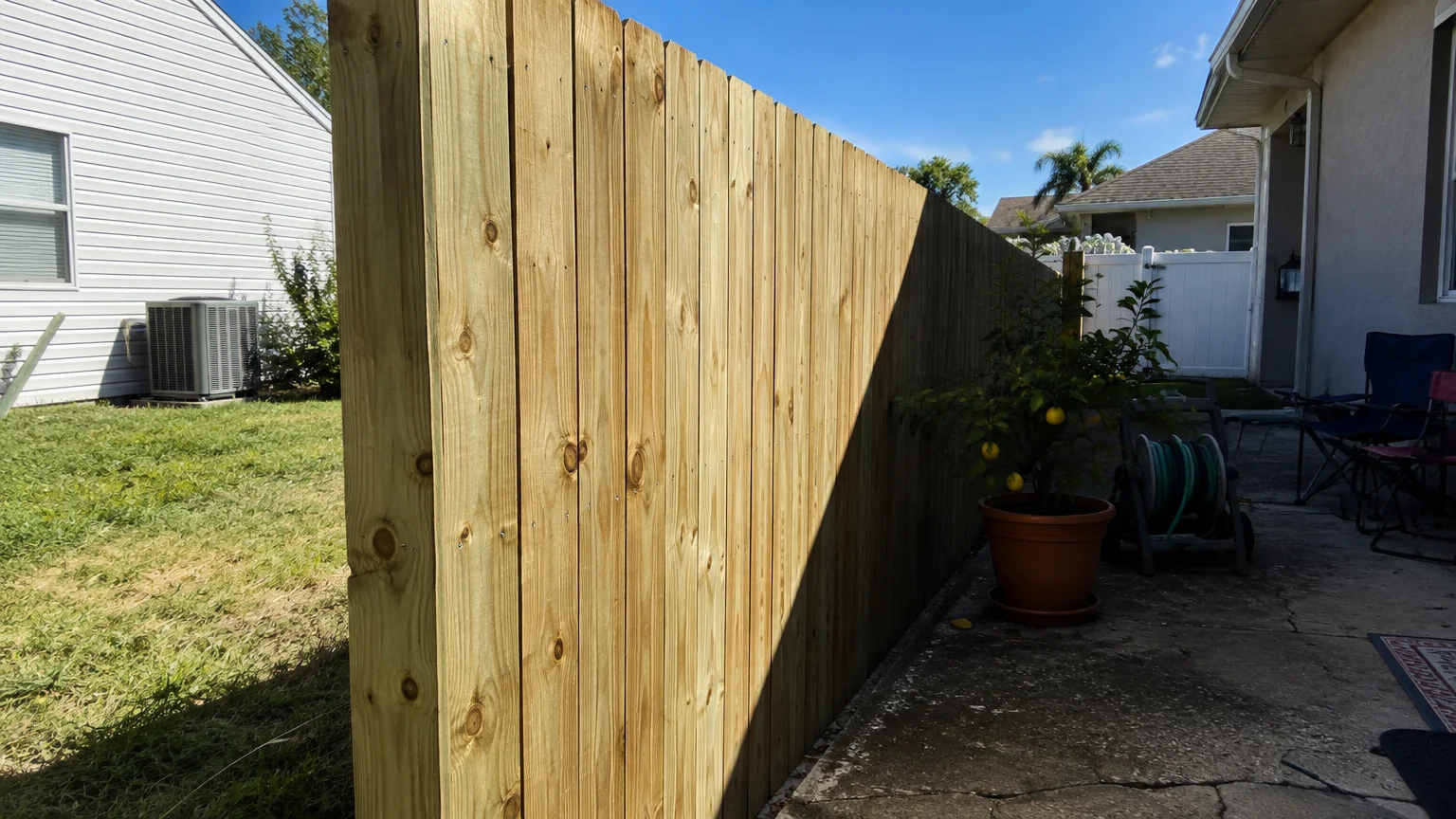
Law 3: Boundary Fences and the Spite Fence Dilemma
Fence disputes frequently ignite heated confrontations when neighbors disagree over privacy barriers, replacement costs, and property aesthetics. Many homeowners mistakenly believe that state law requires adjoining owners to share boundary fence expenses.
Florida maintains no statewide statute compelling residential neighbors to split the cost of constructing or maintaining a fence. If you choose to erect a privacy fence along your boundary line, you must fund the project yourself.
Florida boundary fence statutes in Chapter 588 apply primarily to agricultural parcels and livestock containment. Under Fla. Stat. § 588.01, legal agricultural fences must stand at least 5 feet high.
Agricultural barbed-wire enclosures must feature three strands and stand at least 3 feet high under Fla. Stat. § 588.011. These agricultural statutes do not apply to residential subdivisions or urban parcels.
Residential fence heights, materials, and setback distances are governed entirely by municipal zoning ordinances and county land codes. Most Florida municipalities limit backyard privacy fences to a maximum height of six feet.
Florida also lacks a dedicated statewide statute prohibiting so-called spite fences built solely to irritate neighbors. When a neighbor constructs an unsightly barrier within local height limits, state statutes offer no automatic administrative remedy.
Aggrieved homeowners must instead pursue common law private nuisance lawsuits in Florida circuit courts. To prevail, you must prove the structure serves no reasonable utility and was erected purely out of malice.
Reporting municipal code infractions often proves far faster and cheaper than filing private nuisance lawsuits. If a neighbor builds a fence without required permits or violates local setbacks, code enforcement officers can compel prompt modification.
Law 4: Homeowners Association Authority and Property Restrictions
Approximately 45 percent of Florida homes are located within common-interest communities governed by homeowners associations. These private corporate boards long wielded expansive regulatory power over residential behavior and exterior architectural alterations.
To eliminate systemic board overreach, the Legislature passed significant statutory reforms during the 2024 legislative session. The Governor signed Florida legislative records on House Bill 1203 on May 31, 2024.
Effective July 1, 2024, House Bill 1203 amended Fla. Stat. Chapter 720 to restore substantial property autonomy to homeowners. The statute stripped associations of their authority to fine residents for ordinary driveway vehicle parking.
Under Fla. Stat. § 720.3045, HOAs cannot prohibit homeowners from parking personal or work vehicles in their own driveways. This measure ended predatory fines against residents parking employer-issued pickup trucks or commercial work vans.
The statute explicitly excludes heavy industrial vehicles, ensuring that residential neighborhoods retain baseline aesthetic standards. You can now park your primary work vehicle without fear of association fines or towing threats.
House Bill 1203 also protected sustainable home practices from board interference across the state. Associations cannot ban backyard vegetable gardens or clotheslines, provided they are not visible from streets, adjacent parcels, or golf courses.
The legislation instituted rigorous due process mandates for association fine enforcement under Fla. Stat. § 720.305. Boards must now provide at least 14 days’ written notice before conducting a committee hearing on alleged violations.
Most importantly, if you cure the cited violation before the scheduled hearing date, the association cannot levy the fine. This reform ended the abusive practice of using minor property citations as corporate revenue generators.
Lawmakers expanded these protections through House Bill 803, signed on May 6, 2026, with an effective date of July 1, 2026. This measure amends Fla. Stat. § 720.3035(1)(c) to reform architectural review processes.
Under this update, an architectural review committee cannot require you to obtain a building permit before reviewing your application. You no longer risk wasting municipal permit fees on improvement projects your association board subsequently rejects.
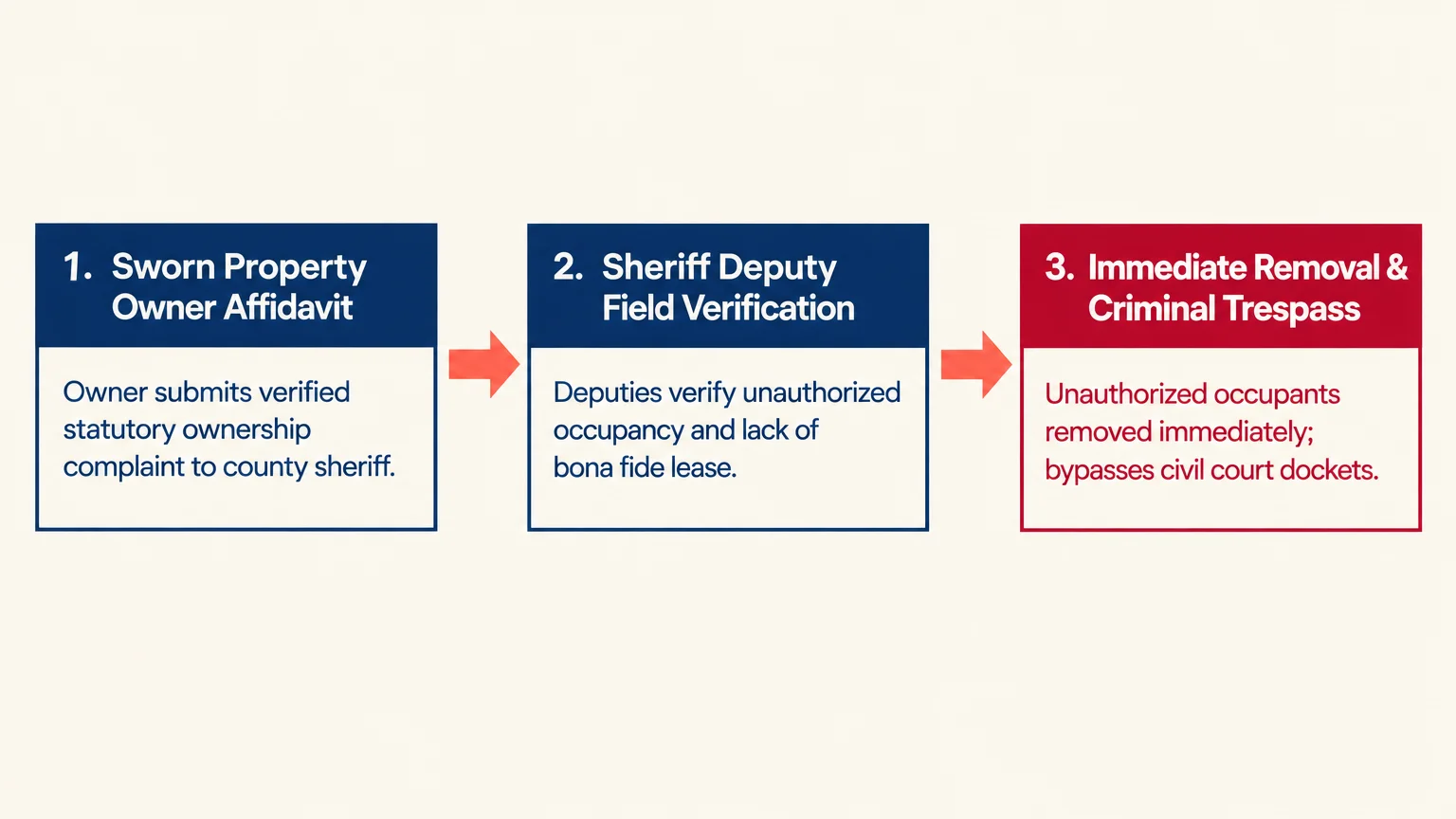
Law 5: Expedited Squatter Evictions and Criminal Penalties
Unauthorized occupants and fraudulent tenancy schemes emerged as critical political priorities as Florida real estate values climbed. Homeowners previously faced months of civil litigation and steep legal expenses to remove brazen property squatters.
Governor Ron DeSantis signed House Bill 621 on March 27, 2024, taking effect on July 1, 2024. As documented in the Florida Senate legislative tracker for House Bill 621, the measure created Fla. Stat. § 82.036.
This landmark statute ended lengthy civil eviction requirements for unauthorized occupants occupying private residential property. Homeowners can now submit a verified complaint directly to the county sheriff for immediate physical removal.
To qualify for expedited removal, the property owner must prove the occupant entered the home without legal authorization. The individual must have refused a direct owner directive to vacate the residential premises.
The expedited statute strictly excludes current or former tenants engaged in bona fide contractual lease disagreements. It also excludes immediate family members, ensuring that domestic family disputes remain under traditional judicial review.
House Bill 621 also established serious criminal penalties to deter fraudulent squatting networks across Florida. Presenting a falsified lease agreement or fraudulent deed to law enforcement constitutes a first-degree misdemeanor.
Individuals convicted of presenting fraudulent documents face up to one year in county jail and fines reaching $1,000. These criminal provisions provide law enforcement officers with clear statutory authority to arrest bad actors immediately.
To prevent malicious landlords from abusing this police procedure, the statute incorporates severe civil liability protections. A property owner who knowingly uses the expedited process to remove a legitimate tenant faces severe statutory damages.
Wrongfully displaced occupants can recover actual damages, full attorney fees, and triple the fair market rent value. This mandatory treble-damage penalty deters property owners from circumventing formal judicial proceedings against lawful tenants.
Constituent Realities: How These Laws Play Out in Florida Communities
The real-world execution of Florida property laws varies significantly across the state’s diverse demographic and geographic regions. Rapid suburban expansion across Central Florida has intensified boundary conflicts between adjacent property owners.
High-density suburban developments feature narrow lot lines where overhanging trees and privacy fences spark immediate neighborhood disputes. Infill construction often alters historical stormwater drainage, funneling runoff onto neighboring lawns and triggering costly civil damage claims.
In coastal communities, recurring hurricanes put common law tree doctrines to severe tests each fall. Major storms frequently topple healthy trees across neighboring driveways, roofs, and residential structures.
Property owners unfamiliar with the Gallo v. Heller precedent often direct misplaced anger toward neighbors during post-storm recovery. Understanding that individual homeowners insurance covers healthy tree falls prevents bitter neighbor feuds during storm cleanup.
In South Florida’s master-planned developments, the passage of House Bill 1203 provided immediate financial relief to working families. Thousands of service technicians and small business owners avoided aggressive fines for parking work vehicles in their own driveways.
Homeowner associations historically generated thousands of dollars in monthly penalty revenue by policing driveway parking overnight. The statutory prohibition on these fines restored economic predictability to suburban working-class families.
Meanwhile, North Florida rural residents continue relying on Chapter 588 agricultural exemptions to manage large-acreage livestock boundaries. Clear statutory separation between residential zoning and agricultural parcels protects traditional farming operations from urban regulatory creep.

Oversight, Ethics, and Transparency Vulnerabilities
While recent legislative reforms expanded homeowner rights, practical enforcement vulnerabilities continue to generate regulatory scrutiny. County sheriffs hold substantial discretionary power when executing summary squatter removals under Fla. Stat. § 82.036.
Watchdog groups monitor whether sheriff deputies receive adequate legal training to identify complex oral lease agreements. Deputizing law enforcement to assess tenancy claims without judicial oversight creates risks of improper displacement for vulnerable residents.
Transparency deficits also persist within Florida’s thousands of independent homeowner association governance boards. Although House Bill 1203 established strict procedural guidelines, volunteer board members often misinterpret statutory compliance standards.
Uninformed association boards continue issuing invalid fines without providing the mandatory 14-day advance committee hearing notice. Homeowners frequently must retain private legal counsel to compel recalcitrant boards to follow state statutes.
County property appraisers also encounter operational challenges managing adverse possession records under Fla. Stat. § 95.18. Appraisers must verify that Form DR-452 submissions strictly coincide with annual tax payments over seven years.
Gaps in public record integration between county tax offices and court clerks can allow invalid adverse claims to cloud titles. Commercial title insurers increasingly scrutinize boundary documentation to prevent unexpected adverse ownership transfers during residential property sales.
The Department of Business and Professional Regulation faces chronic resource limitations when investigating association board complaints. Expanding state investigative resources remains an urgent priority for consumer advocacy groups monitoring board misconduct statewide.
Frequently Asked Questions
Can I trim branches from my neighbor’s tree that hang over my property line?
Yes, Florida common law grants you the absolute legal right to trim overhanging branches back to your property line. You must pay all costs for this trimming yourself under the binding Gallo v. Heller precedent.
You cannot legally step onto your neighbor’s property or cut branches so severely that you destroy the tree’s health. Causing severe damage or killing the tree exposes you to civil liability for its replacement value.
Can my neighbor force me to split the cost of a new boundary fence?
No, Florida has no statewide statute requiring residential property owners to share the construction or maintenance costs of a boundary fence. Your neighbor must fund the project entirely if they choose to build a fence on their land.
State fence statutes requiring shared maintenance apply strictly to agricultural parcels under Fla. Stat. Chapter 588. In suburban subdivisions, you only share fence expenses if you voluntarily sign a private contractual agreement.
Can my HOA tow or fine me for parking my work truck in my driveway?
Under House Bill 1203 and Fla. Stat. § 720.3045, HOAs cannot prohibit homeowners from parking personal or work vehicles in driveways. Associations cannot levy fines or tow vehicles used for primary employment transportation.
This statutory protection does not extend to heavy industrial machinery or commercial vehicles exceeding standard passenger vehicle classifications. Standard commercial vans and pickup trucks used for personal or work transportation remain fully protected by state law.
How long must a neighbor occupy my land before claiming adverse possession?
A claimant must occupy the land openly, notoriously, and exclusively for at least seven consecutive years under Florida law. The occupying neighbor faces demanding statutory hurdles to establish legal ownership without an official deed.
Under Fla. Stat. § 95.18, they must pay all property taxes within one year and file Form DR-452 within 30 days. Failing to pay taxes or missing statutory administrative deadlines completely invalidates their adverse possession claim.
The Legislative and Regulatory Outlook
Florida property statutes will continue evolving as population growth intensifies land use friction across suburban communities. State lawmakers have demonstrated an active willingness to preempt local regulations to protect private property liberties.
The architectural review reforms in House Bill 803 will take full effect on July 1, 2026. This statutory update will prevent association boards from requiring municipal building permits before completing internal design reviews.
State courts will also clarify procedural standards as cases interpreting expedited squatter removals work through appellate dockets. Judicial opinions will define the exact evidentiary thresholds sheriff departments must verify before executing summary removals.
Grassroots homeowner organizations are already preparing legislative agendas for upcoming Capitol committee sessions. Priority proposals include expanding criminal penalties for association accounting fraud and establishing independent state oversight tribunals for HOA disputes.
Staying informed about shifting statutory standards ensures you can protect your property boundaries and avoid costly disputes. Knowledge of Florida property law remains your most valuable asset when dealing with aggressive neighbors or overreaching associations.